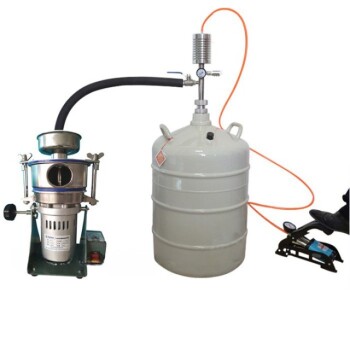
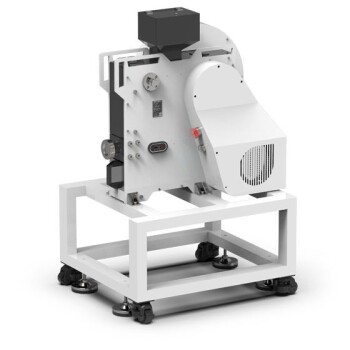
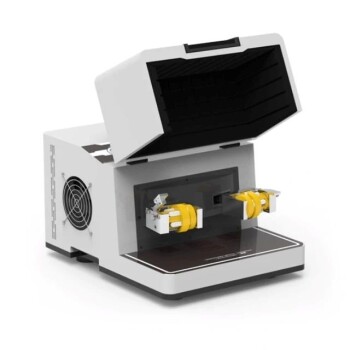
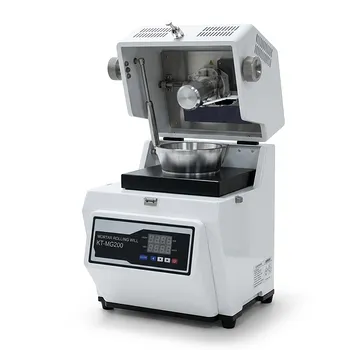
Laboratory crushing and milling systems are the primary tools for controlling the structural evolution of coke. By refining coal into specific particle size ranges—typically between 0 and 3 mm—these systems directly dictate the bulk density and thermal behavior of the coal charge. This precision ensures that shrinkage stress is evenly distributed during carbonization, preventing the macro-cracks that compromise the mechanical integrity of the final product.
Precise mechanical refinement of coal particles is the technical foundation for high-strength coke. By manipulating particle size, laboratory systems control the charge density, surface reactivity, and internal stress gradients that determine the final coke structure.
Optimizing Physical Properties for Carbonization
Controlling Particle Fineness
The ability to achieve a precise 0–3 mm particle size range is essential for high-quality coke production. Laboratory systems allow researchers to fine-tune this distribution to meet specific metallurgical requirements. This controlled fineness is the primary technical prerequisite for producing coke with superior mechanical strength.
Enhancing Bulk Density and Packing
Milling systems optimize the bulk density of the coke oven charge by ensuring particles pack together efficiently. Proper packing reduces the void space between coal grains, which leads to a more continuous and dense carbon matrix. Higher charge density directly correlates with improved coke stability and resistance to abrasion.
Influencing the Chemistry and Kinetics of Coking
Increasing Specific Surface Area
Mechanical grinding transforms coarse coal into a state with a significantly higher specific surface area. This increase in surface area provides more active sites for chemical reactions and improves the contact efficiency between the coal and any added binders. This heightened surface activity is critical for the primary pyrolysis phase and subsequent chemical modifications.
Improving Uniformity and Heat Transfer
Fine powders produced by laboratory milling facilitate uniform heat transfer and gas penetration throughout the coal mass. When particles are homogenized, the carbonization process proceeds evenly, preventing localized areas of incomplete pyrolysis. This uniformity ensures that the pore structure of the resulting coke is consistent and stable.
Managing Structural Integrity and Stress
Reducing Shrinkage Stress and Cracking
During the high-temperature coking process, coal undergoes significant volume changes that create shrinkage stress gradients. By optimizing the degree of grinding, laboratory systems help distribute these stresses more evenly across the coke mass. This reduction in internal tension significantly minimizes the formation of cracks and fissures.
Strengthening Intermolecular Adhesion
Refining coal particles increases the frequency of contact and the efficiency of particle rearrangement under pressure. This enhances intermolecular adhesion forces, such as Van der Waals forces, which are vital during the pressurization and solidification stages. The result is a finished coke product with lower porosity and higher structural density.
Understanding the Trade-offs and Pitfalls
The Risk of Over-Grinding
While fineness is generally beneficial, excessive grinding can lead to negative outcomes. Coal that is too fine may increase the moisture retention of the charge and create handling issues within the laboratory or industrial setting. Furthermore, "superfine" particles (D50 < 20 micrometers) may alter the pyrolysis characteristics so drastically that they no longer represent standard industrial results.
Energy Consumption vs. Material Quality
Achieving extreme particle consistency requires significant mechanical energy and time. Laboratory operators must balance the need for precise size distribution with the practical limitations of the equipment. Over-processing can also lead to the thermal degradation of the coal samples if the milling system generates excessive heat during operation.
How to Apply These Insights to Your Process
When configuring your laboratory crushing and milling workflow, your settings should align with your specific research or production goals.
- If your primary focus is mechanical strength: Optimize your system to maximize the percentage of particles in the 0–3 mm range to ensure ideal bulk density and minimal cracking.
- If your primary focus is reaction kinetics: Utilize high-energy milling to achieve a superfine state (D50 < 20 µm) to increase surface activity and provide more reaction sites for oxidation.
- If your primary focus is structural uniformity: Pair your crushing system with precision sieving (e.g., 100–150 mesh) to ensure a consistent particle diameter, facilitating uniform heat transfer.
By mastering the mechanical refinement of coal, you gain direct control over the physical and chemical transitions that define high-performance coke structures.
Summary Table:
| Parameter | Influence on Coke Structure | Key Benefit |
|---|---|---|
| Particle Size (0-3mm) | Distributes shrinkage stress evenly | Prevents macro-cracks and fissures |
| Bulk Density | Minimizes void space between grains | Increases stability and abrasion resistance |
| Surface Area | Increases active sites for pyrolysis | Enhances chemical reactivity and adhesion |
| Heat Transfer | Ensures uniform homogenization | Provides consistent pore structure |
Elevate Your Metallurgical Research with KINTEK Precision
Ready to optimize your coal preparation and achieve high-strength coke structures? KINTEK provides the professional-grade laboratory equipment needed to control every stage of material refinement.
From our high-performance crushing and milling systems and precision sieving equipment to our robust hydraulic presses and high-temperature furnaces (muffle, vacuum, and atmosphere), we empower researchers to achieve perfect particle size distribution and superior thermal processing. Our portfolio also includes essential consumables like ceramics and crucibles to ensure your lab operates at peak efficiency.
Contact KINTEK today to discuss your specific requirements and discover how our comprehensive range of laboratory solutions can improve your research accuracy and product quality.
References
- Д. В. Мірошниченко, Maryna Kormer. Factors Affecting the Formation the Carbon Structure of Coke and the Method of Stabilizing Its Physical and Mechanical Properties. DOI: 10.3390/c9030066
This article is also based on technical information from Kintek Solution Knowledge Base .
Related Products
- Small Cryogenic Grinder Cryomill Cryogrinder with Liquid Nitrogen for Laboratory Use
- Laboratory Sealed Hammer Crusher for Efficient Sample Preparation
- Laboratory Jar Mill with Agate Grinding Jar and Balls
- High-Energy Omnidirectional Planetary Ball Mill Milling Machine for Laboratory
- High Energy Planetary Ball Mill Milling Machine for Laboratory
People Also Ask
- What are the advantages of using a cryogenic grinder? Achieve Nanoscale Precision for All-Solid-State Battery Cathodes
- Why is a cryogenic grinder required for cured alkyd resin HRMAS NMR? Ensure Structural Integrity & Sample Precision
- What is the role of a cryogenic grinder in PET recycling? Transform Waste into High-Reactive Micron Powders
- What is cryogenic grinding of crumb rubber? Achieve Fine, High-Quality Rubber Powder
- What food is cryogenic grinding? The Ultimate Guide to Preserving Flavor & Aroma