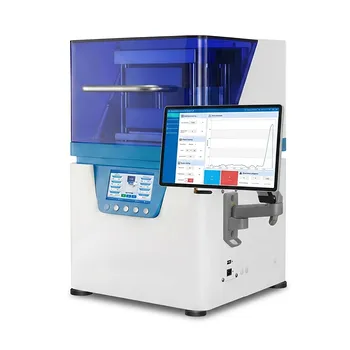
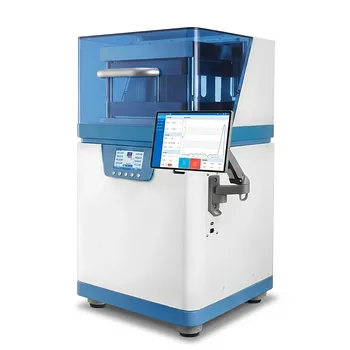
The laboratory hydraulic press is the fundamental bridge between raw powder and a measurable material sample. By applying controlled, high-tonnage pressure, these devices transform loose bulk powders into dense, uniform pellets or "green bodies" with specific geometric shapes. This process is essential for reducing voids, ensuring mechanical interlocking between particles, and creating the standardized foundations required for accurate analytical testing and high-performance material manufacturing.
Core Takeaway: Laboratory hydraulic presses are critical for both material characterization and molding because they provide the precise pressure control needed to eliminate density gradients and maximize particle contact, which directly dictates the success of subsequent sintering and analytical accuracy.
The Role in Powder Molding and Sample Preparation
Creating Structural Integrity Through Mechanical Interlocking
A hydraulic press applies stable, adjustable tonnage to force loose particles into close contact. This physical rearrangement induces plastic deformation and mechanical interlocking, giving the resulting "green body" enough structural integrity to be handled or moved for further processing.
Optimizing the Foundation for Sintering
By significantly reducing internal pores and shortening the distance for atomic diffusion, the press prepares samples for solid-phase sintering. This pre-treatment ensures the final product reaches its theoretical density, improves mechanical strength, and results in a more uniform grain size.
Preparing Samples for Analytical Spectroscopy
In techniques like Infrared (IR) spectroscopy, the press is used to create transparent pellets by mixing samples with a matrix like KBr. The precision of the hydraulic press ensures the pellet is of a uniform thickness and density, which is vital for obtaining clear, reproducible spectral data without interference from light scattering.
Enhancing Material Characterization and Testing
Measuring Compaction and Flowability Parameters
The hydraulic press provides the standardized compaction conditions necessary to calculate a powder's Carr index and Hausner ratio. These metrics are essential for pharmaceutical and industrial sectors to understand how a material will behave during large-scale manufacturing and handling.
Facilitating Hardness and Physical Property Testing
To accurately test a material's hardness or thermal conductivity, the sample must be free of air pockets and density variations. The press creates high-density samples that provide a consistent baseline, ensuring that the resulting data reflects the material's intrinsic properties rather than flaws in the sample preparation.
Controlling Microporosity for Chemical Reactions
For specific applications like hydrogen reduction, the press is used to control micro-porosity. By applying a precise force, technicians can create channels within the pellet that allow reducing gases to penetrate and diffuse efficiently through the material during thermal processing.
Understanding the Trade-offs and Limitations
The Impact of Density Gradients
Even with high-precision presses, wall friction within the mold can lead to uneven pressure distribution. This results in density gradients, where the center or edges of the pellet may be less dense than the rest, potentially causing warping or micro-cracking during the sintering stage.
Limitations of Material Elasticity
Not all powders respond well to static pressure; materials with high elastic recovery may expand or "cap" once the pressure is released. This requires the technical advisor to carefully select dwell times—the duration the pressure is held—to allow for proper particle rearrangement and air escape.
Tooling and Mold Wear
Using high-strength alloy steel molds is necessary for high-pressure applications, but repeated use at maximum tonnage can lead to tooling fatigue. Maintaining the precision of the mold is as important as the accuracy of the press itself to ensure the final sample maintains its geometric tolerances.
How to Apply This to Your Project
Making the Right Choice for Your Goal
- If your primary focus is Infrared Spectroscopy (IR): Use a press that offers fine-tuned control at lower tonnages (typically 5-10 tons) to produce clear, thin pellets without damaging the precision dies.
- If your primary focus is Powder Metallurgy or Ceramics: Prioritize a press with closed-loop pressure control to minimize density gradients and ensure the structural integrity of large green bodies during sintering.
- If your primary focus is Pharmaceutical Characterization: Ensure the press can provide standardized, repeatable compaction cycles to accurately calculate flowability indices and volume change data.
- If your primary focus is Solid-State Chemistry: Focus on maximizing particle contact area through high-tonnage static pressure to shorten atomic diffusion distances and increase reaction efficiency.
Properly leveraging a hydraulic press ensures that the transition from a raw powder to a finished component or analytical sample is predictable, repeatable, and technically sound.
Summary Table:
| Application Area | Key Function of Hydraulic Press | Primary Benefit |
|---|---|---|
| Analytical Spectroscopy | Creates uniform KBr/matrix pellets | Ensures clear, reproducible spectral data |
| Sintering Preparation | Reduces internal voids and pores | Achieves high theoretical density and strength |
| Material Characterization | Standardizes powder compaction | Accurate calculation of Carr and Hausner indices |
| Structural Molding | Facilitates mechanical interlocking | Produces durable "green bodies" for processing |
| Chemical Reactions | Controls microporosity and diffusion | Maximizes particle contact and reaction efficiency |
Elevate Your Material Research with KINTEK Precision
Achieving consistent, high-quality results in powder characterization starts with the right equipment. KINTEK specializes in high-performance laboratory solutions designed to bridge the gap between raw materials and reliable data. Our extensive portfolio includes:
- Advanced Hydraulic Presses: Manual and automatic pellet presses, hot presses, and isostatic systems for perfect sample preparation.
- Material Processing: High-efficiency crushing and milling systems, sieving equipment, and precision molds.
- Thermal Treatment: A full range of high-temperature furnaces (muffle, vacuum, tube, and CVD) to complete your sintering workflow.
Whether you are preparing transparent pellets for IR spectroscopy or developing advanced ceramics, KINTEK provides the technical expertise and durable tools your lab requires.
Ready to enhance your lab's efficiency and accuracy?
Contact KINTEK Today to find the perfect hydraulic press for your specific application!
References
- Pengxin Li, Zhenya Liu. Non‐precious Metal Cu‐Ni Alloy Nanoparticles Supported on Porous Boron Nitride Fibers as Catalysts for Dehydrogenation from Methanolysis of Ammonia‐Borane**. DOI: 10.1002/slct.202204413
This article is also based on technical information from Kintek Solution Knowledge Base .
Related Products
- Laboratory Hydraulic Press Lab Pellet Press Machine for Glove Box
- Laboratory Hydraulic Press Split Electric Lab Pellet Press
- Fully Automatic Heated Hydraulic Lab Press for Materials Sintering and Sample Preparation
- Laboratory Hydraulic Press Lab Pellet Press for Button Battery
- Automatic Laboratory Hydraulic Press for XRF & KBR Pellet Press
People Also Ask
- What is the function of a laboratory hydraulic press in W-Cu composites? Control Porosity and Material Ratio
- What is the role of a laboratory hydraulic press in the initial stages of Li6PS5Cl preparation? Key to Green Pellets
- What role does a laboratory hydraulic press play in triboelectric testing? Achieve Precision Alloy Sample Prep
- How can a laboratory hydraulic press be applied to chitosan for wastewater treatment? Optimize Pores & Strength
- How do a precision laboratory hydraulic press and specialized molds contribute to the fabrication of spherical ceramic samples? Achieving High-Density Material Precision