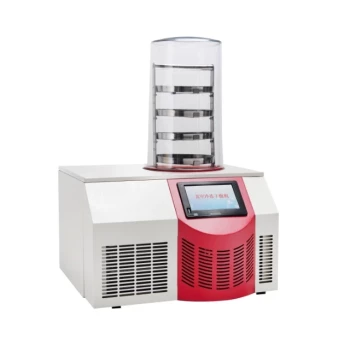
Magnetic stirrers and vacuum drying ovens operate as a synergistic system to control the physical distribution of metal particles during catalyst preparation. The magnetic stirrer ensures the metal precursor is evenly mixed at a microscopic level within the carbon carrier, while the vacuum oven removes the solvent under low pressure to lock that distribution in place. Together, they prevent particle clumping and maximize the available surface area for chemical reactions.
Core Takeaway The combination of magnetic stirring and vacuum drying solves the critical issue of metal ion agglomeration caused by solvent migration. By ensuring uniform distribution before drying and preventing ion movement during drying, this method yields a catalyst with highly dispersed nanoparticles and maximum active site exposure.
The Role of the Magnetic Stirrer
Achieving Microscopic Uniformity
During the impregnation phase, the primary challenge is getting the metal salt precursor to penetrate the carbon carrier evenly. The magnetic stirrer creates a dynamic fluid environment that forces the solution into the porous structure of the biomass activated carbon. This mechanical agitation ensures a homogeneous mixture is established before any drying occurs.
Eliminating Concentration Gradients
Without constant motion, metal salts can settle or create pockets of high concentration. The stirrer maintains a consistent suspension, ensuring that every particle of the carbon carrier is exposed to the same concentration of metal ions. This microscopic uniform distribution is the foundation for a high-performance catalyst.
The Role of the Vacuum Drying Oven
Controlling Solvent Removal
Once the impregnation is complete, the solvent must be removed without disturbing the metal placement. The vacuum drying oven accomplishes this by lowering the pressure surrounding the sample. This allows the solvent to evaporate steadily at lower temperatures, reducing the thermal stress on the material.
Preventing Metal Migration and Agglomeration
The most critical function of the vacuum oven is stopping solvent migration. In standard drying, as liquid moves to the surface to evaporate, it often drags metal ions with it, causing them to pile up and clump (agglomerate). Vacuum drying minimizes this fluid movement, effectively "freezing" the dispersed metal ions in place as the solvent vanishes.
The Result: Optimized Catalyst Performance
High Dispersion of Nanoparticles
Because the metal ions are prevented from clumping during both the mixing and drying phases, the final product consists of highly dispersed metal nanoparticles. Rather than forming large, ineffective clusters, the metal remains spread out across the carbon support.
Maximizing Active Site Exposure
The efficiency of a catalyst is defined by its active sites—the specific spots where reactions happen. By maintaining high dispersion, this method ensures a high rate of active site exposure. More surface area per unit of metal directly translates to superior catalytic performance.
Understanding the Trade-offs
Process Time vs. Quality
While this method yields superior quality, vacuum drying is inherently slower than high-temperature atmospheric drying. You are trading processing speed for structural integrity and dispersion quality.
Sensitivity to Pressure Variations
The success of this technique relies heavily on maintaining a stable vacuum. Inconsistent pressure during the drying phase can lead to uneven evaporation rates, which may re-introduce the very agglomeration issues you are trying to avoid.
Making the Right Choice for Your Goal
To apply this to your catalyst preparation effectively, consider your specific priorities:
- If your primary focus is maximum catalytic efficiency: Strictly adhere to this dual-method approach to guarantee the highest possible surface area and particle dispersion.
- If your primary focus is rapid production throughput: Recognize that the vacuum drying stage is a bottleneck and may require batch optimization to maintain quality without sacrificing too much time.
Mastering the balance between mechanical agitation and controlled evaporation is the key to unlocking the full potential of impregnation-based catalysts.
Summary Table:
| Process Phase | Equipment Used | Key Function | Impact on Catalyst Quality |
|---|---|---|---|
| Impregnation | Magnetic Stirrer | Microscopic mixing & penetration | Ensures uniform distribution of metal ions |
| Solvent Removal | Vacuum Drying Oven | Low-pressure, low-temp evaporation | Prevents ion migration and particle clumping |
| Final Result | Integrated System | Stable nanoparticle dispersion | Maximizes active site exposure and efficiency |
Elevate Your Catalyst Research with KINTEK Precision
Unlock the full potential of your material synthesis with KINTEK’s industry-leading laboratory solutions. From high-performance magnetic stirrers that ensure microscopic uniformity to precision vacuum drying ovens designed to eliminate metal migration, we provide the tools necessary for superior nanoparticle dispersion.
Whether you are developing advanced carbon-supported catalysts or optimizing battery materials, KINTEK specializes in the equipment you need, including:
- Crushing and milling systems for carrier preparation.
- Vacuum and atmosphere furnaces for specialized heat treatments.
- High-temperature high-pressure reactors for complex synthesis.
- Essential consumables like PTFE products and ceramics.
Ready to maximize your active site exposure? Contact our technical experts today to find the perfect equipment configuration for your lab's specific needs!
References
- Apoorva Shetty, Gurumurthy Hegde. Biomass-Derived Carbon Materials in Heterogeneous Catalysis: A Step towards Sustainable Future. DOI: 10.3390/catal13010020
This article is also based on technical information from Kintek Solution Knowledge Base .
Related Products
- 56L Vertical Laboratory Vacuum Drying Oven
- 23L Laboratory Vacuum Drying Oven
- Laboratory Scientific Electric Heating Blast Drying Oven
- Benchtop Laboratory Vacuum Freeze Dryer
- Dental Porcelain Zirconia Sintering Ceramic Vacuum Press Furnace
People Also Ask
- Why is a laboratory vacuum drying oven recommended for rice straw residues? Protect Your Biomass Integrity
- What role does a laboratory vacuum drying oven play in the preparation of modified multi-walled carbon nanotubes?
- What is the importance of using a laboratory vacuum drying oven? Preserving Slow-Release Microcapsule Integrity
- Why is a Laboratory Vacuum Drying Oven recommended for PBAT microspheres? Protect Sensitive Polymer Integrity
- What role does a laboratory vacuum drying oven play in processing nanoparticle powder samples? Protect Sample Integrity