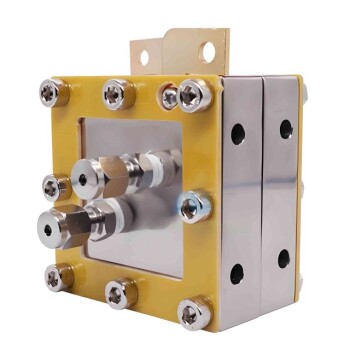
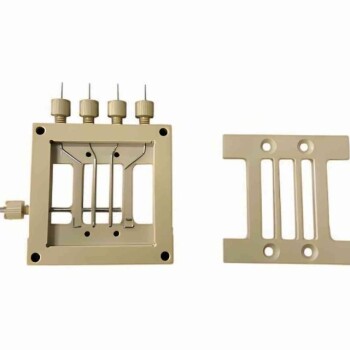
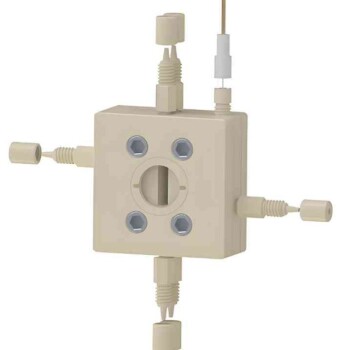
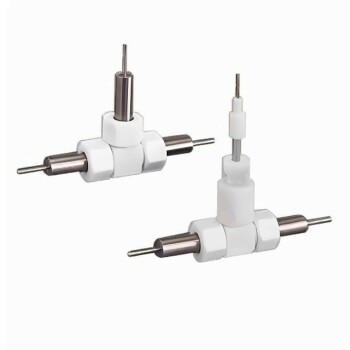
The electrolytic cell and its electrode system function as the architectural control unit for fabricating titanium dioxide nanotube arrays. By maintaining a constant voltage and ensuring uniform current distribution through high-purity electrodes (typically graphite or platinum), the system governs the critical balance between oxidation and chemical dissolution. This precise control creates highly ordered, vertically oriented arrays that effectively minimize electron recombination and significantly enhance quantum efficiency.
The hardware configuration determines the material's final electronic properties. A stable cell environment and a uniform electrode field are the non-negotiable prerequisites for achieving the vertical alignment necessary to transport photogenerated charges efficiently.
The Role of the Electrolytic Cell Environment
Balancing Reaction Mechanisms
The primary function of the electrolytic cell is to control the competition between two simultaneous processes: electrochemical oxidation and chemical dissolution.
The cell maintains this equilibrium by stabilizing electrolyte circulation and holding the cell voltage constant.
If this balance is achieved, the system produces highly ordered nanotube arrays with regular diameters rather than a disorganized oxide layer.
Controlling Reaction Kinetics
Beyond basic oxidation, the cell regulates the physical environment—specifically temperature and mixing—which dictates ion migration rates.
Supplementary data suggests that maintaining specific parameters, such as a stable temperature of 25 °C, allows for the precise management of fluoride ion etching rates.
This stability ensures the reproducibility of dimensions, such as wall thickness and tube length, across the entire titanium sheet.
The Function of the Electrode System
Ensuring Uniform Current Density
The choice of electrode material and placement is critical for the consistency of the nanotube array.
Using high-purity graphite or platinum as the counter electrode ensures that the current density is distributed uniformly across the titanium surface.
Without this uniform distribution, the growth rate would vary across the sample, leading to irregular structures that hamper performance.
Precision via Configuration
Advanced setups often utilize a three-electrode configuration (working, counter, and reference) to establish a stable high-voltage electric field.
This setup allows for the accurate guidance of ion migration across the oxide layer.
It provides the strict potential control necessary for evaluating kinetic parameters and ensuring consistent film growth.
Impact on Material Performance
Enhanced Electron Transport
The structural order dictates the electronic efficiency of the material.
The vertically oriented structure created by this system provides a direct physical path for photogenerated charges.
This orientation effectively reduces the recombination rate of electrons, directly increasing the quantum efficiency of the titanium dioxide.
Surface Area and Loading Capacity
The regulated electrochemical environment fosters the growth of a porous, three-dimensional hierarchical structure.
This results in a massive specific surface area, which is essential for loading auxiliary materials like Graphene Quantum Dots (GQDs).
Understanding the Trade-offs
Sensitivity to Parameter Fluctuations
While this system allows for high precision, it introduces significant sensitivity to minor environmental changes.
Fluctuations in stirring efficiency or electrode spacing can alter ion migration rates, leading to uneven tube lengths or diameters.
Complexity vs. Reproducibility
Achieving the highest level of order requires a complex interplay of variables (voltage, temperature, electrode purity).
A system designed for maximum precision (e.g., a three-electrode setup with strict temperature control) yields superior results but requires more rigorous calibration than simpler setups.
Optimizing Your Setup for Specific Goals
The design of your electrolytic cell should be dictated by the specific requirements of your final application.
- If your primary focus is Maximum Quantum Efficiency: Prioritize high-purity platinum electrodes and strict voltage stability to ensure perfect vertical alignment and minimize charge recombination.
- If your primary focus is Material Loading (e.g., GQDs): Focus on electrolyte circulation and temperature control to maximize the specific surface area and pore diameter of the nanotubes.
Ultimately, the electrolytic cell is not just a container for the reaction; it is the active tool that defines the geometry and efficiency of the final semiconductor material.
Summary Table:
| Feature | Role in Fabrication | Impact on Performance |
|---|---|---|
| Cell Voltage Stability | Balances oxidation & dissolution | Ensures highly ordered, vertical alignment |
| Electrode Purity (Pt/C) | Uniform current density distribution | Prevents structural defects and irregular growth |
| Three-Electrode Setup | Precise potential control | Accurate ion migration guidance for consistent film |
| Thermal Management | Regulates reaction kinetics | Controls wall thickness, tube length, and reproducibility |
| System Configuration | Provides direct electron paths | Reduces charge recombination; boosts quantum efficiency |
Elevate Your Nanomaterials Research with KINTEK
Precision is the foundation of high-performance semiconductor fabrication. KINTEK specializes in providing cutting-edge laboratory equipment designed to meet the rigorous demands of anodic oxidation and material science.
From advanced electrolytic cells and high-purity electrodes to precise high-temperature furnaces (muffle, vacuum, CVD) and cooling solutions, our comprehensive portfolio ensures your lab achieves the stability required for vertical nanotube alignment and superior quantum efficiency. Whether you are optimizing battery research, developing catalysts, or scaling up production with our hydraulic presses and crushing systems, we bring the tools and expertise to drive your innovation forward.
Ready to refine your experimental setup? Contact our specialists today to discover how KINTEK can enhance your laboratory's capabilities and research outcomes.
References
- Huaitao Yang, Junjiao Yang. Preparation and Photocatalytic Activities of TiO2-Based Composite Catalysts. DOI: 10.3390/catal12101263
This article is also based on technical information from Kintek Solution Knowledge Base .
Related Products
- PTFE Electrolytic Cell Electrochemical Cell Corrosion-Resistant Sealed and Non-Sealed
- Super Sealed Electrolytic Electrochemical Cell
- Electrolytic Electrochemical Cell with Five-Port
- H Type Electrolytic Cell Triple Electrochemical Cell
- Electrolytic Electrochemical Cell Gas Diffusion Liquid Flow Reaction Cell
People Also Ask
- What is the necessity of selecting a PTFE electrolytic cell? Ensure Precise Graphene Corrosion Testing Accuracy
- What is the proper method for cleaning the surface of an all-PTFE electrolytic cell? Ensure Accurate Results with a Pristine Surface
- How should an all-PTFE electrolytic cell be stored after use? Expert Maintenance Tips for Long-Lasting Performance
- What is the proper cleaning method for an all-PTFE electrolytic cell? Essential Tips for Surface Integrity
- What are the standard opening specifications for all-PTFE electrolytic cells? A Guide to Sealed vs. Non-Sealed Ports