To calculate ball mill residence time, you must first distinguish between batch and continuous operations. For a simple batch process, the residence time is simply the total time the mill is running. For a continuous mill, the average residence time (T) is calculated by dividing the mass of material inside the mill, known as the holdup (H), by the mass flow rate (F) of the material being fed into it.
The core principle is a simple balance: residence time is determined by how much material the mill holds versus how quickly you push new material through it. Mastering this balance is the key to controlling your final product size and operational efficiency.
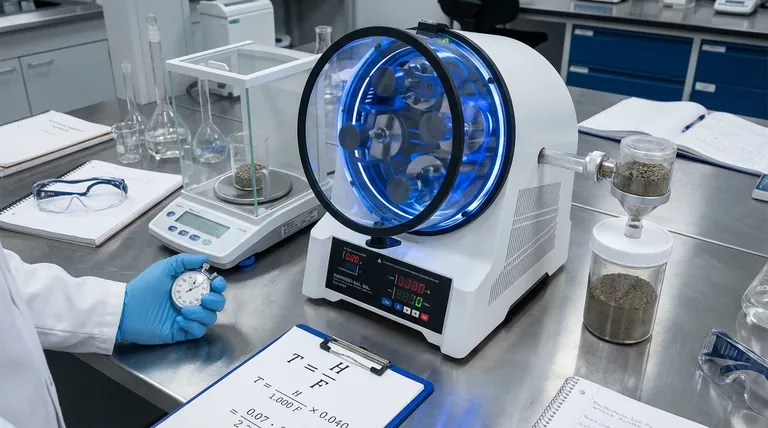
The Two Scenarios: Batch vs. Continuous Milling
The method for determining residence time depends entirely on how your mill operates.
For Batch Mills: A Simple Duration
In a batch operation, a fixed amount of material is loaded into the mill, ground for a specific period, and then discharged.
The calculation here is trivial: Residence Time = Total Grinding Time. If you run the mill for 90 minutes, the residence time is 90 minutes.
For Continuous Mills: The Core Formula
In a continuous operation, material is constantly fed into one end of the mill and discharged from the other. Here, we calculate an average residence time.
The foundational formula is: T = H / F
Where:
- T = Average residence time (e.g., in minutes)
- H = Mill Holdup, the total mass of material inside the mill at steady state (e.g., in kilograms)
- F = Mass Flow Rate, the rate at which new material is fed into the mill (e.g., in kilograms per minute)
Key Factors Influencing Residence Time
To use the formula effectively, you must understand the variables that you can control. Residence time is not a fixed property of the mill; it's a direct result of your operational settings.
The Input: Mass Flow Rate (F)
The mass flow rate, or feed rate, is your most direct lever for controlling residence time.
All other factors being equal, increasing the feed rate will decrease the residence time, and decreasing the feed rate will increase it.
The Contents: Mill Holdup (H)
Holdup is the weight of the slurry or powder being processed inside the mill during operation. It is influenced by several factors.
These include the mill's internal volume, the volume of the grinding media (ball charge), and the density of the material being ground. In wet milling, the slurry's percent solids also directly impacts the mass inside.
The Machine: Mill Speed and Design
The rotational speed of the mill affects how the material and media behave inside.
While speed doesn't appear in the simple formula, it significantly impacts grinding efficiency and the rate at which material transports from the inlet to the outlet, thereby influencing the residence time distribution.
Understanding the Trade-offs
Calculating residence time is a means to an end. The true goal is to optimize a process, which always involves balancing competing priorities.
Throughput vs. Product Fineness
This is the fundamental trade-off in milling.
A short residence time (achieved with a high feed rate) results in high throughput but yields a coarser product. A long residence time produces a finer product but at the cost of lower throughput.
Energy Consumption
Over-grinding is a significant source of inefficiency.
Increasing residence time beyond what is necessary to achieve the target particle size wastes a tremendous amount of energy and can even be detrimental to some processes.
The Reality of Distribution
The formula T = H / F gives you an average. In reality, not all particles spend the same amount of time in the mill.
Some particles may pass through quickly, while others may remain for much longer. This is known as the Residence Time Distribution (RTD), and a narrow distribution is often a sign of a more stable and predictable process.
Optimizing Residence Time for Your Goal
Use your understanding of residence time to directly control your operational outcomes. The ideal setting is a deliberate choice based on your primary objective.
- If your primary focus is maximizing throughput: You should aim for the shortest possible residence time (highest feed rate) that still produces a particle size within your acceptable quality specification.
- If your primary focus is achieving a very fine particle size: You must increase residence time by reducing the feed rate, allowing the material more time to be broken down by the grinding media.
- If your primary focus is improving energy efficiency: Your goal is to find the "sweet spot"—the shortest residence time that reliably achieves your target fineness, ensuring no energy is wasted on over-grinding.
Ultimately, controlling residence time is how you take command of your milling circuit's performance.
Summary Table:
| Key Variable | Symbol | Role in Calculation |
|---|---|---|
| Average Residence Time | T | The result of the calculation (e.g., minutes). |
| Mill Holdup | H | The mass of material inside the mill (e.g., kg). |
| Mass Flow Rate | F | The feed rate into the mill (e.g., kg/min). |
Ready to optimize your ball mill's performance?
Accurate control of residence time is critical for achieving your target particle size, maximizing throughput, and improving energy efficiency. KINTEK specializes in providing high-quality lab equipment and consumables for all your milling and grinding needs.
Our experts can help you select the right equipment and develop efficient processes for your laboratory. Contact KINTALK today to discuss how we can support your grinding operations and enhance your results.
Visual Guide

Related Products
- Laboratory Horizontal Planetary Ball Mill Milling Machine
- High-Energy Omnidirectional Planetary Ball Mill Machine for Laboratory
- High Energy Planetary Ball Mill Milling Machine for Laboratory
- High Energy Planetary Ball Mill Milling Machine for Laboratory
- High-Energy Omnidirectional Planetary Ball Mill Milling Machine for Laboratory
People Also Ask
- What is a planetary ball mill? Achieve Superior Fine Grinding and Mixing
- What are the disadvantages of planetary ball mill? Key Drawbacks in Energy, Noise, and Wear
- What are the parameters of a planetary ball mill? Master Speed, Time, and Media for Perfect Grinding
- What is a planetary ball mill? Achieve Rapid, High-Energy Grinding for Advanced Materials
- What are the advantages of planetary ball milling? Achieve High-Energy Grinding and Material Synthesis