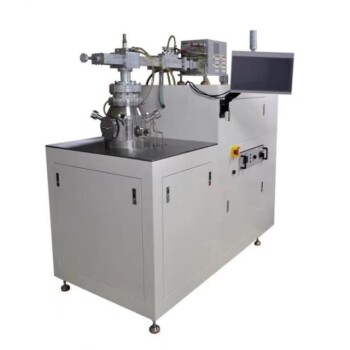
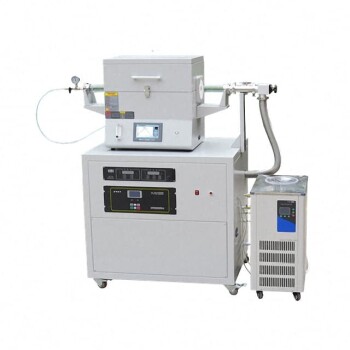
The primary mechanism for ensuring coating quality in a Chemical Vapor Deposition (CVD) reactor is strict environmental control. By maintaining a high-temperature atmosphere within an independent reaction chamber, the system facilitates specific chemical reactions—such as thermal decomposition, reduction, or oxidation—among gaseous precursors. These resultant vapors are then precisely delivered to a heated workspace, allowing them to deposit uniformly onto the sample surface.
By decoupling the chemical reaction from the surrounding environment, CVD reactors produce dense, strongly adherent layers that provide fundamental high-temperature corrosion resistance, even on parts with complex geometries.
The Mechanics of Quality Assurance
Controlled Chemical Reactions
The core of the CVD process occurs in an independent reaction chamber. This isolation allows the reactor to manage the exact conditions required for precursors to react.
Whether through thermal decomposition, reduction, or oxidation, the reactor ensures these transformations happen predictably. This consistency prevents impurities from forming within the coating layer.
Precise Vapor Delivery
Once the chemical reaction generates the necessary metal or compound vapors, they must be transported to the substrate. The reactor delivers these vapors to a heated workspace.
By heating the workspace and the substrate, the system ensures the deposition happens directly on the sample surface. This promotes a uniform buildup of material rather than a chaotic precipitation of particles.
Coverage of Complex Geometries
One of the distinct advantages of this gaseous approach is the ability to coat irregular shapes. Unlike line-of-sight methods (like spraying), the gas flows around the workpiece.
This results in a uniform coating thickness across the entire object, ensuring no weak points are left exposed to corrosive elements.
Why CVD Coatings Resist Corrosion
Achieving High Density
The reference highlights the formation of "dense protective layers." In corrosion protection, density is paramount.
A dense coating creates an impermeable barrier. This prevents corrosive agents, such as oxygen or moisture, from penetrating through pores to attack the underlying substrate.
Ensuring Strong Adhesion
The high temperatures involved in the CVD process do more than just facilitate reactions; they promote bonding. The coating develops strong adhesion to the substrate.
This prevents the protective layer from peeling or flaking off during thermal cycling or mechanical stress, maintaining the integrity of the corrosion barrier over time.
Understanding the Trade-offs
Thermal Limitations
The process relies heavily on a "high-temperature atmosphere" and a "heated workspace."
This inherently limits the types of substrates you can use. Materials that are sensitive to heat or prone to warping may not be suitable for standard CVD processes.
Reactivity Management
Because the process uses active gaseous precursors to trigger decomposition or oxidation, the chemistry must be managed carefully.
If the reactant flow or temperature fluctuates, the stoichiometry of the coating can change, potentially compromising its protective qualities.
Making the Right Choice for Your Goal
To determine if CVD is the right solution for your corrosion protection needs, consider the nature of your workpiece:
- If your primary focus is complex geometry: Choose CVD for its ability to flow gases around intricate shapes, ensuring total coverage where line-of-sight methods fail.
- If your primary focus is durability: Rely on CVD to produce the dense, high-adhesion layers required to withstand high-temperature corrosion environments.
Ultimately, the value of a CVD reactor lies in its ability to turn volatile gases into a solid, impenetrable shield that fundamentally enhances the lifespan of your components.
Summary Table:
| Quality Factor | CVD Mechanism | Benefit for Corrosion Resistance |
|---|---|---|
| Coating Density | High-temperature thermal decomposition | Creates an impermeable barrier against corrosive agents |
| Adhesion | Substrate heating & chemical bonding | Prevents peeling or flaking under thermal or mechanical stress |
| Uniformity | Gaseous precursor flow | Ensures full coverage of complex geometries without weak points |
| Purity | Independent reaction chamber isolation | Eliminates impurities that could compromise layer integrity |
Elevate Your Thin-Film Research with KINTEK Precision
Unlock the full potential of your materials science with KINTEK’s advanced CVD and PECVD reactor systems. Whether you are developing high-temperature corrosion-resistant layers or cutting-edge semiconductors, our reactors provide the precise temperature control and atmospheric stability required for dense, high-adhesion coatings.
As specialists in laboratory equipment, KINTEK offers a comprehensive range of solutions, including:
- High-Temperature Furnaces: Muffle, tube, rotary, and vacuum systems.
- Advanced Deposition: CVD, PECVD, and MPCVD reactors for superior thin-film quality.
- Material Processing: Crushing, milling, and high-pressure hydraulic presses.
- Specialized Labware: High-purity ceramics, crucibles, and PTFE products.
Don't compromise on coating integrity. Contact KINTEK today to consult with our experts and find the perfect equipment to enhance your laboratory’s efficiency and research outcomes.
References
- Rakesh Kumar, Santosh Kumar. Erosion and Hot Corrosion Phenomena in Thermal Power Plant and their Preventive Methods: A Study. DOI: 10.51983/arme-2018.7.1.2436
This article is also based on technical information from Kintek Solution Knowledge Base .
Related Products
- Cylindrical Resonator MPCVD Machine System Reactor for Microwave Plasma Chemical Vapor Deposition and Lab Diamond Growth
- Customer Made Versatile CVD Tube Furnace Chemical Vapor Deposition Chamber System Equipment
- Microwave Plasma Chemical Vapor Deposition MPCVD Machine System Reactor for Lab and Diamond Growth
- 915MHz MPCVD Diamond Machine Microwave Plasma Chemical Vapor Deposition System Reactor
- Split Chamber CVD Tube Furnace with Vacuum Station Chemical Vapor Deposition System Equipment Machine
People Also Ask
- What are the advantages of a Microwave Plasma CVD reactor for MCD/NCD coatings? Precision Multilayer Diamond Engineering
- How does a microwave plasma reactor facilitate the synthesis of diamond? Master MPCVD with Precision Technology
- Why is argon-rich gas phase chemistry used for UNCD growth? Unlock Precision Nano-Diamond Synthesis
- How does chemical vapor deposition work for diamonds? Grow Lab-Created Diamonds Layer by Layer
- What are the primary advantages of the CVD method for growing diamonds? Engineering High-Purity Gems and Components