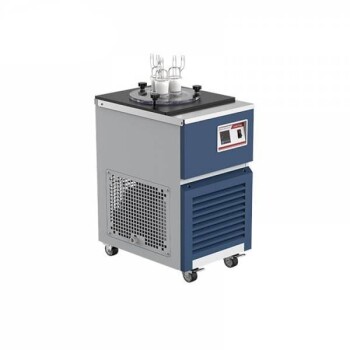
The condensation system serves as the critical bridge between chemical conversion and product recovery. Its primary function is to rapidly lower the temperature of hot gases exiting the pyrolysis reactor. By aggressively cooling these vapors, the system forces a phase change that converts gaseous intermediates into a stable liquid state known as pyrolysis oil.
While the reactor breaks down plastic polymers into gas, the condensation system captures that value by effectively locking it into a tangible, usable liquid fuel. Without this rapid cooling phase, the chemical potential remains suspended in a vapor state that is difficult to process or analyze.
The Thermodynamics of Recovery
Managing Reactor Discharge
The process begins immediately after the pyrolysis reactor does its work. High-temperature gases are discharged from the reactor core.
These gases contain the breakdown products of the waste plastic. At this stage, they are volatile and exist strictly as gaseous intermediates.
The Mechanism of Rapid Cooling
The condensation system functions by subjecting these hot gases to rapid cooling.
This is not a gradual decline in temperature. It is an engineered, sharp reduction designed to arrest the gaseous state immediately.
Triggering Phase Change
The physical goal of this cooling is to induce a phase change.
By removing heat energy quickly, the system forces the matter to transition from a gas phase into a liquid phase. This is the moment the material becomes a manageable fuel product.
From Vapor to Value
Effective Product Collection
The efficiency of the entire plastic-to-fuel process relies on this step.
The reference highlights that the condensation system is responsible for effective product collection. It ensures that the vaporized plastic does not escape or remain gaseous, but is captured physically.
Creating Liquid Pyrolysis Oil
The direct output of this system is liquid pyrolysis oil.
This oil is the recovered fuel derived from the plastic waste. Once condensed, it is stable enough to be collected in tanks.
Enabling Future Steps
Once the product is in liquid form, it is ready for the next stages of the lifecycle.
As noted in technical documentation, this liquid allows for further processing (refining the fuel) or analysis (testing quality and composition).
Understanding the Trade-offs
Sensitivity to Cooling Rates
The text emphasizes "rapidly cooling."
If the cooling process is too slow, the phase change may be incomplete. This leads to poor collection efficiency and the potential loss of valuable gases that fail to condense into oil.
System Dependencies
The condensation system is entirely dependent on the reactor's output.
It must be sized and calibrated to handle the specific volume and temperature of the gases discharged. A mismatch here results in a bottleneck for the entire waste-to-energy operation.
Optimizing Your Recovery Strategy
To ensure your condensation system delivers maximum value, align your operational focus with the specific outcomes you need.
- If your primary focus is Production Yield: Ensure the cooling rate is aggressive enough to capture all gaseous intermediates, preventing vapor loss.
- If your primary focus is Downstream Processing: Prioritize a stable phase change to ensure the resulting pyrolysis oil is consistent for refining or chemical analysis.
The condensation unit is the defining factor in successfully capturing the energy released during plastic decomposition.
Summary Table:
| Process Phase | Action | Outcome |
|---|---|---|
| Reactor Discharge | High-temp gas entry | Volatile gaseous intermediates |
| Rapid Cooling | Aggressive heat removal | Forced thermal transition |
| Phase Change | Vapor-to-liquid shift | Stabilization of pyrolysis oil |
| Product Recovery | Tangible collection | Ready for refining or analysis |
Maximize Your Waste-to-Energy Recovery with KINTEK
Transforming plastic waste into high-quality liquid fuel requires precision engineering at every stage. KINTEK specializes in high-performance laboratory equipment, including high-temperature high-pressure reactors, cooling solutions, and specialized autoclaves, designed to optimize your pyrolysis and condensation processes. Whether you are conducting battery research, material analysis, or refining biofuels, our comprehensive range of rotary furnaces and vacuum systems ensures maximum yield and efficiency.
Don't let valuable energy escape as vapor. Partner with KINTEK for reliable equipment and expert support. Contact us today to enhance your recovery strategy!
References
- Latifah Hauli, Akhmad Syoufian. Hydrocracking of LDPE Plastic Waste into Liquid Fuel over Sulfated Zirconia from a Commercial Zirconia Nanopowder. DOI: 10.13005/ojc/350113
This article is also based on technical information from Kintek Solution Knowledge Base .
Related Products
- Vacuum Cold Trap Chiller Indirect Cold Trap Chiller
- Chemical Vapor Deposition CVD Equipment System Chamber Slide PECVD Tube Furnace with Liquid Gasifier PECVD Machine
- Multi Heating Zones CVD Tube Furnace Machine Chemical Vapor Deposition Chamber System Equipment
- Customer Made Versatile CVD Tube Furnace Chemical Vapor Deposition Chamber System Equipment
- Vacuum Cold Mounting Machine for Sample Preparation
People Also Ask
- Why are precision Condensers and Cold Traps necessary at the collection end of a pyrolysis system? Maximize Yield & Purity
- Why is it necessary to configure efficient cold traps in membrane distillation? Ensure Flux Stability & Data Accuracy
- What is the purpose of connecting a cold trap at the reactor outlet? Protect Equipment and Analyze Liquid Products
- What is the role of glass condensation components in arsenic collection? Optimize Niccolite Roasting & Kinetics
- What is the function of a cold trap in bio-ethanol and methane reforming experiments? Optimize Purity & Protect Systems