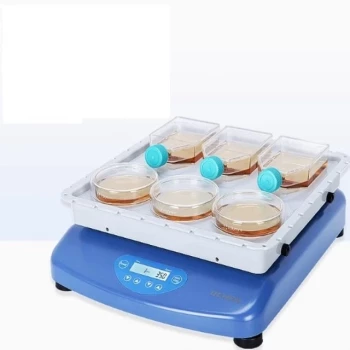
A constant temperature water bath circulation system stabilizes laboratory-scale anaerobic reactors by using a pump to actively drive hot water through a jacket surrounding the reactor. This dynamic circulation ensures uniform heat transfer throughout the vessel, compensating for external heat loss and maintaining internal temperature variations within a strict range of ± 1 °C.
By leveraging the high thermal conductivity of water, this system creates a thermal buffer that isolates the reaction from environmental fluctuations. This precision is essential for distinguishing true biological kinetic responses from temperature-induced artifacts.
The Mechanics of Thermal Stability
Uniform Heat Transfer via Active Circulation
The core advantage of this system lies in the use of a pump to drive water circulation. Unlike static baths, a circulating system moves hot water continuously through the reactor jacket.
This eliminates "hot spots" or "cold zones" that can occur in static heating methods. The fluid motion ensures that thermal energy is distributed evenly across the reactor surface area.
Leveraging High Thermal Conductivity
Water possesses significantly higher thermal conductivity than air. As a medium, it absorbs and transfers thermal energy much more efficiently than air-based incubators.
This allows the system to rapidly correct temperature deviations. The water bath acts as a highly responsive thermal mass, stabilizing the reactor core against ambient shifts.
Ensuring Experimental Integrity
Compensating for System Heat Loss
Anaerobic reactions, particularly at the laboratory scale, are susceptible to heat loss through the reactor walls. The circulation system actively compensates for this energy loss.
By maintaining a constant flow of temperature-regulated water, the system counteracts the cooling effect of the surrounding environment. This ensures the biological process remains at the target setpoint.
Validating Kinetic Characteristics
Precise temperature control is a prerequisite for accurately studying reaction kinetics. In studies involving substrates like fruit wine distillery residues, temperature fluctuations can skew data on organic loading rates (OLR).
By keeping variation within ± 1 °C, the system ensures that observed changes in efficiency or yield are attributed solely to the biological kinetics, not thermal instability.
Understanding the Trade-offs
Equipment Complexity and Maintenance
While highly effective, a circulation system introduces mechanical complexity compared to simple incubators. It relies on the continuous function of a mechanical pump and the integrity of the reactor jacket.
Failure in the circulation pump leads to an immediate loss of thermal uniformity. This requires regular monitoring to ensure flow rates remain constant.
Thermal Response Time
The high thermal capacity of water provides excellent stability but introduces thermal inertia. While it resists unwanted fluctuations well, deliberately changing the temperature setpoint (e.g., moving from mesophilic to thermophilic conditions) takes longer than in air-based systems.
Making the Right Choice for Your Goal
To maximize the value of your experimental setup, align the thermal control strategy with your specific research objectives.
- If your primary focus is Kinetic Modeling: Prioritize circulation systems to keep variation within ± 1 °C, ensuring your data reflects true biological reaction rates.
- If your primary focus is High-Throughput Screening: Evaluate if the complexity of plumbing individual reactor jackets is justified, or if a high-quality air incubator offers sufficient stability for basic feasibility tests.
Ultimately, the reliability of your anaerobic data is directly proportional to the thermal stability of your reactor environment.
Summary Table:
| Feature | Benefit to Anaerobic Reactors | Impact on Research |
|---|---|---|
| Active Pump Circulation | Eliminates hot spots and cold zones | Ensures uniform thermal distribution |
| High Thermal Conductivity | Rapidly corrects temperature deviations | Isolates reactions from ambient fluctuations |
| Jacketed Compensation | Offsets continuous wall heat loss | Maintains target setpoint within ± 1 °C |
| Thermal Buffering | Provides high thermal inertia | Protects biological kinetics from artifacts |
Maximize Your Research Precision with KINTEK
Ensure the integrity of your anaerobic studies with KINTEK’s premium laboratory equipment. From advanced constant temperature water baths and cooling solutions to specialized high-temperature high-pressure reactors and autoclaves, we provide the thermal stability your complex biological processes demand.
Whether you are performing kinetic modeling or high-throughput screening, KINTEK specializes in high-performance tools—including crushing and milling systems, hydraulic presses, and high-quality consumables—tailored for global research laboratories.
Ready to eliminate temperature-induced artifacts in your data? Contact KINTEK today to discuss your project requirements!
References
- Elena Cristina Rada, Vincenzo Torretta. Laboratory-scale anaerobic sequencing batch reactor for treatment of stillage from fruit distillation. DOI: 10.2166/wst.2013.611
This article is also based on technical information from Kintek Solution Knowledge Base .
Related Products
- High Pressure Laboratory Autoclave Reactor for Hydrothermal Synthesis
- Mini SS High Pressure Autoclave Reactor for Laboratory Use
- Stainless High Pressure Autoclave Reactor Laboratory Pressure Reactor
- Customizable Laboratory High Temperature High Pressure Reactors for Diverse Scientific Applications
- Customizable High Pressure Reactors for Advanced Scientific and Industrial Applications
People Also Ask
- What role does a high-pressure reactor (autoclave) play in the synthesis of NiCuFe-LDH? Master Hydrothermal Growth
- What Role Does a High-Pressure Reactor or Autoclave Play in HA Catalyst Synthesis? Achieve High Surface Area Materials
- What equipment is required for hydrothermal synthesis of Ga0.25Zn4.67S5.08? Optimize Your Semiconductor Production
- What is the function of a high-pressure reactor in the hydrothermal synthesis of boehmite? Expert Process Insights
- What role does an autoclave play in the synthesis of MnO2 nanofibers? Mastering Hydrothermal Growth