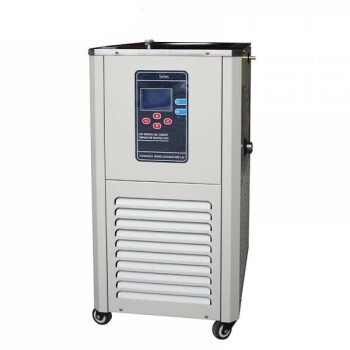
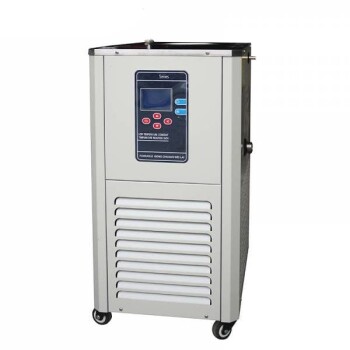
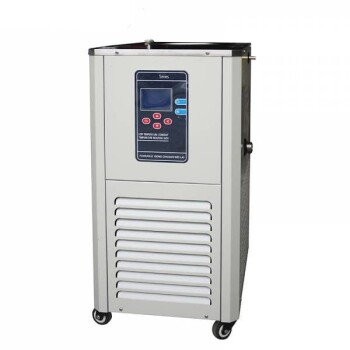
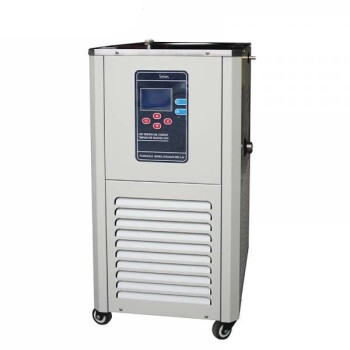
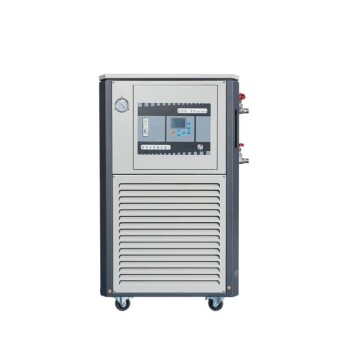
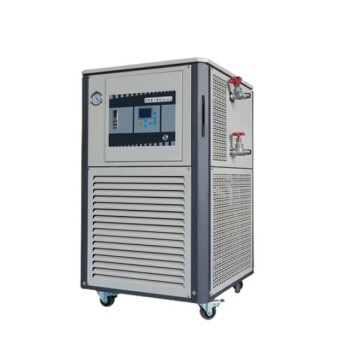
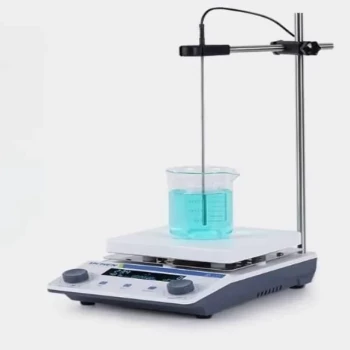
A constant temperature water bath acts as the fundamental control mechanism in the study of CO2 absorption kinetics, ensuring that experimental data reflects chemical reality rather than environmental noise. By maintaining a precise thermal environment—typically set to a standard such as 40°C—the water bath eliminates temperature fluctuations that would otherwise skew the measurement of reaction rates and absorption capacity.
Because CO2 absorption is governed simultaneously by reaction kinetics and thermodynamic equilibrium, stability is non-negotiable. A constant temperature water bath isolates the variable of heat, ensuring that any observed changes in absorption are due to the properties of the amine solution, not thermal inconsistencies.
The Critical Role of Thermal Stability
Balancing Kinetics and Thermodynamics
The process of capturing CO2 in amine solutions is complex because it is driven by two competing forces: reaction kinetics (how fast the reaction happens) and thermodynamic equilibrium (how much CO2 can be absorbed).
Both of these forces are highly sensitive to heat. A constant temperature water bath ensures that both the speed of the reaction and the final equilibrium state are measured under a unified, static condition.
Eliminating Environmental Interference
Without a controlled thermal environment, ambient temperature shifts could mimic or mask the effects of the chemical reaction.
The water bath serves as a thermal buffer. It creates a "thermal wall" around the experiment, preventing external room temperature changes from interfering with the reaction vessel.
Impact on Data Accuracy and Calculations
Precision in Absorption Load
To determine the true capacity of an amine solution (the absorption load), the temperature must remain fixed throughout the experiment.
The water bath allows researchers to calculate the exact load without worrying that a temperature drop artificially increased the solution's capacity, or a spike decreased it.
Calculating the Enhancement Factor
The enhancement factor is a specific metric that describes how much the chemical reaction improves CO2 absorption compared to physical absorption alone.
This calculation relies on precise kinetic data. By locking the temperature at a specific set point (e.g., 40°C), the water bath ensures the enhancement factor derived is mathematically accurate and physically representative.
Guaranteeing Repeatability
Scientific rigor demands that an experiment yields the same results when repeated under the same conditions.
The water bath is the primary tool for achieving this repeatability. It ensures that data collected on Monday is directly comparable to data collected on Friday, regardless of changes in the laboratory environment.
Common Pitfalls to Avoid
The Assumption of Instant Equilibrium
While a water bath maintains the external temperature, it does not guarantee that the liquid inside the reaction vessel is instantly at the same temperature.
A common mistake is starting the experiment before the amine solution has fully equilibrated with the bath temperature.
Thermal Lag and Gradients
If the reaction is highly exothermic (generates heat), the water bath must be capable of removing that heat quickly to maintain the set point.
If the bath circulation is poor, localized "hot spots" can form around the reactor vessel. This creates a thermal gradient where the reactor wall is at 40°C, but the core of the solution is significantly hotter, leading to kinetic errors.
Making the Right Choice for Your Experiment
To maximize the quality of your kinetic data, align your equipment use with your specific analytical goals:
- If your primary focus is Thermodynamic Accuracy: Ensure the water bath acts as a heat sink to counter exothermic spikes, preserving the integrity of absorption load calculations.
- If your primary focus is Kinetic Modeling: Prioritize high-circulation baths that eliminate thermal gradients, ensuring the enhancement factor is calculated based on a uniform temperature field.
By strictly controlling the thermal variable, you transform raw data into a reliable baseline for analyzing CO2 capture efficiency.
Summary Table:
| Feature | Role in CO2 Kinetics Study | Benefit to Researcher |
|---|---|---|
| Thermal Stability | Maintains set points (e.g., 40°C) | Eliminates temperature-induced data skew |
| Kinetic Control | Isolates reaction speed variables | Accurate calculation of Enhancement Factors |
| Thermodynamic Sink | Manages exothermic heat release | Ensures consistent absorption load capacity |
| Uniform Circulation | Prevents localized hot spots | Guarantees repeatability and data integrity |
Elevate Your Kinetic Research with KINTEK Precision
Accuracy in CO2 absorption studies depends on uncompromising thermal control. KINTEK specializes in high-performance laboratory equipment designed to eliminate environmental noise and deliver repeatable results. Whether you need advanced cooling solutions (ULT freezers, cold traps) to manage exothermic reactions, or high-temperature high-pressure reactors and autoclaves for complex gas-liquid studies, we provide the tools necessary for scientific excellence.
Our comprehensive range for researchers includes:
- Thermal Control: Constant temperature baths and cooling solutions.
- Sample Processing: Crushing, milling, and hydraulic presses for material preparation.
- Specialized Labware: PTFE products, ceramics, and crucibles for chemical resistance.
Don't let thermal lag compromise your data. Contact KINTEK today to find the perfect thermal management solution for your laboratory.
References
- Qiuli Zhang, Jun Zhou. Experimental study of CO<sub>2</sub> capture by nanoparticle-enhanced 2-amino-2-methyl-1-propanol aqueous solution. DOI: 10.1039/d3ra06767j
This article is also based on technical information from Kintek Solution Knowledge Base .
Related Products
- High Temperature Constant Temperature Heating Circulator Water Bath Chiller Circulator for Reaction Bath
- 50L Chiller Water Bath Cooling Circulator Low Temperature Constant Temperature Reaction Bath
- 10L Chilling Circulator Cooling Water Bath Low Temperature Constant Temperature Reaction Bath
- 30L Chiller Water Bath Cooling Circulator Low Temperature Constant Temperature Reaction Bath
- 40L Chiller Water Bath Cooling Circulator Low Temperature Constant Temperature Reaction Bath
People Also Ask
- What is the necessity of a circulating water bath in chlorate production? Optimize Yield & Purity with Precision
- How do constant temperature circulators impact weight-loss immersion tests? Ensure Precision in Corrosion Analysis
- How does a constant temperature circulator support the leaching reaction of gold scrap? Optimize Gold Recovery Results
- Why is a constant temperature water bath used for precursor storage in CVD? Achieve Stable Nanocrystalline SiC Deposition
- Why is a high-precision constant temperature water bath necessary for anaerobic digestion? Ensure Success at 37±0.02°C