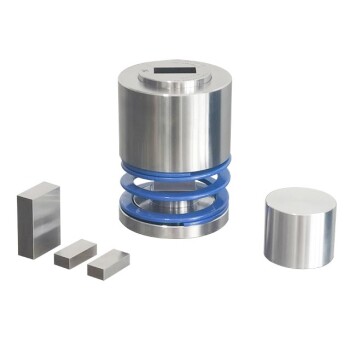
High-pressure reactors facilitate silicide hydrogenation by providing extreme hydrogen partial pressures—often up to 400 bar—to overcome the inherent thermodynamic stability of precursors like magnesium silicide ($Mg_2Si$). This intense pressure environment shifts the chemical equilibrium to favor hydrogenation-decomposition reactions that are physically impossible at atmospheric levels. By maintaining these conditions, the reactor enables the Hydrogenation-Disproportionation-Desorption-Recombination (HDDR) process, which is essential for structural transformation.
The high-pressure reactor acts as a thermodynamic driver that forces hydrogen into stable crystalline lattices, triggering a controlled breakdown and reconfiguration of the silicide precursor. This environment is the only way to bypass the high energy barriers associated with stable metal-silicon bonds.
Overcoming Thermodynamic Barriers
Shifting the Chemical Equilibrium
Silicide precursors are characterized by high thermodynamic stability, making them resistant to standard chemical changes. The high-pressure reactor provides a hydrogen-rich environment that essentially "crowds" the reaction, forcing the equilibrium to shift toward the products of hydrogenation.
Enabling the HDDR Process
The reactor provides the foundation for the Hydrogenation-Disproportionation-Desorption-Recombination (HDDR) cycle. This process requires a specific high-pressure threshold to initiate the disproportionation phase, where the precursor breaks down into intermediate phases.
Overcoming Phase Stability
At atmospheric pressure, precursors like $Mg_2Si$ remain inert in the presence of hydrogen. The reactor’s ability to maintain high hydrogen partial pressure provides the chemical potential necessary to destabilize these phases and allow for new material formation.
Kinetic and Structural Control
Promoting Lattice Penetration
High pressure facilitates the dissociation of diatomic hydrogen molecules into atomic hydrogen. This transition allows hydrogen atoms to enter the interstitial sites of the silicide lattice, such as tetrahedral or octahedral positions, which is critical for the reaction to proceed internally.
Precise Environmental Management
The reactor ensures a controlled physical and chemical environment by synchronizing high temperature and constant pressure. This precision allows for the complete reduction of precursors while preventing the uncontrolled growth of metal grains.
Maintaining Surface Area
By providing a stable and uniform reduction atmosphere, the reactor helps maintain the highly dispersed nature of the resulting nanoparticles. This prevents the excessive coarsening of grains, ensuring the final material retains a high active surface area for its intended application.
Understanding the Trade-offs
Equipment Integrity and Safety
Operating at pressures of 400 bar introduces significant mechanical stress on the reactor vessels. This necessitates specialized materials and engineering, which can increase the complexity of the setup and require stringent safety monitoring.
Kinetic Bottlenecks
While high pressure effectively addresses thermodynamic limitations, it may not entirely resolve kinetic limitations. Even under high pressure, certain silicide reactions may require catalysts or mechanical agitation to ensure thorough contact between the gas and solid phases.
Scalability Constraints
The cost and energy requirements for maintaining extreme pressures can make large-scale industrial implementation challenging. Balancing the pressure-to-yield ratio is a critical consideration for those moving from laboratory research to commercial production.
Applying This to Your Project
When utilizing a high-pressure reactor for silicide treatment, your approach should be dictated by your specific material goals.
- If your primary focus is structural refinement: Utilize the HDDR cycle within the reactor to achieve a highly controlled disproportionation and recombination of the precursor grains.
- If your primary focus is catalytic performance: Prioritize the inhibition of grain growth by carefully balancing the reduction temperature against the hydrogen pressure to maintain surface area.
- If your primary focus is thermodynamic study: Use the reactor's high-pressure capabilities to validate theoretical models regarding hydrogen entry into interstitial lattice sites.
The high-pressure reactor is a definitive tool for transforming stable silicides, providing the thermodynamic force necessary to unlock new material properties.
Summary Table:
| Key Feature | Mechanism | Impact on Silicide Treatment |
|---|---|---|
| Hydrogen Partial Pressure | Up to 400 bar | Shifts equilibrium to bypass thermodynamic stability. |
| HDDR Process Support | Controlled cycle | Facilitates structural transformation and reconfiguration. |
| Lattice Penetration | H2 dissociation | Forces atomic hydrogen into stable crystalline lattices. |
| Precise Environmental Control | Temp/Pressure Sync | Prevents grain coarsening and maintains high surface area. |
| Phase Destabilization | Chemical Potential | Overcomes phase stability of inert precursors like $Mg_2Si$. |
Elevate Your Material Synthesis with KINTEK Precision
At KINTEK, we understand that breaking through thermodynamic barriers requires more than just high pressure—it requires reliability and precision. Our specialized high-temperature high-pressure reactors and autoclaves are engineered to handle the extreme demands of silicide hydrogenation and HDDR processes, ensuring consistent structural refinement and catalytic performance.
From high-pressure systems to crushing, milling, and advanced cooling solutions, KINTEK provides a comprehensive portfolio of laboratory equipment designed for the most rigorous research environments. Whether you are a researcher in energy storage or a specialist in nanoparticle synthesis, we offer the technical expertise and robust hardware you need to succeed.
Ready to optimize your hydrogenation workflows? Contact KINTEK today to find the perfect high-pressure solution for your laboratory.
References
- Imants Dirba, Oliver Gutfleisch. Bulk Nanostructured Silicide Thermoelectric Materials by Reversible Hydrogen Absorption–Desorption. DOI: 10.1002/smll.202208098
This article is also based on technical information from Kintek Solution Knowledge Base .
Related Products
- Customizable Laboratory High Temperature High Pressure Reactors for Diverse Scientific Applications
- Customizable High Pressure Reactors for Advanced Scientific and Industrial Applications
- Stainless High Pressure Autoclave Reactor Laboratory Pressure Reactor
- Visual High-Pressure Reactor for In-Situ Observation
- Mini SS High Pressure Autoclave Reactor for Laboratory Use
People Also Ask
- How do high-pressure and high-temperature reactors ensure the effective treatment of lignocellulosic wastewater in WAO?
- What equipment is required for high-pressure high-temperature reactions? Master Extreme Chemistry Safely
- How do you control high pressure in a reactor? A Guide to Safe & Stable Operation
- How does initial oxygen pressure affect the wet oxidation of pharmaceutical sludge? Master Your Oxidation Depth
- Why is argon better than nitrogen for inert atmosphere? Ensure Absolute Reactivity & Stability