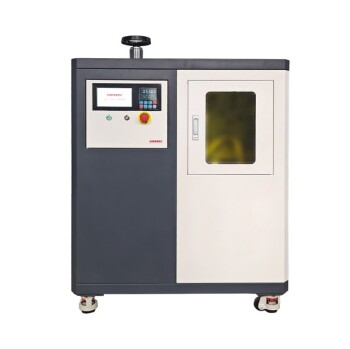
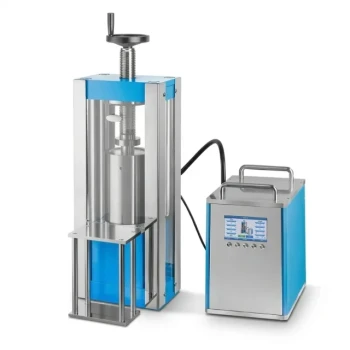
Hot Isostatic Pressing (HIP) is the definitive solution for maximizing the structural integrity of additive manufactured titanium. By subjecting the part to simultaneous high temperature and high uniform gas pressure, a HIP furnace effectively closes internal micro-pores and voids inherent to the printing process. This treatment forces the material to achieve near 100% relative density, transforming a printed part with potential internal defects into a component capable of withstanding critical aerospace standards.
While additive manufacturing enables complex geometries, the printing process often leaves microscopic voids that act as failure points. HIP treats the "deep structure" of the metal, eliminating these defects to ensure the part does not fail under cyclic stress or fatigue.
The Mechanism of Defect Elimination
Closing Voids via Plastic Deformation
The core function of the HIP furnace is to apply omnidirectional pressure—often exceeding 100 MPa—to the titanium part while it is heated. This extreme environment causes the material surrounding internal voids to yield and collapse inward.
Self-Healing the Microstructure
This process induces plastic deformation at a microscopic level, effectively "healing" internal cracks and discontinuities. Unlike simple heat treatment, which only alters the grain structure, HIP physically bonds the material across the gap of the void.
Achieving 100% Relative Density
As-printed titanium parts may have high density, but they are rarely perfect. HIP pushes the material to 100% relative density, ensuring that the theoretical mechanical properties of the alloy are actually realized in the physical part.
Transforming Mechanical Performance
Drastic Improvement in Fatigue Stability
The most critical benefit of using a HIP furnace is the enhancement of fatigue life. Micro-pores act as stress concentrators where cracks initiate under cyclic loading; by eliminating these pores, you significantly extend the lifespan of the part.
Relief of Residual Stresses
Rapid melting and solidification cycles in additive manufacturing generate significant residual stresses that can lead to warping. The thermal cycle of the HIP process simultaneously acts as a stress relief treatment, relaxing these internal forces and preventing future distortion.
Enhanced Environmental Resistance
A fully dense, defect-free surface and interior improve the part's resistance to external factors. Post-HIP titanium components exhibit superior resistance to heat, wear, and abrasion compared to their as-printed counterparts.
Understanding the Trade-offs
Homogeneous Shrinkage
Because HIP removes porosity, the volume of the part decreases. This shrinkage is generally homogeneous (uniform in all directions) and does not typically cause distortion, but it must be accounted for during the initial design phase to maintain net-shape tolerances.
Process Intensity and Cost
HIP is a high-energy, time-intensive batch process. While essential for critical components, it adds a layer of cost and logistical complexity compared to simple stress-relief annealing.
Making the Right Choice for Your Goal
To determine if HIP is necessary for your specific titanium application, consider your performance requirements:
- If your primary focus is Fatigue Life and Safety: You must utilize HIP to eliminate crack-initiation sites for any mission-critical or aerospace component.
- If your primary focus is Dimensional Precision: You must calculate the expected densification shrinkage and adjust your digital model (CAD) prior to printing.
- If your primary focus is Material Uniformity: You should use HIP to ensure isotropic properties, guaranteeing the part performs equally well regardless of load direction.
Ultimately, Hot Isostatic Pressing bridges the gap between a printed prototype and a production-ready component that can be trusted in the most demanding environments.
Summary Table:
| Performance Factor | As-Printed Condition | Post-HIP Treatment Effect |
|---|---|---|
| Internal Density | Contains micro-pores/voids | Reaches near 100% theoretical density |
| Fatigue Life | Lower (pores act as crack sites) | Significantly extended through pore closure |
| Residual Stress | High (due to rapid cooling) | Relieved via thermal cycling |
| Microstructure | Potential discontinuities | Fully bonded and homogeneous |
| Dimensions | As-designed net shape | Uniform shrinkage (densification) |
Elevate Your Additive Manufacturing Standards with KINTEK
Don't let internal defects compromise your mission-critical components. KINTEK specializes in advanced laboratory solutions, offering a comprehensive range of Hot Isostatic Pressing (HIP) furnaces, vacuum systems, and crushing and milling equipment designed for the most demanding materials research.
Whether you are producing high-performance titanium aerospace parts or developing next-gen medical implants, our high-temperature high-pressure solutions ensure your materials achieve 100% density and peak fatigue resistance. From isostatic presses and high-temperature reactors to specialized ceramics and crucibles, KINTEK provides the tools you need to transform printed prototypes into production-ready assets.
Ready to maximize your material performance? Contact our expert team today to find the perfect HIP solution for your laboratory or production facility.
References
- Alexander Katz‐Demyanetz, Andrey Koptyug. Powder-bed additive manufacturing for aerospace application: Techniques, metallic and metal/ceramic composite materials and trends. DOI: 10.1051/mfreview/2019003
This article is also based on technical information from Kintek Solution Knowledge Base .
Related Products
- 600T Vacuum Induction Hot Press Furnace for Heat Treat and Sintering
- Warm Isostatic Press for Solid State Battery Research
- Laboratory High Pressure Vacuum Tube Furnace
- Vacuum Hot Press Furnace Heated Vacuum Press Machine Tube Furnace
- Vacuum Hot Press Furnace Machine Heated Vacuum Press
People Also Ask
- What role does an induction vacuum hot pressing furnace play in sintering? Achieve 98% Density in Carbide Blocks
- What advantages does a vacuum hot press furnace provide for LSLBO ceramic electrolytes? Achieve 94% Relative Density
- What role does a Vacuum Hot Press (VHP) furnace play in the densification of austenitic stainless steel 316 composites?
- What are the advantages of a vacuum hot press furnace for W-50%Cu? Achieve 99.6% Density at Lower Temperatures
- What role does mechanical pressure play during the vacuum diffusion bonding of tungsten and copper? Keys to Solid Bonding