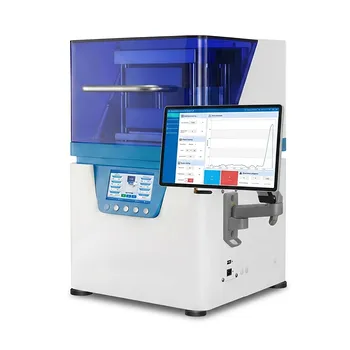
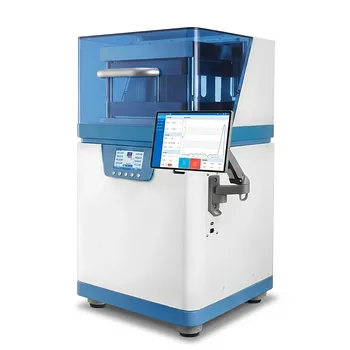
A laboratory hydraulic press is essential for transforming loose active materials into high-performance electrode sheets by applying precise, uniform pressure to compact the material. This process ensures a dense, uniform shape while establishing the critical electrical and mechanical bonds necessary for the electrode to function effectively within a symmetric supercapacitor.
Core Takeaway: The hydraulic press serves as the bridge between raw chemical mixtures and functional electrodes by minimizing internal resistance and maximizing mechanical adhesion to current collectors, which directly dictates the device's rate performance and cycle life.
Minimizing Electrical Resistance
Reducing Interfacial Contact Resistance
The primary function of the hydraulic press is to force tight mechanical contact between the active material slurry and the current collector (such as nickel foam or stainless steel mesh). By applying high pressure, the press eliminates microscopic gaps at the interface, which significantly enhances charge transfer efficiency and reduces the overall impedance of the supercapacitor.
Optimizing Particle-to-Particle Connectivity
High-pressure compression (often ranging from 10 MPa to 80 MPa) causes the particles of active carbon, conductive agents, and binders to rearrange and bond. This tight packing ensures a continuous pathway for electrons to travel through the electrode material, which is vital for maintaining high rate performance during rapid charge-discharge cycles.
Ensuring Structural and Mechanical Integrity
Enhancing Adhesion to Substrates
Without sufficient compression, active materials tend to delaminate or shed from the current collector when exposed to liquid electrolytes. The hydraulic press creates a robust physical bond that allows the electrode to withstand the mechanical stresses of ion intercalation and electrolyte flushing without structural failure.
Maintaining Stability During Cycling
Supercapacitors undergo repeated physical expansion and contraction during operation. The high-density compaction provided by the press ensures that the electrode remains structurally sound, preventing the loss of active material and ensuring long-term cycling stability over thousands of uses.
Defining Physical and Geometric Uniformity
Achieving Consistent Density and Thickness
Precision molds used in the press allow researchers to produce electrode sheets with a fixed shape and density. This uniformity is critical for scientific reproducibility, ensuring that every electrode tested has the same mass loading and volume, which allows for accurate comparisons between different active materials.
Controlling Porosity for Ion Transport
While the goal is high density, the hydraulic press must be used to find a balance between compaction and porosity. Precise pressure control ensures the material is dense enough for conductivity but remains porous enough to allow the electrolyte to penetrate the electrode and access the internal surface area for charge storage.
Understanding the Trade-offs and Pitfalls
The Risk of Over-Compression
Applying excessive pressure can lead to the collapse of the internal pore structure of the active material, particularly in microporous carbons. This reduction in accessible surface area can paradoxically decrease the total capacitance of the device, despite improving its electrical conductivity.
Managing Binder Distribution
If the pressure is applied unevenly or if the binder is not well-distributed, the hydraulic press can cause "islands" of high density and regions of fragility. This lack of uniformity results in uneven current distribution across the electrode, leading to premature degradation and inconsistent test results.
How to Apply This to Your Project
Making the Right Choice for Your Goal
To achieve the best results with a laboratory hydraulic press, you must tailor the pressure settings to your specific materials and collectors.
- If your primary focus is high power density: Prioritize higher compaction pressures (e.g., 25–30 MPa) to minimize contact resistance and maximize the speed of charge transfer.
- If your primary focus is maximum energy storage: Use moderate pressure to ensure you do not crush the delicate pore structures of your active materials, preserving the surface area available for ion adsorption.
- If your primary focus is electrode longevity: Focus on the quality of the mechanical bond between the slurry and the current collector to prevent delamination during long-term cycling.
The laboratory hydraulic press remains the definitive tool for ensuring that the electrochemical potential of your materials is fully realized in a stable, conductive, and reproducible electrode format.
Summary Table:
| Key Function | Impact on Electrode | Benefit to Supercapacitor |
|---|---|---|
| Resistance Reduction | Eliminates gaps at the collector interface | Higher charge transfer efficiency & rate performance |
| Mechanical Adhesion | Creates robust physical bonds with substrates | Prevents delamination and improves cycling stability |
| Uniformity Control | Standardizes density, mass loading, and thickness | Ensures scientific reproducibility and accuracy |
| Porosity Balancing | Maintains accessible internal surface area | Maximizes energy storage and ion transport |
Elevate Your Energy Storage Research with KINTEK
Precision is the foundation of high-performance energy storage. KINTEK provides a comprehensive range of hydraulic presses, including pellet, hot, and isostatic models, specifically designed to meet the rigorous demands of electrode preparation.
Whether you are optimizing active material density or ensuring maximum mechanical adhesion for symmetric supercapacitors, our equipment delivers the uniform pressure control needed to achieve industry-leading results. Beyond pressing, KINTEK offers a full suite of laboratory solutions—from high-temperature furnaces and crushing systems to battery research tools and consumables.
Ready to enhance your lab's efficiency and data reproducibility?
Contact KINTEK Today to Find Your Perfect Solution
References
- Kai Fan, Jing Liu. Preparation of Carbon Electrode Material with a Large Specific Surface Area and Multiscale Pore Structure from Biowaste Kochia for Symmetrical Supercapacitor. DOI: 10.1002/ente.202201281
This article is also based on technical information from Kintek Solution Knowledge Base .
Related Products
- Laboratory Hydraulic Press Lab Pellet Press Machine for Glove Box
- Laboratory Hydraulic Press Split Electric Lab Pellet Press
- Fully Automatic Heated Hydraulic Lab Press for Materials Sintering and Sample Preparation
- Laboratory Hydraulic Press Lab Pellet Press for Button Battery
- Automatic Laboratory Hydraulic Press for XRF & KBR Pellet Press
People Also Ask
- What is the function of a laboratory hydraulic press in W-Cu composites? Control Porosity and Material Ratio
- What is the role of a laboratory hydraulic press in the initial stages of Li6PS5Cl preparation? Key to Green Pellets
- What role does a laboratory hydraulic press play in triboelectric testing? Achieve Precision Alloy Sample Prep
- How can a laboratory hydraulic press be applied to chitosan for wastewater treatment? Optimize Pores & Strength
- How do a precision laboratory hydraulic press and specialized molds contribute to the fabrication of spherical ceramic samples? Achieving High-Density Material Precision