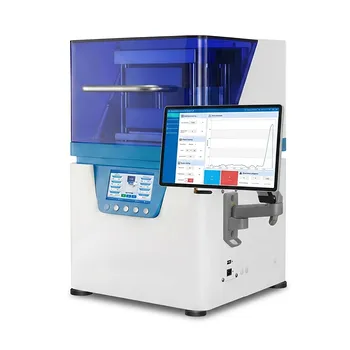
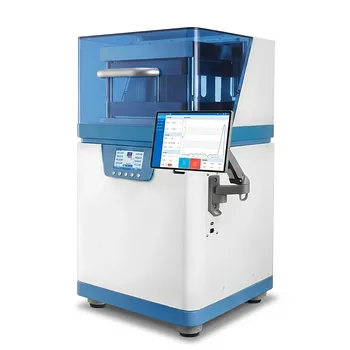
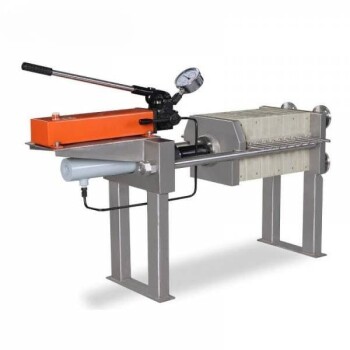
A laboratory hydraulic press is the critical link between loose powder and accurate electrical data. By applying high, controlled pressure, the press transforms loose carbon particles into a dense, uniform pellet. This process eliminates air gaps and minimizes contact resistance, ensuring the measured resistance reflects the material's intrinsic properties rather than the random orientation of the powder.
The hydraulic press facilitates accurate resistance measurements by standardizing the physical state of the sample, effectively removing the "noise" caused by variable particle packing and high contact resistance.
The Role of Compaction in Electrical Characterization
Eliminating Voids and Inter-particle Gaps
In its loose state, carbon powder contains significant air pockets that act as insulators. A hydraulic press applies high static pressure to force these particles into intimate contact, creating a continuous conductive path. Without this consolidation, measurements would reflect the resistance of air gaps rather than the carbon itself.
Minimizing Contact Resistance
Contact resistance occurs at the interface where individual particles meet. By compressing the powder into a dense disc, the press reduces these interface barriers, allowing for a more accurate reading of intrinsic conductivity. This ensures that subsequent tests, such as the four-probe resistance test, are performed under consistent and repeatable conditions.
Standardizing Sample Geometry
For techniques like X-ray diffraction (XRD) or in-plane resistance testing, a flat and uniform surface is mandatory. The press ensures a consistent sample surface height, which maximizes signal intensity and ensures the accuracy of the collected analytical data. This uniformity is essential for scientific reproducibility across different laboratories.
Enhancing Data Precision Through Dynamic Analysis
Simulating Real-World Compaction States
Modern hydraulic presses allow for continuously variable pressure application to simulate how materials behave under different manufacturing loads. When integrated with a conductivity measurement module, researchers can record the dynamic relationship between electrical resistance and compaction density. This is vital for identifying high-performance electrode materials.
Calculating Compaction Parameters
The press provides the standardized conditions necessary to obtain accurate volume change data. This data is used to calculate parameters like the Carr index and Hausner ratio, which describe the powder's flowability and compressibility. These physical metrics provide a deeper context for why certain carbon powders perform better under pressure than others.
Understanding the Trade-offs and Pitfalls
The Risk of Structural Damage
While high pressure is necessary for density, excessive force can crush delicate carbon nanostructures. Over-compaction may lead to mechanical fracture of the particles, which permanently alters the material's conductive network and produces misleading results.
Pressure Gradients and Non-Uniformity
If the powder is not distributed evenly in the die or if the press is not calibrated, density gradients can form within the pellet. These internal variations cause the in-plane resistance to fluctuate across the surface, leading to inconsistent data that does not represent the bulk material accurately.
Contamination from Tooling
The high-pressure environment can cause "blocking" or adhesion, where the powder sticks to the press dies. If the dies are not properly cleaned or made of incompatible materials, cross-contamination can occur, introducing impurities that skew the electrical resistance measurements.
How to Apply This to Your Project
Making the Right Choice for Your Goal
To achieve the most accurate measurements, your approach to compaction must match your specific research objective.
- If your primary focus is determining intrinsic conductivity: Apply high, static pressure to reach the material's maximum theoretical density and eliminate all inter-particle gaps.
- If your primary focus is electrode performance optimization: Use a press with a precision pressure-holding function to record resistance changes across a range of compaction states.
- If your primary focus is material comparison and QC: Standardize a specific pressure (e.g., 1 MPa) and hold time to ensure every sample is tested under identical physical conditions.
By treating the hydraulic press as a precision instrument rather than a simple crushing tool, you ensure that your carbon-based samples yield data that is both scientifically rigorous and technically sound.
Summary Table:
| Feature | Impact on Resistance Measurement | Scientific Benefit |
|---|---|---|
| Void Elimination | Removes insulating air pockets between loose particles | Measures intrinsic conductivity, not air gaps |
| Contact Optimization | Minimizes interface resistance between carbon grains | Reduces signal noise for higher data precision |
| Geometric Standardization | Creates a flat, uniform surface and consistent height | Ensures reproducibility across different lab trials |
| Pressure Control | Simulates manufacturing loads and density states | Identifies optimal performance for electrode materials |
Elevate Your Material Research with KINTEK Precision
Achieving accurate electrical data starts with superior sample preparation. KINTEK specializes in high-performance laboratory equipment designed to meet the rigorous demands of material science. Our extensive range of hydraulic presses—including pellet, hot, and isostatic models—provides the controlled pressure necessary to transform loose carbon powders into uniform, high-density samples for precise resistance testing.
Beyond compaction, KINTEK offers a comprehensive ecosystem for your lab, including:
- High-Temperature Furnaces: Muffle, tube, vacuum, and CVD/PECVD systems.
- Sample Preparation: Crushing, milling, and sieving equipment.
- Specialized Reactors: High-pressure reactors, autoclaves, and electrolytic cells.
- Essential Consumables: High-quality ceramics, crucibles, and PTFE products.
Ready to eliminate measurement variables and achieve scientifically rigorous results? Contact our technical experts today to find the perfect compaction solution for your project!
References
- Vishal Shrivastav, Shashank Sundriyal. Diffusion controlled electrochemical analysis of MoS2 and MOF derived metal oxide–carbon hybrids for high performance supercapacitors. DOI: 10.1038/s41598-023-47730-4
This article is also based on technical information from Kintek Solution Knowledge Base .
Related Products
- Laboratory Hydraulic Press Lab Pellet Press Machine for Glove Box
- Laboratory Hydraulic Press Split Electric Lab Pellet Press
- Fully Automatic Heated Hydraulic Lab Press for Materials Sintering and Sample Preparation
- Laboratory Hydraulic Press Lab Pellet Press for Button Battery
- Automatic Laboratory Hydraulic Press for XRF & KBR Pellet Press
People Also Ask
- What is the function of a laboratory hydraulic press in W-Cu composites? Control Porosity and Material Ratio
- What is the role of a laboratory hydraulic press in the initial stages of Li6PS5Cl preparation? Key to Green Pellets
- What role does a laboratory hydraulic press play in triboelectric testing? Achieve Precision Alloy Sample Prep
- How can a laboratory hydraulic press be applied to chitosan for wastewater treatment? Optimize Pores & Strength
- How do a precision laboratory hydraulic press and specialized molds contribute to the fabrication of spherical ceramic samples? Achieving High-Density Material Precision