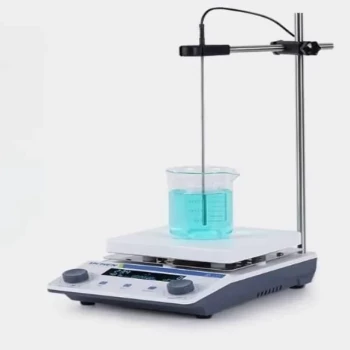
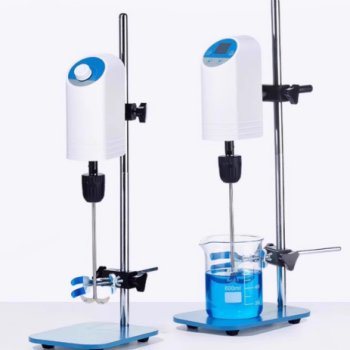
A magnetic stirrer acts as a critical catalyst for efficiency in the zinc ash leaching process by actively managing the physical interaction between the solid and liquid phases. By maintaining a controlled rotation speed, it ensures that zinc ash particles remain suspended and in constant contact with the sulfuric acid, rather than settling and stalling the reaction.
Core Takeaway The limiting factor in leaching is often not the chemical strength of the acid, but the physical ability of ions to move. A magnetic stirrer solves this by disrupting stagnant boundaries around particles, preventing local saturation and allowing the chemical extraction to proceed continuously and stably.
The Mechanics of Mass Transfer
Maximizing Solid-Liquid Contact
For sulfuric acid to effectively leach zinc, the acid molecules must physically touch the surface of the zinc ash particles. A magnetic stirrer creates a homogenous suspension, ensuring particles are distributed throughout the solution volume.
Without this agitation, solids would settle at the bottom of the container. This settling drastically reduces the available surface area for the reaction, leading to incomplete or inefficient extraction.
Facilitating Stable Ion Transfer
The primary goal of the process is the transfer of metal ions from the solid matrix into the liquid phase. Continuous stirring creates a stable hydrodynamic environment where this transfer can occur predictably.
By regulating the rotation speed, you ensure that the kinetic energy in the system is sufficient to keep reactants moving without introducing chaotic turbulence that might impede the process.
Overcoming Chemical Barriers
Breaking the Diffusion Layer
In any static solid-liquid reaction, a thin, stagnant film of liquid—known as the diffusion layer—forms around the solid particle. This layer acts as a barrier, slowing down the movement of fresh acid to the particle surface.
The magnetic stirrer generates shear forces that physically "break" or thin this diffusion layer. This reduces the distance reagents must travel, significantly speeding up the reaction rate.
Preventing Local Supersaturation
As zinc dissolves, the liquid immediately surrounding the particle becomes highly concentrated with metal ions. If left undisturbed, this creates a zone of local concentration supersaturation.
High local concentration inhibits further dissolving because the solution right next to the particle cannot hold more ions. Stirring constantly sweeps this saturated liquid away and replaces it with fresh sulfuric acid, maintaining a high driving force for the reaction.
Operational Considerations and Trade-offs
The Balance of Rotation Speed
While agitation is necessary, the speed of the magnetic stirrer must be carefully controlled. The goal is to achieve a state of "just-suspended" solids where all particles are in motion.
Potential Downsides of Improper Mixing
If the stirring is too slow, the diffusion layer remains thick, and the reaction creates a "halo" of saturation that slows efficiency. Conversely, excessive speed can cause vortexing, which may introduce air bubbles or cause splashing, though the primary reference emphasizes the value of controlled rotation for stability.
Optimizing Your Leaching Setup
To maximize the efficiency of your zinc ash recovery, focus on the interaction between agitation and dissolution kinetics.
- If your primary focus is Reaction Speed: Increase the stirring rate to the point where the diffusion layer is minimized, ensuring fresh acid constantly contacts the particle surface.
- If your primary focus is Process Stability: Maintain a consistent rotation speed that prevents particle settling but avoids turbulent splashing to ensure uniform ion transfer.
By treating agitation as a precise variable rather than a passive step, you transform the leaching process from a static soak into a dynamic, high-efficiency extraction system.
Summary Table:
| Factor | Impact on Leaching Efficiency | Role of Magnetic Stirrer |
|---|---|---|
| Mass Transfer | Critical for ion movement between phases | Creates homogenous suspension and prevents settling |
| Diffusion Layer | High resistance slows reaction rate | Applies shear force to thin the stagnant liquid film |
| Concentration | Local supersaturation halts dissolution | Sweeps away saturated liquid; replaces with fresh acid |
| Solid Contact | Surface area exposure dictates speed | Maintains particles in suspension for maximum contact |
| Kinetic Stability | Predictable reaction environment | Regulates rotation speed for stable ion transfer |
Maximize Your Leaching Extraction with KINTEK Precision
Efficiency in chemical extraction relies as much on high-quality agitation as it does on chemical reagents. At KINTEK, we specialize in providing researchers and industrial professionals with the robust laboratory equipment needed to optimize complex processes like zinc ash recovery.
Whether you require high-performance magnetic stirrers and shakers, specialized electrolytic cells, or durable PTFE and ceramic consumables, KINTEK offers a comprehensive portfolio designed for stability and precision. From crushing and milling systems to prepare your samples, to high-temperature reactors for advanced leaching, our solutions ensure you overcome diffusion barriers and achieve superior yields.
Ready to upgrade your laboratory setup? Contact us today to discover how KINTEK’s range of laboratory equipment and consumables can enhance your process efficiency and results.
References
- Grzegorz Włoch, Leszek Szatan. Preliminary Investigation on Leaching Behavior of Zinc ash. DOI: 10.24425/122406
This article is also based on technical information from Kintek Solution Knowledge Base .
Related Products
- Laboratory Small Constant Temperature Heated Magnetic Stirrer Heater and Stirrer
- Custom PTFE Teflon Parts Manufacturer for Magnetic Stirring Bar
- High Performance Laboratory Stirrers for Diverse Applications
- Three-dimensional electromagnetic sieving instrument
- Custom PTFE Teflon Parts Manufacturer for PTFE Stirring Bar Recovery Rod
People Also Ask
- What role does a magnetic stirrer with heating play in ZnO nanoparticle synthesis? Precision Control for Quality Results
- What role does a constant temperature heating magnetic stirrer play in MFC-HAp synthesis? Achieve Material Homogeneity
- What is the function of a laboratory magnetic stirrer in Ni–Cr–P electrodeposition? Optimize Ion Transport & Coating
- Why is a laboratory magnetic stirrer required for benzoic acid esters? Boost Reaction Speed & Yield with High RPM
- What role does a laboratory magnetic stirrer play in TiO2 and TiO2-Ag sol preparation? Master Chemical Kinetics