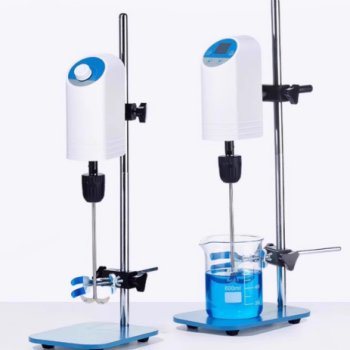
A precision stirred reactor regulates the polycondensation reaction between resorcinol and formaldehyde by maintaining constant thermal stability and continuous, uniform mixing. This precise control is the determining factor in creating a homogeneous organic gel network, which serves as the precursor to the final carbon aerogel.
By ensuring uniform mixing and stable temperatures, the reactor dictates the physical architecture of the gel. This control directly translates to the final aerogel's pore size distribution and density, ultimately determining its efficiency and energy density in high-performance applications like supercapacitors.
Mastering the Polycondensation Process
The production of carbon aerogels relies on a delicate chemical process called polycondensation. The precision stirred reactor acts as the central control unit for this reaction.
Achieving Chemical Uniformity
The reactor ensures the continuous and uniform dispersion of reagents throughout the solution.
Without this constant motion, the reaction between resorcinol and formaldehyde would occur unevenly. Precision stirring guarantees that the pH conditions remain consistent throughout the entire volume of the liquid, preventing localized variations that could compromise the material.
Thermal Stability and Reaction Rate
Temperature control is just as critical as mixing. The reactor provides constant temperature heating during the polymerization phase.
This thermal stability ensures that the reaction proceeds at a predictable rate. Fluctuations in heat can lead to structural inconsistencies, making the precision of the reactor essential for reproducible results.
Impact on Material Properties
The specific conditions maintained by the reactor do not just affect the chemistry; they define the physical properties of the final solid material.
Defining the Network Structure
The mixing uniformity and thermal stability directly shape the network structure of the organic gel.
This organic gel acts as a scaffold. If the network forms unevenly during the liquid phase, the final solid structure will be flawed. A precision reactor ensures a cohesive, uniform lattice is formed from the very beginning.
Pore Size and Density Control
The network structure established in the reactor determines the pore size distribution and density of the resulting carbon aerogel.
These properties are non-negotiable for performance. A uniform pore structure is required to maximize surface area, while density affects the mechanical strength and conductivity of the material.
The Trade-offs of Process Control
While precision reactors offer superior control, understanding the potential pitfalls of the process is vital for consistent production.
The Risk of Localized Reactions
If stirring intensity is uncontrolled or insufficient, localized rapid reactions can occur.
Similar to how poor mixing affects metal recovery processes, uneven mixing in aerogel production creates "hotspots." This leads to a heterogeneous product where some areas are dense and others are porous, ruining overall performance.
Balancing Mixing Intensity
There is a balance to be struck with stirring speed.
The goal is uniform dispersion, but aggressive over-mixing could potentially disrupt the delicate formation of the gel network as it begins to solidify. Precision allows you to find the exact intensity required for optimal nucleation without damaging the growing structure.
Making the Right Choice for Your Goal
The configuration of your stirred reactor should be dictated by the specific performance metrics you need from your carbon aerogels.
- If your primary focus is High Energy Density: Prioritize thermal stability to create a fine, highly consistent pore structure that maximizes surface area for charge storage.
- If your primary focus is Cycling Efficiency: Focus on mixing uniformity to ensure a homogeneous density that prevents physical degradation during repeated charge/discharge cycles.
Precision control in the liquid phase is the single most important factor in guaranteeing the structural integrity of the solid phase.
Summary Table:
| Process Parameter | Impact on Resorcinol-Formaldehyde Solution | Effect on Final Carbon Aerogel |
|---|---|---|
| Mixing Uniformity | Ensures consistent pH and reagent dispersion | Homogeneous lattice and uniform density |
| Thermal Stability | Regulates reaction rate and polymerization | Precise pore size distribution and surface area |
| Stirring Intensity | Prevents localized rapid reactions ("hotspots") | Structural integrity and consistent energy density |
| Nucleation Control | Balances chemical dispersion vs. gel formation | Optimized cycling efficiency in supercapacitors |
Elevate Your Material Science with KINTEK Precision Solutions
Unlock the full potential of your carbon aerogel research with KINTEK’s high-precision stirred reactors. Our advanced equipment provides the thermal stability and mixing uniformity essential for mastering complex polycondensation reactions.
Beyond reactors, KINTEK specializes in a comprehensive range of laboratory equipment including high-temperature furnaces (muffle, vacuum, CVD), crushing and milling systems, and high-pressure autoclaves designed for the most demanding research environments. Whether you are developing high-energy-density supercapacitors or specialized battery materials, we provide the tools and consumables—from PTFE products to electrolytic cells—to ensure reproducible, high-performance results.
Ready to optimize your lab’s efficiency and material performance? Contact our technical experts today to find the perfect solution for your specific application.
References
- Tsenka Grancharova, Plamen Zagorchev. Photothermal performance of bimetallic Ag-Fe nanoparticles obtained by green synthesis. DOI: 10.21175/rad.abstr.book.2023.30.4
This article is also based on technical information from Kintek Solution Knowledge Base .
Related Products
- High Performance Laboratory Stirrers for Diverse Applications
- Laboratory Micro Horizontal Jar Mill for Precision Sample Preparation in Research and Analysis
- Mini SS High Pressure Autoclave Reactor for Laboratory Use
- Laboratory Small Constant Temperature Heated Magnetic Stirrer Heater and Stirrer
- Customizable High Pressure Reactors for Advanced Scientific and Industrial Applications
People Also Ask
- How does a laboratory stirrer influence MOF product quality? Master Precision in Non-Solvothermal Synthesis
- What critical role does a Laboratory Stirrer play during leaching? Enhance Titanium-Magnesium Waste Recovery
- What is the primary function of laboratory stirring equipment in the preparation of compost leachate? Optimize Extraction
- What is a laboratory mixer? A Guide to Achieving Perfect Sample Homogeneity
- What is a laboratory mixer used for? Choose the Right Tool for Liquids or Solids