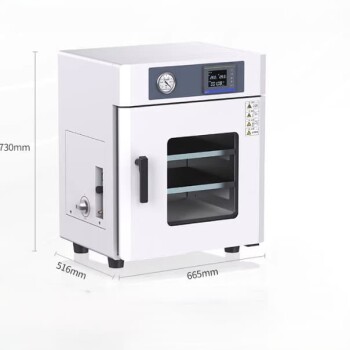
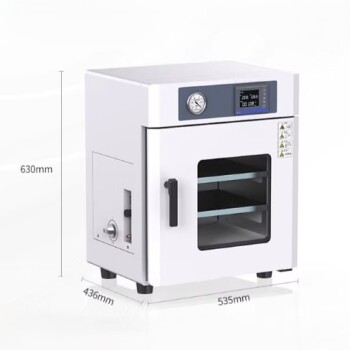
A vacuum drying oven optimizes the preparation of CuFe12O19 nanoparticles by creating a low-pressure environment that significantly lowers the boiling point of water and residual solvents. This allows moisture to be removed efficiently at controlled temperatures (typically around 100°C) without subjecting the delicate precursor material to the damage often caused by standard high-heat drying.
By lowering the evaporation temperature, vacuum drying acts as a safeguard for nanoparticle synthesis. It primarily prevents oxidation and minimizes physical agglomeration, ensuring the material retains its microscopic morphology and porous structure prior to high-temperature calcination.
Preserving Chemical Purity and Integrity
Prevention of Oxidation
The synthesis of magnetic nanoparticles like CuFe12O19 is sensitive to oxygen exposure, particularly during the drying phase when precursors are vulnerable. A vacuum oven removes air from the chamber, creating an oxygen-deficient environment.
This prevents the oxidation of the nanoparticles during the drying process. By avoiding unwanted chemical reactions with oxygen, the vacuum environment ensures the chemical composition of the precursor remains pure before the final calcination step.
Lowering Evaporation Thresholds
Standard drying methods require high temperatures to drive off solvents, which can degrade materials. A vacuum oven reduces the environmental pressure, allowing solvents like water or ethanol to evaporate rapidly at much lower temperatures.
For CuFe12O19 precipitates, this is typically done around 100°C. However, depending on the solvent, effective drying can occur at temperatures as low as 45°C, thoroughly removing moisture while shielding the material from thermal stress.
Enhancing Physical Microstructure
Reducing Physical Agglomeration
One of the most critical challenges in nanoparticle synthesis is preventing the particles from clumping together into large masses. Standard thermal drying often promotes this "caking" or agglomeration.
The vacuum drying process facilitates a gentler removal of solvents, which significantly reduces physical agglomeration. This keeps the particles distinct and prevents the collapse of the material's fine structure.
Maintaining Porous Morphology
To function effectively, magnetic nanoparticles often require a specific microscopic structure. Rapid, low-temperature evaporation helps maintain the microscopic morphology of the particles.
By preventing the collapse of the structure during drying, the process ensures that the porous structure of the particles is preserved. This maximization of surface area is essential for the material's final performance.
Understanding the Alternatives and Risks
The Risks of Standard Atmospheric Drying
It is important to understand why the vacuum method is preferred over standard atmospheric ovens. Without a vacuum, higher temperatures are required to remove the same amount of solvent.
Thermal Degradation and Surface Issues
High-temperature atmospheric drying increases the risk of thermal degradation. It can leads to the surface cross-linking of functional groups or the destruction of active sites, ultimately resulting in a catalyst or magnetic particle with lower performance and specific surface area.
Making the Right Choice for Your Goal
When preparing CuFe12O19 nanoparticles, the drying method is not merely a logistical step; it defines the quality of the final product.
- If your primary focus is Chemical Purity: Use vacuum drying to eliminate oxygen exposure, ensuring the magnetic metal oxides do not undergo unwanted oxidation phases before calcination.
- If your primary focus is Structural Performance: Rely on the vacuum environment to prevent agglomeration, thereby maintaining the high specific surface area and porous structure required for optimal reactivity.
The use of a vacuum drying oven is the definitive method for ensuring that the precursor material remains chemically pure and physically dispersed before final processing.
Summary Table:
| Feature | Vacuum Drying Benefit | Impact on CuFe12O19 Nanoparticles |
|---|---|---|
| Oxygen Levels | Oxygen-deficient environment | Prevents unwanted oxidation of magnetic precursors |
| Boiling Point | Lowered via pressure reduction | Enables efficient moisture removal at low temperatures (~100°C) |
| Particle State | Gentler solvent evaporation | Minimizes physical agglomeration and "caking" |
| Microstructure | Preservation of morphology | Maintains high specific surface area and porous structure |
| Thermal Stress | Low-temperature processing | Prevents thermal degradation and surface cross-linking |
Precision drying is the foundation of high-performance nanomaterials. KINTEK specializes in advanced laboratory solutions designed to elevate your research outcomes. From precision vacuum drying ovens and high-temperature furnaces (muffle, tube, CVD) to crushing and milling systems and isostatic presses, we provide the tools necessary to maintain chemical purity and structural integrity. Whether you are developing magnetic nanoparticles, battery materials, or advanced ceramics, our expertise in thermal processing and material preparation ensures your lab achieves maximum efficiency. Contact KINTEK today to find the perfect equipment for your synthesis workflow!
References
- Hajar Barkhor, Negin Nasseh. Construction of S-scheme CuFe12O19/CuS green nanocomposite for effective photocatalytic degradation of tetracycline from aqueous solution: mechanism, recyclability, and kinetic study. DOI: 10.1007/s13201-024-02346-5
This article is also based on technical information from Kintek Solution Knowledge Base .
Related Products
- 56L Vertical Laboratory Vacuum Drying Oven
- 23L Laboratory Vacuum Drying Oven
- Laboratory Scientific Electric Heating Blast Drying Oven
- Benchtop Laboratory Vacuum Freeze Dryer
- Dental Porcelain Zirconia Sintering Ceramic Vacuum Press Furnace
People Also Ask
- Why is a laboratory vacuum drying oven recommended for rice straw residues? Protect Your Biomass Integrity
- What role does a laboratory vacuum drying oven play in the preparation of modified multi-walled carbon nanotubes?
- What is the importance of using a laboratory vacuum drying oven? Preserving Slow-Release Microcapsule Integrity
- Why is a Laboratory Vacuum Drying Oven recommended for PBAT microspheres? Protect Sensitive Polymer Integrity
- What role does a laboratory vacuum drying oven play in processing nanoparticle powder samples? Protect Sample Integrity