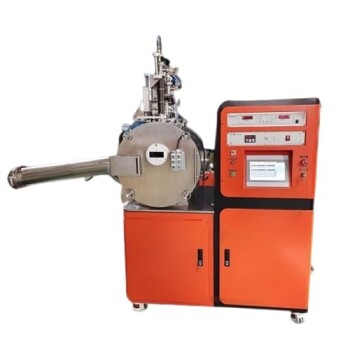
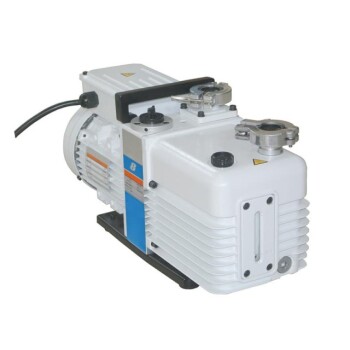
A vacuum reactor facilitates hydrophobic modification by creating a controlled environment that enables the precise grafting of hydrophobic agents, such as propyltrimethoxysilane, onto the surface of catalyst supports like mesoporous silica. This process fundamentally alters the chemical nature of the catalyst's pores, shifting them from a polar state to a non-polar state to optimize their interaction with reactants.
By reducing pore polarity, this modification prevents water and polar impurities from blocking active acid sites, effectively resolving catalyst deactivation issues and significantly extending the catalyst's operational life in biodiesel synthesis.
The Mechanism of Modification
Precise Grafting of Agents
The primary function of the vacuum reactor in this context is to facilitate the chemical attachment of hydrophobic agents.
The reactor allows for the introduction of agents like propyltrimethoxysilane under conditions that promote uniform distribution. This ensures that the grafting process covers the necessary surface area of the silica support.
Reducing Pore Polarity
The core objective of this treatment is to alter the polarity of the catalyst's internal structure.
Native mesoporous silica is typically polar. The vacuum reactor process successfully reduces this polarity, rendering the pore surfaces hydrophobic. This change is critical for controlling which substances can adhere to or enter the catalyst's active zones.
Solving the Deactivation Problem
Preventing Blockage by Impurities
In biodiesel production, the reaction environment often contains water and other polar impurities.
Without modification, these impurities are attracted to the polar pores of the silica. They tend to accumulate and physically block the pores, preventing the actual reactants from reaching the catalyst.
Protecting Active Acid Sites
The most critical components of the catalyst are its active acid sites, where the chemical conversion occurs.
By utilizing the vacuum reactor to make the surface hydrophobic, you create a barrier against polar substances. This ensures that active acid sites remain accessible to the biodiesel feedstock rather than being neutralized or covered by water.
Understanding the Operational Trade-offs
Process Complexity vs. Catalyst Longevity
While using a vacuum reactor enhances catalyst performance, it introduces higher complexity compared to standard atmospheric impregnation methods.
You must balance the need for specialized vacuum equipment against the benefit of extended catalyst life. The initial setup and energy requirements for vacuum processing are higher, but this is often justified by the reduction in downtime caused by catalyst deactivation.
Sensitivity to Grafting Uniformity
The effectiveness of this modification relies entirely on the uniformity of the grafting.
If the vacuum process is not controlled precisely, you may leave "patches" of unmodified, polar silica. These weak points can become accumulation sites for water, potentially undermining the stability of the entire catalyst batch over time.
Optimizing Your Biodiesel Production Strategy
To determine if this modification method aligns with your production goals, consider the following:
- If your primary focus is extending catalyst cycle life: Prioritize vacuum reactor modification to maximize the time between catalyst replacements by protecting acid sites from water deactivation.
- If your primary focus is feedstock flexibility: Use this hydrophobic modification to handle lower-quality feedstocks that may contain higher moisture levels or polar impurities.
The vacuum reactor is not just a vessel for mixing; it is a precision tool for engineering the surface chemistry required for durable, high-efficiency biodiesel catalysis.
Summary Table:
| Feature | Impact on Catalyst Support | Benefit for Biodiesel Production |
|---|---|---|
| Vacuum Environment | Enables precise grafting of hydrophobic agents | Ensures uniform surface modification |
| Polarity Reduction | Shifts pore state from polar to non-polar | Repels water and polar impurities |
| Surface Engineering | Protects active acid sites from blockage | Extends catalyst operational life |
| Controlled Grafting | Uniform distribution of silane agents | Prevents localized catalyst deactivation |
Revolutionize Your Catalyst Performance with KINTEK
Don't let water deactivation stall your biodiesel production. KINTEK specializes in advanced laboratory solutions, offering high-performance vacuum reactors and autoclaves designed for precise chemical grafting and surface engineering.
Our comprehensive range includes:
- High-Temperature & High-Pressure Reactors: Perfect for complex hydrophobic modifications.
- Crushing, Milling & Sieving Systems: For uniform support preparation.
- Essential Consumables: Premium ceramics and PTFE products to ensure process purity.
Whether you are refining mesoporous silica or developing next-generation catalysts, our experts are here to provide the tools you need for superior material durability.
Ready to extend your catalyst life? Contact KINTEK Today
References
- J. C. Nnaji. ADVANCES IN BIODIESEL SYNTHESIS: THE ROLE OF VARIOUS CATALYSTS. DOI: 10.52417/ojes.v1i1.83
This article is also based on technical information from Kintek Solution Knowledge Base .
Related Products
- Electric Heated Hydraulic Vacuum Heat Press for Lab
- 56L Vertical Laboratory Vacuum Drying Oven
- Vacuum Cold Mounting Machine for Sample Preparation
- Vacuum Arc Induction Melting Furnace
- 23L Laboratory Vacuum Drying Oven
People Also Ask
- How does a laboratory vacuum hot press influence the microstructure of AlFeTiCrZnCu high-entropy alloys? Guide to VHP
- How does the high-temperature and high-pressure environment provided by vacuum hot press equipment improve the interfacial bonding between Mo fibers and the TiAl matrix?
- What roles do graphite molds play in (WC + B4C)p/6063Al composite fabrication? Enhancing Densification & Precision
- What are the process advantages of using a vacuum hot press vs. HIP? Simplify your steel preparation workflow.
- What are the advantages of using a vacuum hot press for ZnS ceramics? Efficiency and Optical Performance Explored