Knowledge laboratory mill How does a vibration mixing mill optimize composite cathode preparation? Achieve Superior Interface Density
Author avatar

Tech Team · Kintek Solution

Updated 11 hours ago

How does a vibration mixing mill optimize composite cathode preparation? Achieve Superior Interface Density


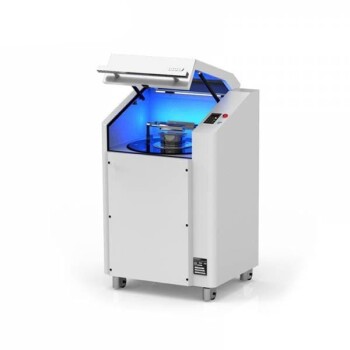
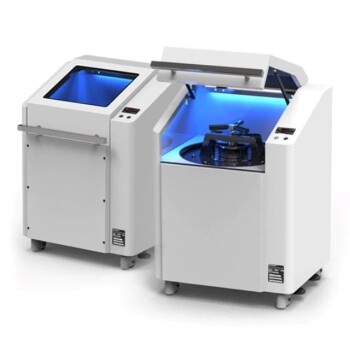
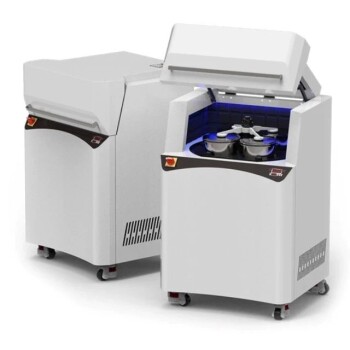
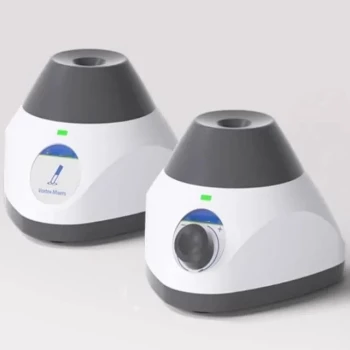
A vibration mixing mill optimizes composite cathode preparation by utilizing high-frequency mechanical energy to disperse materials with distinct physical properties. Unlike conventional mixing, which may struggle with differing textures, this method leverages vibration to prevent soft materials from clumping. This ensures flexible solid electrolytes evenly coat rigid active materials, resulting in a uniform and structurally sound composite.

Core Takeaway: The primary advantage of vibration mixing is its ability to overcome the mechanical mismatch between hard active particles and soft electrolytes. By preventing the flexible electrolyte from agglomerating, the mill forces it to fill microscopic voids, creating the dense, continuous interface required for efficient ion transport.

Overcoming Mechanical Disparity

The Rigid vs. Flexible Conflict

Composite cathodes are complex mixtures requiring the integration of rigid active materials with flexible solid electrolytes and conductive agents.

These materials have vastly different mechanical behaviors, making them difficult to blend using standard low-energy mixing methods.

Without the right energy input, flexible electrolytes tend to stick to themselves rather than dispersing among the harder particles.

Preventing Agglomeration via Vibration

The vibration mixing mill addresses this by applying high-frequency vibrations to the powder mixture.

This rapid, oscillating motion creates a fluidized state within the mixing vessel.

By keeping the particles in constant, energetic motion, the process physically prevents the flexible electrolyte particles from agglomeration (clumping together).

Optimizing the Microstructure

Filling Inter-Particle Voids

Once agglomeration is neutralized, the electrolyte is free to move into the correct positions.

The vibration forces the flexible electrolyte to settle into and fill the empty spaces between the rigid active material particles.

This creates a dense packing arrangement that minimizes porosity within the cathode structure.

Creating an Effective Interface

The ultimate goal of this process is to establish a dense ion-conducting interface.

By uniformly distributing the electrolyte, the mill ensures maximum contact surface area between the active material and the ion conductor.

This connectivity is essential for the battery's electrochemical performance, allowing ions to move freely through the cathode.

Understanding the Trade-offs

Managing Energy and Heat

While high-frequency vibration is effective, it imparts significant kinetic energy into the materials.

This energy can convert to heat, which may be detrimental if the solid electrolyte is sensitive to temperature changes.

Process parameters must be carefully tuned to prevent thermal degradation during the mixing phase.

material Integrity Risks

There is a fine line between optimal dispersion and over-processing.

If the vibration intensity or duration is excessive, there is a risk of mechanically damaging the rigid active materials or altering their morphology.

Operators must balance the need for a dense interface with the preservation of the individual particle structures.

Making the Right Choice for Your Goal

To maximize the benefits of a vibration mixing mill for your specific cathode composition, consider the following:

  • If your primary focus is Ion Conductivity: Prioritize processing times that ensure the electrolyte completely fills the interstitial voids to create a continuous pathway.
  • If your primary focus is Material Stability: Monitor the vibration frequency to prevent excessive heat buildup that could degrade the flexible electrolyte.

Effective cathode preparation relies not just on mixing, but on the strategic management of mechanical forces to unite disparate materials.

Summary Table:

Feature Impact on Composite Cathode Preparation
High-Frequency Vibration Creates a fluidized state to prevent soft electrolyte agglomeration.
Mechanical Integration Forces flexible electrolytes into microscopic voids between rigid particles.
Interface Optimization Maximizes contact surface area for enhanced ion transport pathways.
Energy Management Precision control over frequency prevents thermal degradation of sensitive materials.
Structural Integrity Balances dispersive energy with the preservation of active material morphology.

Elevate Your Battery Research with KINTEK Precision Equipment

Achieving the perfect ion-conducting interface requires more than just mixing—it requires precise mechanical control. KINTEK specializes in advanced laboratory solutions designed to handle the toughest material disparities. From our high-energy crushing and milling systems to precision hydraulic presses and high-temperature furnaces, we provide the tools necessary to optimize your composite cathode workflows.

Whether you are focusing on solid-state battery research, electrode development, or material synthesis, our comprehensive portfolio—including PTFE products, ceramics, and specialized electrolytic cells—is engineered to meet the rigorous demands of modern energy storage R&D.

Ready to optimize your material blending and enhance electrochemical performance?

Contact KINTEK Today for Expert Solutions

Related Products

People Also Ask

Related Products

High Energy Planetary Ball Mill Milling Machine for Laboratory

High Energy Planetary Ball Mill Milling Machine for Laboratory

The biggest feature is that the high energy planetary ball mill can not only perform fast and effective grinding, but also has good crushing ability

Laboratory Ten-Body Horizontal Jar Mill for Lab Use

Laboratory Ten-Body Horizontal Jar Mill for Lab Use

The Ten-body horizontal jar mill is for 10 ball mill pots (3000ml or less). It has frequency conversion control, rubber roller movement, and PE protective cover.

Laboratory Vibratory Sieve Shaker Machine Slap Vibrating Sieve

Laboratory Vibratory Sieve Shaker Machine Slap Vibrating Sieve

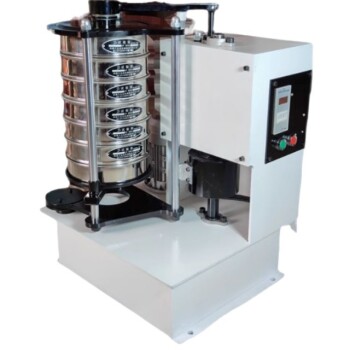
KT-T200TAP is a slapping and oscillating sieving instrument for laboratory desktop use, with 300 rpm horizontal circular motion and 300 vertical slapping motions to simulate manual sieving to help sample particles pass through better.

Laboratory Vibratory Sieve Shaker Machine for Dry and Wet Three-Dimensional Sieving

Laboratory Vibratory Sieve Shaker Machine for Dry and Wet Three-Dimensional Sieving

KT-VD200 can be used for sieving tasks of dry and wet samples in the laboratory. The screening quality is 20g-3kg. The product is designed with a unique mechanical structure and an electromagnetic vibrating body with a vibration frequency of 3000 times per minute.

Vibratory Sieve Shaker Machine Dry Three-Dimensional Vibrating Sieve

Vibratory Sieve Shaker Machine Dry Three-Dimensional Vibrating Sieve

The KT-V200 product focuses on solving common sieving tasks in the laboratory. It is suitable for sieving 20g-3kg dry samples.

Laboratory Test Sieves and Vibratory Sieve Shaker Machine

Laboratory Test Sieves and Vibratory Sieve Shaker Machine

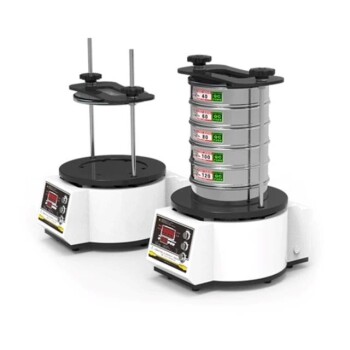
Efficiently process powders, granules, and small blocks with a high-frequency vibration sieve. Control vibration frequency, screen continuously or intermittently, and achieve accurate particle size determination, separation, and classification.

Powerful Plastic Crusher Machine

Powerful Plastic Crusher Machine

KINTEK's powerful plastic crusher machines process 60-1350 KG/H of diverse plastics, ideal for labs and recycling. Durable, efficient, and customizable.

Small Lab Rubber Calendering Machine

Small Lab Rubber Calendering Machine

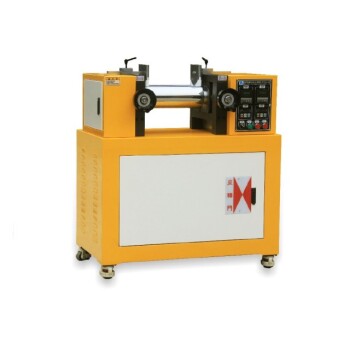
Small lab rubber calendering machine is used for producing thin, continuous sheets of plastic or rubber materials. It is commonly employed in laboratories, small-scale production facilities, and prototyping environments to create films, coatings, and laminates with precise thickness and surface finish.

Single Punch Electric Tablet Press Machine Laboratory Powder Tablet Punching TDP Tablet Press

Single Punch Electric Tablet Press Machine Laboratory Powder Tablet Punching TDP Tablet Press

The single-punch electric tablet press is a laboratory-scale tablet press suitable for corporate laboratories in pharmaceutical, chemical, food, metallurgical and other industries.

Rubber Vulcanizer Vulcanizing Machine Plate Vulcanizing Press for Lab

Rubber Vulcanizer Vulcanizing Machine Plate Vulcanizing Press for Lab

The Plate vulcanizing press is a kind of equipment used in the production of rubber products, mainly used for the vulcanization of rubber products. Vulcanization is a key step in rubber processing.

Lab Internal Rubber Mixer Rubber Kneader Machine for Mixing and Kneading

Lab Internal Rubber Mixer Rubber Kneader Machine for Mixing and Kneading

Lab internal rubber mixer is suitable for mixing, kneading and dispersing various chemical raw materials such as plastics, rubber, synthetic rubber, hot melt adhesive and various low-viscosity materials.

Electric Split Lab Cold Isostatic Press CIP Machine for Cold Isostatic Pressing

Electric Split Lab Cold Isostatic Press CIP Machine for Cold Isostatic Pressing

Split cold isostatic presses are capable of providing higher pressures, making them suitable for testing applications that require high pressure levels.

Metallographic Specimen Mounting Machine for Laboratory Materials and Analysis

Metallographic Specimen Mounting Machine for Laboratory Materials and Analysis

Precision metallographic mounting machines for labs—automated, versatile, and efficient. Ideal for sample prep in research and quality control. Contact KINTEK today!

Single Punch Electric Tablet Press Machine TDP Tablet Punching Machine

Single Punch Electric Tablet Press Machine TDP Tablet Punching Machine

The electric tablet punching machine is a laboratory equipment designed for pressing various granular and powdery raw materials into discs and other geometric shapes. It is commonly used in pharmaceutical, healthcare products, food, and other industries for small batch production and processing. The machine is compact, lightweight, and easy to operate, making it suitable for use in clinics, schools, laboratories, and research units.

Heated Hydraulic Press Machine with Integrated Manual Heated Plates for Lab Use

Heated Hydraulic Press Machine with Integrated Manual Heated Plates for Lab Use

Efficiently process heat-pressing samples with our Integrated Manual Heated Lab Press. With a heating range up to 500°C, it's perfect for various industries.

Small Injection Molding Machine for Lab Use

Small Injection Molding Machine for Lab Use

The small injection molding machinehas fast and stable movements; good controllability and repeatability, super energy saving; the product can be automatically dropped and formed; the machine body is low, convenient for feeding, easy to maintain, and no height restrictions on the installation site.

Lab Plastic PVC Calender Stretch Film Casting Machine for Film Testing

Lab Plastic PVC Calender Stretch Film Casting Machine for Film Testing

The cast film machine is designed for the molding of polymer cast film products and has multiple processing functions such as casting, extrusion, stretching, and compounding.

Single Punch Tablet Press Machine and Mass Production Rotary Tablet Punching Machine for TDP

Single Punch Tablet Press Machine and Mass Production Rotary Tablet Punching Machine for TDP

Rotary tablet punching machine is an automatic rotating and continuous tableting machine. It is mainly used for tablet manufacturing in the pharmaceutical industry, and is also suitable for industrial sectors such as food, chemicals, batteries, electronics, ceramics, etc. to compress granular raw materials into tablets.

Automatic Heated Hydraulic Press Machine with Heated Plates for Laboratory Hot Press 25T 30T 50T

Automatic Heated Hydraulic Press Machine with Heated Plates for Laboratory Hot Press 25T 30T 50T

Efficiently prepare your samples with our Automatic Heated Lab Press. With a pressure range up to 50T and precise control, it's perfect for various industries.

Laboratory Sterilizer Lab Autoclave Herbal Powder Sterilization Machine for Plant

Laboratory Sterilizer Lab Autoclave Herbal Powder Sterilization Machine for Plant

The herbal powder sterilization autoclave machine for Chinese medicine uses saturated steam for effective sterilization. It utilizes the heat and penetrative properties of steam, achieves sterilization after heat preservation, and maintains a good drying effect with a dedicated drying system.


Leave Your Message