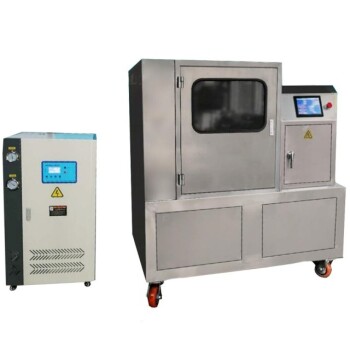
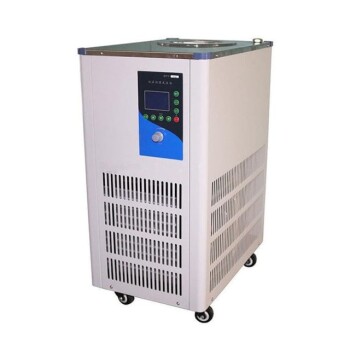
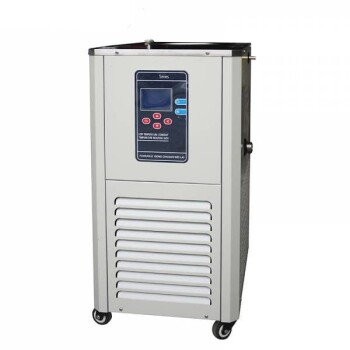
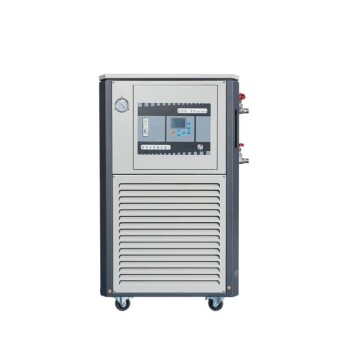
A water-cooled stainless steel reactor ensures the quality of nanopowders by acting as a strictly controlled thermal chamber that manages the extreme conditions of RF plasma synthesis. By utilizing a circulating water system to actively cool the reactor walls, the system controls the thermal gradient within the reaction zone. This precise temperature regulation dictates the nucleation process, resulting in chemically stable nanoparticles with a uniform size distribution of 10–15 nm.
The reactor’s cooling system is not merely a safety feature; it is a critical process variable. By defining the thermal gradient, the water-cooled walls force nanoparticles to nucleate and grow within a specific size range while preserving their chemical integrity.
Establishing a Controlled Reaction Environment
To achieve high-quality synthesis, the reactor must isolate the process from external variables.
The Closed System Advantage
The stainless steel construction provides a sealed, closed environment. This isolation is essential for preventing external atmospheric contaminants from interfering with the sensitive plasma reaction.
Preserving Chemical Stability
By maintaining a closed loop, the reactor ensures the chemical composition of the synthesized material—such as Tungsten Carbide (W2C) and carbon nanopowders—remains stable. The environment prevents oxidation or impurities that would degrade the material's properties.
Managing Extreme Thermal Loads
Radio frequency plasma generates temperatures high enough to melt standard reactor materials without active intervention.
The Circulating Water Mechanism
The core of the reactor's design is its circulating water cooling system. This system continuously flows water through the reactor walls (or a jacket) to extract heat.
Withstanding Plasma Heat
This active heat removal allows the stainless steel walls to withstand the extreme heat loads generated by the plasma. Without this cooling, the reactor integrity would fail, potentially contaminating the nanopowders with wall material.
Direct Control Over Particle Size
The quality of a nanopowder is largely defined by the uniformity of its particle size. This is directly controlled by how the reactor manages heat.
Regulating the Thermal Gradient
The cooling system does more than protect the walls; it establishes a specific thermal gradient from the plasma core to the reactor periphery. This gradient controls how quickly the vaporized materials cool down.
Controlling Nucleation and Growth
The rate of cooling determines how particles nucleate (form) and grow. By stabilizing the wall temperature, the reactor ensures a consistent cooling rate for the reactants.
Achieving Uniform Distribution
This controlled environment restricts particle growth to a precise range. The reference data confirms that this method yields a uniform particle size distribution specifically between 10–15 nm.
Understanding Operational Trade-offs
While a water-cooled reactor offers superior control, it introduces specific complexities that must be managed.
Dependence on Active Systems
The system relies entirely on the continuous circulation of water. A failure in the pump or a blockage in the flow can lead to rapid overheating and potential reactor failure.
Thermal Gradient Sensitivity
While the gradient controls particle size, it is sensitive to fluctuations in coolant temperature or flow rate. Inconsistent cooling can lead to variations in the particle size distribution, pushing it outside the desired 10–15 nm range.
Optimizing Synthesis Outcomes
To ensure the highest quality nanopowders, you must align your operational parameters with the reactor's capabilities.
- If your primary focus is particle size uniformity: Ensure the water circulation rate is constant to maintain a stable thermal gradient, which locks the particle size to the 10–15 nm range.
- If your primary focus is chemical purity: Prioritize the integrity of the stainless steel vessel's seals to maintain the closed environment required for composition stability.
Mastering the thermal gradient through active water cooling is the key to transforming raw plasma energy into precise, high-performance nanomaterials.
Summary Table:
| Feature | Function in RF Plasma Synthesis | Impact on Nanopowder Quality |
|---|---|---|
| Water Cooling System | Regulates thermal gradients and protects reactor walls | Ensures uniform particle size (10–15 nm) |
| Stainless Steel Build | Provides a sealed, closed-loop reaction environment | Prevents contamination and preserves chemical stability |
| Thermal Management | Controls nucleation and particle growth rates | Eliminates overheating and ensures size distribution |
| Sealing Integrity | Isolates process from atmospheric variables | Guarantees high purity for materials like Tungsten Carbide |
Elevate Your Nanomaterial Synthesis with KINTEK Precision
Unlock the full potential of your research with KINTEK’s advanced laboratory solutions. Whether you are synthesizing high-purity nanopowders or conducting complex chemical reactions, our high-temperature high-pressure reactors and autoclaves provide the precise thermal control and atmospheric integrity your work demands.
From high-temperature furnaces (muffle, vacuum, CVD) to specialized electrolytic cells and battery research tools, KINTEK specializes in providing the robust equipment and consumables necessary for cutting-edge material science. Let our experts help you optimize your synthesis outcomes and achieve consistent, high-performance results.
Ready to upgrade your lab’s capabilities? Contact KINTEK Today to Consult with Our Specialists
References
- Jānis Grabis, Dzintra Ārija Rašmane. Formation of High Temperature Compounds in W-C-B System by Reactive Spark Plasma Sintering. DOI: 10.5755/j01.ms.21.3.7352
This article is also based on technical information from Kintek Solution Knowledge Base .
Related Products
- Custom PTFE Teflon Parts Manufacturer for Hydrothermal Synthesis Reactor Polytetrafluoroethylene Carbon Paper and Carbon Cloth Nano-growth
- High Pressure Laboratory Autoclave Reactor for Hydrothermal Synthesis
- Stainless High Pressure Autoclave Reactor Laboratory Pressure Reactor
- Customizable Laboratory High Temperature High Pressure Reactors for Diverse Scientific Applications
- Mini SS High Pressure Autoclave Reactor for Laboratory Use
People Also Ask
- What is the function of a PTFE reactor in MXene etching? Ensure Safe, High-Purity MAX Phase Conversion
- Why is a PTFE reactor required for titanium-based nano-ceramic coating solutions? Ensure Chemical Inertness & Purity
- Why must a Polytetrafluoroethylene (PTFE) reactor be used for Ti3C2TX MXene etching? Ensure Safety and Purity
- Why are PTFE reactors preferred for silver phosphate glass testing? Ensure Purity and Kinetic Accuracy
- What are the advantages of using polytetrafluoroethylene (PTFE) liners in hydrothermal synthesis reactors? High Purity