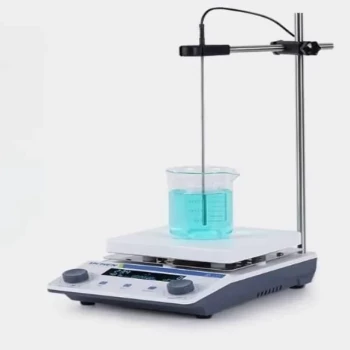
An electric magnetic stirrer acts as the fundamental driver for converting solid potassium hydroxide (KOH) and methanol into a usable potassium methoxide catalyst. By utilizing continuous magnetic stirring, the device ensures that the solid KOH is completely dissolved and that the necessary pre-reaction is finalized. This preparation creates a solution rich in highly active catalytic ions before it ever interacts with the corn oil, directly increasing the kinetic rate of the subsequent transesterification.
The magnetic stirrer transforms raw ingredients into a potent catalyst by ensuring total dissolution and ion generation. This pre-reaction step is essential for maximizing the kinetic rate of corn oil transesterification.
The Mechanics of Catalyst Preparation
Achieving Complete Dissolution
The primary function of the electric magnetic stirrer is to manage the physical state change of the catalyst components. Potassium hydroxide (KOH) begins as a solid, which must be fully integrated into the liquid methanol.
The stirrer provides continuous agitation, preventing the solid particles from settling. This ensures the KOH is completely dissolved, creating a uniform liquid mixture essential for consistent chemical results.
Facilitating the Pre-Reaction
Beyond simple mixing, the stirrer facilitates a critical chemical "pre-reaction." The interaction between KOH and methanol must reach a point of completion to form potassium methoxide effectively.
By maintaining constant motion, the device ensures that the reagents interact thoroughly. This guarantees that the pre-reaction is finished completely, rather than partially, establishing a stable chemical foundation for the next stage.
Impact on Reaction Kinetics
Generating Active Ions
The ultimate goal of this stirring process is the generation of specific chemical agents. The thorough mixing produces highly active catalytic ions.
These ions are the "engine" of the transesterification process. By generating them in high concentrations prior to introducing the oil, the stirrer primes the solution for immediate chemical activity.
Accelerating Transesterification
Because the catalyst is pre-activated, the reaction with corn oil does not suffer from a "warm-up" period where solids are still dissolving.
The presence of fully dissolved, active ions leads to an increase in the kinetic rate of the transesterification process. This means the conversion of corn oil happens faster and more efficiently once the catalyst solution is added.
Operational Dependencies and Risks
The Necessity of Time and Motion
While the electric magnetic stirrer is effective, its success relies on the duration and continuity of the stirring process.
If the stirring is interrupted or stopped too early, the solid KOH may not fully dissolve. This leads to an incomplete pre-reaction, resulting in fewer active ions and a significantly slower reaction rate when the oil is added.
Process Isolation
It is critical to note that this stirring occurs in isolation before the corn oil is involved.
The efficiency gains are derived from separating the catalyst preparation from the main reaction. Attempting to mix solids, methanol, and oil simultaneously would bypass this critical ion-generation phase, negating the kinetic benefits.
Optimizing Your Catalyst Preparation
To ensure you are getting the most out of your electric magnetic stirrer, consider your specific production goals:
- If your primary focus is reaction speed: Ensure the stirring duration is sufficient to reach full dissolution, as this maximizes the count of active ions available to attack the corn oil immediately.
- If your primary focus is chemical consistency: Verify that the pre-reaction is finished visibly (no solids remaining) before adding the solution to the oil, ensuring every batch has the same catalytic potential.
The electric magnetic stirrer is not just a mixer; it is a kinetic accelerator that dictates the efficiency of the entire fuel conversion process.
Summary Table:
| Feature | Role in Catalyst Preparation | Impact on Transesterification |
|---|---|---|
| Continuous Agitation | Ensures complete dissolution of solid KOH in methanol | Uniform catalyst distribution |
| Pre-reaction Facilitation | Completes the formation of potassium methoxide | Eliminates reaction 'warm-up' period |
| Ion Generation | Produces highly active catalytic ions | Maximizes kinetic reaction rate |
| Process Isolation | Separates catalyst prep from oil mixing | Prevents incomplete chemical conversion |
Elevate Your Chemical Synthesis with KINTEK Precision
Optimize your laboratory workflows with KINTEK’s high-performance magnetic stirrers and homogenizers. Whether you are preparing catalysts for transesterification or conducting complex battery research, our equipment ensures the chemical consistency and kinetic efficiency your projects demand.
Our laboratory solutions include:
- Stirring & Mixing: Advanced magnetic stirrers, homogenizers, and shakers.
- Thermal Processing: Muffle, tube, and vacuum furnaces for high-temperature applications.
- Pressure & Reaction: High-temperature high-pressure reactors and autoclaves.
- Specialized Tools: Electrolytic cells, hydraulic presses, and precision ceramics.
Ready to achieve superior reaction kinetics? Contact KINTEK today to find the perfect equipment and consumables for your lab!
References
- Noureddin El Boulifi, José Aracil. Process Optimization for Biodiesel Production from Corn Oil and Its Oxidative Stability. DOI: 10.1155/2010/518070
This article is also based on technical information from Kintek Solution Knowledge Base .
Related Products
- Laboratory Small Constant Temperature Heated Magnetic Stirrer Heater and Stirrer
- Three-dimensional electromagnetic sieving instrument
- Custom PTFE Teflon Parts Manufacturer for Magnetic Stirring Bar
- High Performance Laboratory Stirrers for Diverse Applications
- Custom PTFE Teflon Parts Manufacturer for PTFE Stirring Bar Recovery Rod
People Also Ask
- What role does a magnetic stirrer with heating play in ZnO nanoparticle synthesis? Precision Control for Quality Results
- What role does a constant temperature heating magnetic stirrer play in MFC-HAp synthesis? Achieve Material Homogeneity
- What is the function of a laboratory magnetic stirrer in Ni–Cr–P electrodeposition? Optimize Ion Transport & Coating
- Why is a laboratory magnetic stirrer required for benzoic acid esters? Boost Reaction Speed & Yield with High RPM
- What role does a laboratory magnetic stirrer play in TiO2 and TiO2-Ag sol preparation? Master Chemical Kinetics