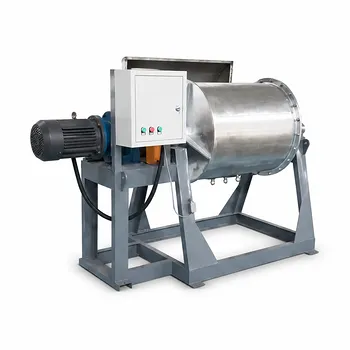
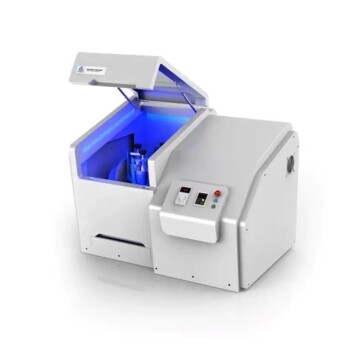
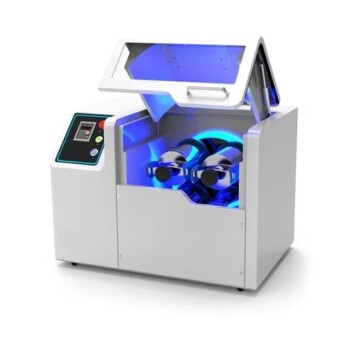
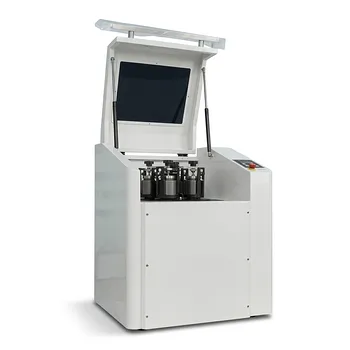
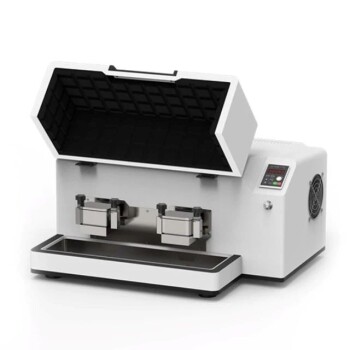
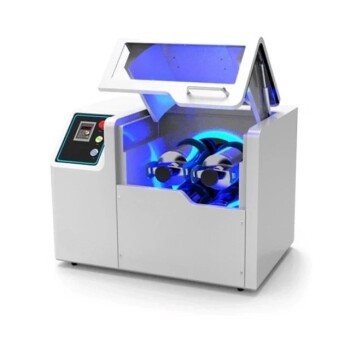
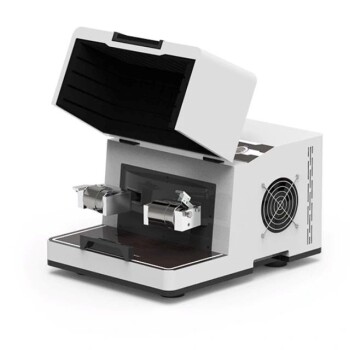
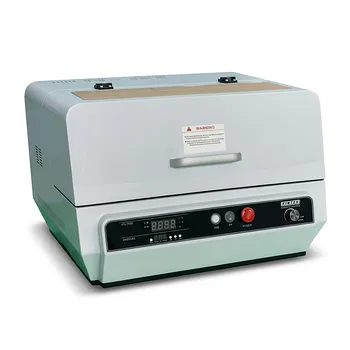
Ball milling equipment serves as the primary driver of mechanochemical synthesis by delivering intense mechanical energy to coarse precursors through high-frequency impacts and shear forces. In solvent-free or solvent-deficient environments, this equipment physically breaks down lattice energy and induces chemical reactions, replacing the need for thermal energy or liquid solvents traditionally used to initiate synthesis.
Core Takeaway Ball milling does not merely grind materials down; it induces a controlled amorphization process that fundamentally alters the material's chemical potential. by modifying the density and accessibility of active sites, this technique enables the crystallization of specific zeolite structures (like MFI and BEA) at significantly lower temperatures than conventional methods.
The Mechanics of Energy Transfer
Generating High-Impact Forces
High-energy ball mills, particularly planetary ball mills, generate a complex physical environment. By rotating grinding jars around a central axis while simultaneously spinning them in the opposite direction on their own axis, the equipment creates intense centrifugal forces.
Shear Forces and Friction
These centrifugal forces drive the grinding media to produce high-frequency impacts against the precursors. Beyond simple impact, the motion generates strong shear forces and friction. This mechanical stress effectively breaks down solid particles and induces the rupture and reorganization of chemical bonds within the material.
Driving Structural Transformation
Controlled Amorphization
The primary reference highlights that the energy input from ball milling induces controlled amorphization. This is not random destruction; it is a deliberate transition that prepares the precursor materials for recrystallization into complex structures.
Altering Active Sites
This process directly influences the type, density, and accessibility of active sites. By physically altering the particle size and crystal aggregation state, the equipment exposes new surfaces and creates a more reactive precursor conducive to forming specific zeolite frameworks.
Breaking Lattice Energy
As seen in analogous solid-phase reactions (such as with ZIF-8), the mechanical energy is sufficient to break the lattice energy of solid precursors. This triggers solid-phase reactions without the need for liquid grinding aids, significantly improving the biosafety of the process by eliminating toxic organic solvents.
Critical Process Variables
Regulating Rotation Speed
The intensity of the mechanochemical reaction is directly controlled by the rotation speed of the grinding jars. Higher speeds equate to higher kinetic energy, which accelerates the breakdown of precursors but must be balanced to avoid excessive structural damage.
Grinding Media Selection
The size of the grinding balls determines the nature of the energy transfer. Larger balls generally provide higher impact energy for fracturing, while smaller balls offer more friction points for fine grinding and mixing.
Processing Time
The duration of the milling process governs the extent of the reaction. Precise control over processing time is required to achieve the specific level of amorphization needed for the target zeolite structure.
Understanding the Trade-offs
The Risk of Over-Processing
While high-energy impacts are necessary to induce reactivity, there is a risk of excessive fragmentation. If the mechanical energy is applied too aggressively or for too long, it can lead to the total collapse of the desired crystalline potential rather than the intended partial structural change.
Energy Management
The process relies on a delicate balance. You are substituting thermal energy with mechanical energy. While this allows for lower subsequent heating temperatures during crystallization, the mechanical input itself requires significant energy to maintain the high-speed rotation and impact forces.
Making the Right Choice for Your Goal
To effectively utilize ball milling for zeolite synthesis, you must align the equipment parameters with your specific chemical objectives.
- If your primary focus is Process Efficiency: Prioritize the reduction of subsequent heating requirements by ensuring the milling stage achieves sufficient amorphization of the precursors.
- If your primary focus is Environmental Safety: Leverage the solvent-deficient capabilities of the equipment to eliminate toxic organic solvents and improve the biosafety of your synthesis line.
- If your primary focus is Structural Specificity: Finely tune the rotation speed and ball size to control the density of active sites, enabling the formation of complex structures like MFI and BEA.
Mastering the variable of mechanical energy allows you to dictate the architecture of the zeolite at the molecular level.
Summary Table:
| Factor | Influence on Zeolite Synthesis | Mechanical Mechanism |
|---|---|---|
| Rotation Speed | Controls reaction intensity & kinetic energy | High-frequency impacts |
| Grinding Media | Determines impact energy vs. friction | Size-dependent fracturing |
| Milling Time | Regulates level of amorphization | Cumulative energy transfer |
| Shear Forces | Breaks lattice energy and chemical bonds | Friction-induced reaction |
| Amorphization | Modifies density/accessibility of active sites | Structural reorganization |
Revolutionize Your Material Synthesis with KINTEK Precision
Unlock the full potential of mechanochemical synthesis with KINTEK’s advanced laboratory solutions. Whether you are aiming for high-efficiency zeolite production or solvent-free chemical reactions, our industry-leading planetary ball mills, crushing and milling systems, and high-pressure reactors provide the precise energy control required for molecular-level architecture.
From high-temperature furnaces and vacuum systems to essential consumables like crucibles and PTFE products, KINTEK empowers researchers and manufacturers to achieve superior structural specificity and environmental safety. Ready to optimize your lab’s performance? Contact us today to find the perfect equipment for your application!
References
- Natalia Kordala, Mirosław Wyszkowski. Zeolite Properties, Methods of Synthesis, and Selected Applications. DOI: 10.3390/molecules29051069
This article is also based on technical information from Kintek Solution Knowledge Base .
Related Products
- Mini Planetary Ball Mill Machine for Laboratory Milling
- High-Energy Omnidirectional Planetary Ball Mill Milling Machine for Laboratory
- Stainless Steel Laboratory Ball Mill for Dry Powder and Liquid with Ceramic Polyurethane Lining
- Laboratory Horizontal Planetary Ball Mill Milling Machine
- High-Energy Omnidirectional Planetary Ball Mill Machine for Laboratory
People Also Ask
- How does a laboratory ball mill ensure the mixing quality of Mn3Zn0.8Sn0.2N and Ti? Achieve Perfect Homogeneity
- Why is a laboratory ball mill required for ultra-fine fly ash? Unlock Nano-Scale Adsorption Power
- Why is a laboratory ball mill used in Co-Ni catalyst research? Optimize CO2 Conversion with Precise Milling
- What is the function of a laboratory ball mill in the pretreatment of waste tire char (WTC)? Optimize Material Reactivity
- What is the primary function of a laboratory ball mill in the modification of sulfide-based solid electrolytes with LiPO2F2?