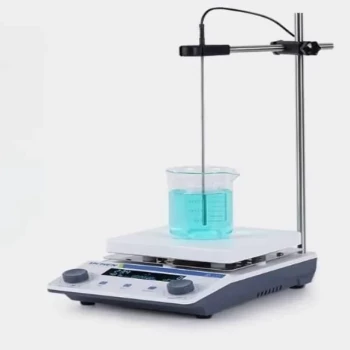
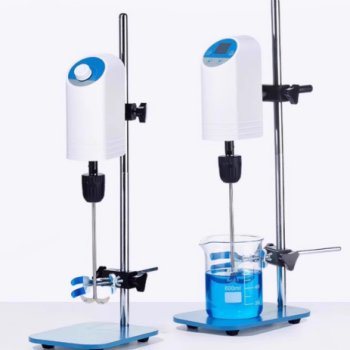
Magnetic stirring is the fundamental process used to guarantee the uniformity of solid polymer electrolyte membranes during the preparation stage. It acts as the primary mechanical force that drives the complete dissolution and dispersion of high-molecular-weight polymers, such as PEO, and lithium salts within solvents like acetonitrile. This continuous agitation creates a homogeneous viscous solution, which is the prerequisite for casting a membrane with consistent physical and electrochemical properties.
The ultimate goal of magnetic stirring is to prevent component segregation before the film is formed. By creating a perfectly mixed viscous baseline, you ensure the final solid electrolyte exhibits uniform ionic conductivity and mechanical strength across its entire surface area.
The Mechanics of Solution Homogeneity
Dissolving High-Molecular-Weight Polymers
Polymers like PEO (polyethylene oxide) consist of long molecular chains that can be difficult to dissolve evenly.
Magnetic stirring provides the constant motion required to untangle these chains and integrate them fully into the solvent. Without this active dispersion, polymer clusters may remain, leading to structural inconsistencies in the final membrane.
Dispersing Lithium Salts
For an electrolyte to function, lithium ions must be free to move through the polymer matrix.
Stirring ensures that lithium salts are distributed atomically and evenly throughout the mixture. This prevents the formation of "salt pockets" or areas with low ion concentration, which would otherwise compromise the material's conductivity.
Preventing Component Segregation
Stabilizing the Viscous Solution
As the polymer dissolves, the solution becomes increasingly viscous.
Continuous stirring maintains this viscosity at a uniform level throughout the container. This prevents the heavier or denser components from settling at the bottom, maintaining a single-phase mixture ready for the casting process.
Ensuring Uniform Film Formation
The quality of the final solid film is determined by the state of the liquid solution immediately prior to casting.
By preventing segregation during the liquid phase, stirring ensures that when the solvent evaporates, the remaining solid structure is uniform. This results in a membrane where ionic conductivity and mechanical properties are identical at every point on the surface.
Common Pitfalls to Avoid
The Risk of Incomplete Dissolution
If the stirring duration or intensity is insufficient, the polymer matrix may not fully integrate with the solvent.
This leads to a heterogeneous solution where undissolved solids exist. In the final product, this manifests as mechanical weak points or grains that can lead to membrane failure under stress.
Consequences of Segregation
Stopping the agitation process too early allows components to separate based on density.
If the solution segregates before film-forming, the resulting membrane will have variable performance zones. Some areas may conduct ions efficiently, while others act as insulators, rendering the electrolyte ineffective for practical applications.
Making the Right Choice for Your Goal
To maximize the performance of your solid polymer electrolyte, align your preparation protocol with your specific performance targets:
- If your primary focus is Ionic Conductivity: Prioritize the complete dispersion of lithium salts to ensure there are no "dead zones" in the membrane that impede ion flow.
- If your primary focus is Mechanical Strength: Focus on the thorough dissolution of the high-molecular-weight polymer (PEO) to create a robust, continuous structural matrix without granular defects.
Consistently uniform stirring is the single most effective variable for transforming raw chemical ingredients into a reliable, high-performance electrolyte membrane.
Summary Table:
| Key Stirring Objective | Benefit to Electrolyte Membrane | Impact of Poor Stirring |
|---|---|---|
| Polymer Dissolution | Creates a robust, continuous structural matrix | Results in mechanical weak points and grains |
| Salt Dispersion | Ensures consistent ionic conductivity throughout | Creates salt pockets and low-ion zones |
| Viscosity Stabilization | Prevents component segregation/settling | Causes variable performance zones in the film |
| Phase Control | Maintains a single-phase mixture for casting | Leads to structural inconsistencies and failure |
Elevate Your Material Research with KINTEK Precision
Achieving the perfect viscous baseline for your solid polymer electrolytes requires reliable, high-performance equipment. KINTEK specializes in advanced laboratory solutions designed for rigorous research, including high-precision magnetic stirrers, high-temperature furnaces, and specialized battery research tools.
Whether you are focusing on maximizing ionic conductivity or enhancing mechanical strength, our comprehensive range of crushing and milling systems, vacuum furnaces, and PTFE consumables ensures your preparation phase is flawless.
Ready to optimize your lab's efficiency and product uniformity? Contact us today to discover how KINTEK’s expert-grade equipment can transform your chemical processing and material synthesis.
Related Products
- Laboratory Small Constant Temperature Heated Magnetic Stirrer Heater and Stirrer
- Custom PTFE Teflon Parts Manufacturer for Magnetic Stirring Bar
- High Performance Laboratory Stirrers for Diverse Applications
- Three-dimensional electromagnetic sieving instrument
- Custom PTFE Teflon Parts Manufacturer for PTFE Stirring Bar Recovery Rod
People Also Ask
- What role does a magnetic stirrer with heating play in ZnO nanoparticle synthesis? Precision Control for Quality Results
- What role does a constant temperature heating magnetic stirrer play in MFC-HAp synthesis? Achieve Material Homogeneity
- What is the function of a laboratory magnetic stirrer in Ni–Cr–P electrodeposition? Optimize Ion Transport & Coating
- Why is a laboratory magnetic stirrer required for benzoic acid esters? Boost Reaction Speed & Yield with High RPM
- What role does a laboratory magnetic stirrer play in TiO2 and TiO2-Ag sol preparation? Master Chemical Kinetics