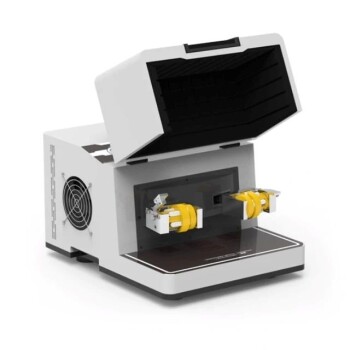
The multi-stage grinding process serves as the critical mechanism for structural and chemical refinement in solid-state synthesis. By subjecting the material to continuous mechanical force, this method systematically breaks down particle agglomerates and ensures that dopants, such as vanadium pentoxide, are thoroughly dispersed within the host precursor.
The core value of multi-stage grinding lies in its ability to alternate mechanical refinement with thermal treatment. This cycle prevents particle clustering and facilitates a homogenous distribution of active elements, resulting in nanopowders with consistent particle sizes and uniform optical or electronic properties.
The Mechanics of Particle Refinement
Breaking Down Agglomerates
In solid-state synthesis, precursor materials naturally tend to cluster together. Multi-stage grinding applies continuous mechanical force to physically shatter these agglomerates.
By reducing these clusters early in the process, you prevent the formation of large, chemically uneven particles in the final product.
Achieving High Dispersion of Dopants
For functional materials, the introduction of dopants (like vanadium pentoxide) is essential. Grinding ensures these dopants are not just sitting on the surface but are highly dispersed throughout the host matrix.
This mixing prevents "hot spots" where dopant concentration is too high, or "dead zones" where it is too low.
Alternating with Heat Treatments
The process is rarely just about grinding; it involves distinct stages often alternated with heat treatments.
Heat induces the necessary chemical reactions, while subsequent grinding steps refine the resulting product, correcting any coarsening that occurred during calcination.
Impact on Final Material Quality
Uniform Particle Size Distribution
A single grinding step often leaves a wide variance in particle sizes. Multi-stage processing narrows this range, producing a uniform particle size distribution.
This uniformity is vital for applications requiring consistent packing density or predictable surface area.
Consistent Dopant Concentration
The quality of a nanopowder is defined by its chemical homogeneity. Multi-stage grinding ensures a consistent dopant concentration across the entire batch.
This guarantees that every gram of the powder exhibits the same physical properties.
Optimized Luminescent Centers
In optical applications, the arrangement of the atomic structure dictates performance. This method facilitates a well-distributed arrangement of luminescent centers.
Proper distribution ensures efficient energy transfer and maximized brightness in the final application.
Understanding the Trade-offs
Process Efficiency vs. Quality
While multi-stage grinding produces superior quality, it significantly increases total processing time. You are trading speed and throughput for necessary precision and uniformity.
Risk of Contamination
Every time you introduce mechanical force via grinding media, there is a potential risk of introducing impurities from the grinding tools. Purity protocols become more critical as the number of grinding stages increases.
Making the Right Choice for Your Goal
To determine if a multi-stage grinding protocol is necessary for your specific synthesis, consider your performance requirements.
- If your primary focus is optical or electronic performance: Prioritize multi-stage grinding to ensure the uniform distribution of luminescent centers and dopants.
- If your primary focus is particle morphology: Use this method to break down agglomerates and achieve a tight, uniform particle size distribution.
The difference between a functional laboratory curiosity and a viable commercial nanopowder often comes down to the rigor of your grinding strategy.
Summary Table:
| Feature | Single-Stage Grinding | Multi-Stage Grinding |
|---|---|---|
| Particle Size | Wide distribution; potential clusters | Uniform distribution; refined size |
| Dopant Dispersion | Non-uniform; possible 'hot spots' | Highly homogenous throughout matrix |
| Chemical Purity | Higher (less tool exposure) | Requires strict purity protocols |
| Core Benefit | Fast throughput | Superior optical & electronic properties |
| Process Flow | Direct processing | Alternates with thermal treatments |
Elevate Your Material Synthesis with KINTEK Precision
Achieving the perfect nanopowder requires more than just a formula—it demands the right mechanical refinement. KINTEK specializes in high-performance laboratory equipment designed for rigorous solid-state synthesis. From advanced crushing and milling systems and sieving equipment to ensure uniform particle size, to high-temperature furnaces for critical thermal cycles, we provide the tools necessary to optimize your luminescent centers and dopant distribution.
Whether you are refining battery research materials or developing functional ceramics, our comprehensive range—including high-pressure reactors, PTFE products, and hydraulic pellet presses—is engineered to meet the highest standards of precision and durability.
Ready to transform your laboratory efficiency and material quality? Contact our experts today to find the perfect solution for your research goals.
References
- Pravesh Kumar, R.V.S.S.N. Ravikumar. Synthesis and spectral characterizations of VO2+ ions-doped CaZn2(PO4)2 nanophosphor. DOI: 10.1007/s42452-019-0903-8
This article is also based on technical information from Kintek Solution Knowledge Base .
Related Products
- lab cryogenic grinding use liquid-nitrogen for pulverizing plastic raw materials and heat sensitive materials
- Laboratory Hybrid Tissue Grinding Mill
People Also Ask
- What are the advantages of using a cryogenic grinder? Achieve Nanoscale Precision for All-Solid-State Battery Cathodes
- Why is a cryogenic grinder required for cured alkyd resin HRMAS NMR? Ensure Structural Integrity & Sample Precision
- What is the role of a cryogenic grinder in PET recycling? Transform Waste into High-Reactive Micron Powders
- What is cool grinding technology? Unlock Efficient Milling for Heat-Sensitive Materials
- What are cryogenic ground spices? Unlock Maximum Flavor with Advanced Grinding Technology