Knowledge How is biomass converted into biofuels? Unlock the Path from Plant Matter to Renewable Fuel
Author avatar

Tech Team · Kintek Solution

Updated 5 days ago

How is biomass converted into biofuels? Unlock the Path from Plant Matter to Renewable Fuel


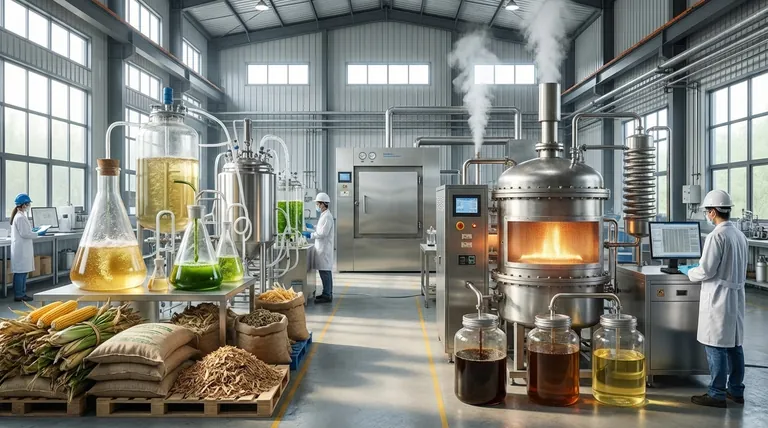
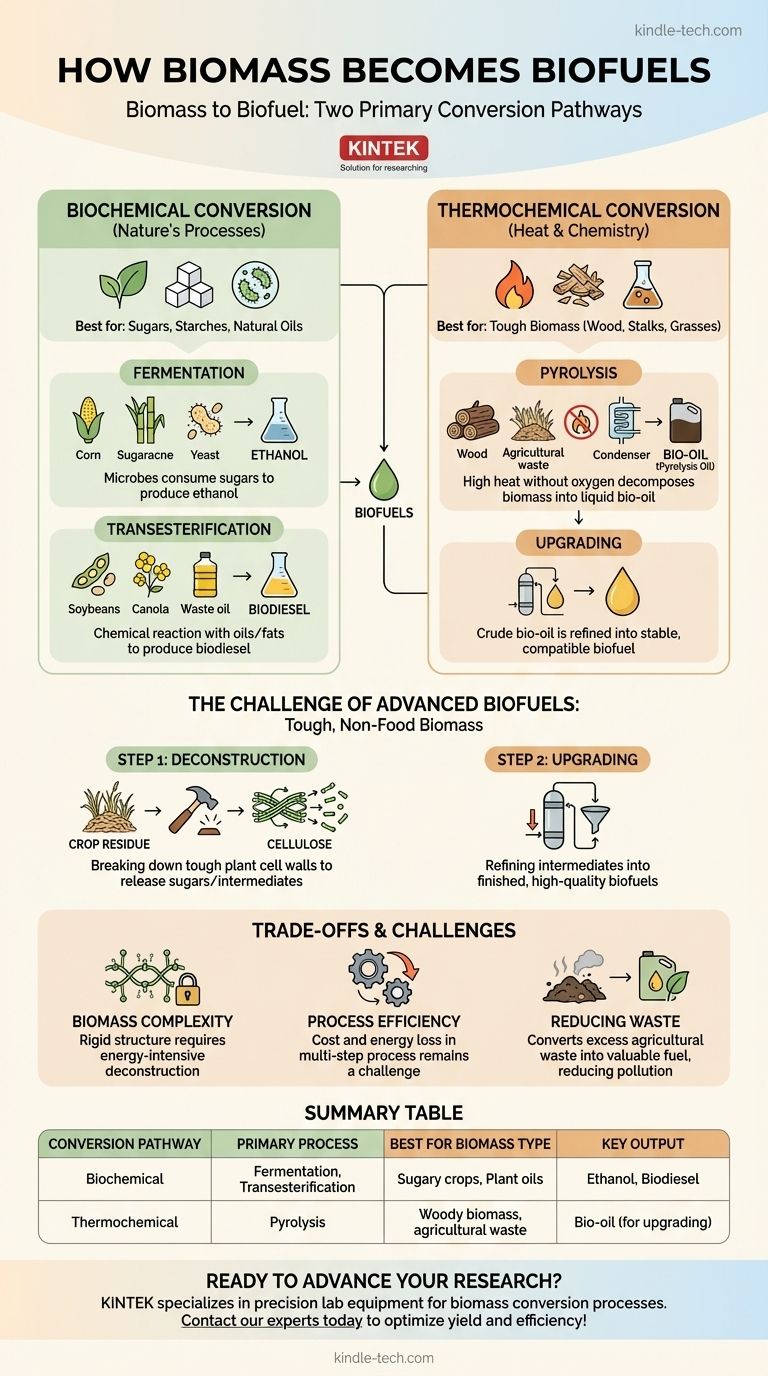
To convert biomass into biofuels, two primary pathways are used: biochemical and thermochemical. Biochemical methods, like fermentation, use microorganisms to break down plant sugars into fuels like ethanol. Thermochemical methods, like pyrolysis, use heat in the absence of oxygen to decompose biomass into a liquid known as bio-oil.

The core principle is that no single conversion method fits all types of biomass. The right process—whether it's biological fermentation or heat-based pyrolysis—is determined by the chemical makeup of the starting material and the desired final fuel.
How is biomass converted into biofuels? Unlock the Path from Plant Matter to Renewable Fuel

The Two Primary Conversion Pathways

Understanding how biomass becomes fuel requires separating the methods into two distinct categories. One leverages biology, while the other leverages heat and chemistry.

Biochemical Conversion: Using Nature's Processes

This pathway uses enzymes and microorganisms to do the conversion work. It is most effective for biomass that is rich in sugars, starches, or natural oils.

The most common biochemical process is fermentation. In this method, microbes (like yeast) consume simple sugars from crops like corn or sugarcane and produce ethanol as a byproduct.

Another key process is transesterification. This chemical reaction is used to produce biodiesel from oils and fats found in sources like soybeans, canola, or even waste vegetable oil.

Thermochemical Conversion: Using Heat and Chemistry

This pathway uses high temperatures and chemical catalysts to break down the entire structure of the biomass, making it suitable for tougher materials like wood, agricultural stalks, or grasses.

The primary thermochemical process is pyrolysis. Biomass is heated rapidly to high temperatures in an oxygen-free environment. Instead of burning, it decomposes into a mix of gases, which are then rapidly cooled and condensed into a liquid bio-oil, also called pyrolysis oil.

This bio-oil is a dense, crude intermediate that can be further processed or "upgraded" to produce more refined fuels.

The Challenge of Advanced Biofuels

Converting simple sugars or plant oils is relatively straightforward. The real challenge, and the focus of advanced biofuel production, lies in using tough, non-food biomass like crop residue or wood.

Step 1: Deconstruction

This material is primarily composed of cellulose, a rigid plant fiber that is difficult to break down. The first step, deconstruction, uses heat, chemicals, or enzymes to dismantle these tough plant cell walls.

The goal of deconstruction is to release the valuable sugars and other chemical intermediates locked inside the plant fiber.

Step 2: Upgrading

Once deconstructed, the resulting intermediates—whether they are crude bio-oils from pyrolysis or sugars from cellulosic breakdown—are not yet finished fuels.

They must be upgraded. This is a refining stage where impurities are removed and the chemical structure of the liquid is altered to create a stable, high-quality biofuel compatible with existing engines.

Understanding the Trade-offs and Challenges

The primary goal of biofuel conversion is to transform bulky, inconvenient solid biomass into a dense, easily transportable liquid fuel. However, the process is not without its difficulties.

Biomass Complexity

The main obstacle is the rigid structure of plant biomass. While starch from a corn kernel is easy for microbes to access, the cellulose in a corn stalk is chemically locked away, requiring the energy-intensive deconstruction step.

Process Efficiency

Each conversion step, from deconstruction to upgrading, has an associated cost and potential for energy loss. Achieving an affordable and efficient multi-step process for advanced biofuels remains a significant engineering challenge.

Reducing Waste

A key driver for this technology is solving environmental problems, such as the pollution caused by burning excess agricultural waste. Converting this waste into fuel provides a valuable alternative to open-field burning.

Matching the Process to the Goal

Choosing the correct conversion technology depends entirely on your starting material and your desired end product.

  • If your primary focus is converting sugary or starchy crops (like corn or sugarcane): Biochemical fermentation is the most direct and established pathway to produce ethanol.
  • If your primary focus is converting plant oils or waste grease: Biochemical transesterification is the standard industrial process for creating biodiesel.
  • If your primary focus is converting tough, non-food biomass (wood, switchgrass, or agricultural stalks): A thermochemical process like pyrolysis or a multi-step deconstruction-and-upgrading approach is necessary.

Ultimately, mastering these conversion technologies is essential for turning abundant, low-value biomass into a valuable source of renewable energy.

Summary Table:

Conversion Pathway Primary Process Best For Biomass Type Key Output
Biochemical Fermentation, Transesterification Sugary crops (corn), plant oils Ethanol, Biodiesel
Thermochemical Pyrolysis Woody biomass, agricultural waste Bio-oil (for upgrading)

Ready to advance your biofuel research or production? KINTEK specializes in precision lab equipment and consumables essential for biomass conversion processes, from pyrolysis reactors to fermentation monitoring systems. Our solutions help you optimize yield and efficiency. Contact our experts today to find the right tools for your laboratory's needs!

Visual Guide
How is biomass converted into biofuels? Unlock the Path from Plant Matter to Renewable Fuel Visual Guide

Related Products

People Also Ask

Related Products

Laboratory Sterilizer Lab Autoclave Herbal Powder Sterilization Machine for Plant

Laboratory Sterilizer Lab Autoclave Herbal Powder Sterilization Machine for Plant

The herbal powder sterilization autoclave machine for Chinese medicine uses saturated steam for effective sterilization. It utilizes the heat and penetrative properties of steam, achieves sterilization after heat preservation, and maintains a good drying effect with a dedicated drying system.

Inclined Rotary Plasma Enhanced Chemical Vapor Deposition PECVD Equipment Tube Furnace Machine

Inclined Rotary Plasma Enhanced Chemical Vapor Deposition PECVD Equipment Tube Furnace Machine

Introducing our inclined rotary PECVD furnace for precise thin film deposition. Enjoy automatic matching source, PID programmable temperature control, and high accuracy MFC mass flowmeter control. Built-in safety features for peace of mind.

Laboratory Test Sieves and Vibratory Sieve Shaker Machine

Laboratory Test Sieves and Vibratory Sieve Shaker Machine

Efficiently process powders, granules, and small blocks with a high-frequency vibration sieve. Control vibration frequency, screen continuously or intermittently, and achieve accurate particle size determination, separation, and classification.

Single Punch Electric Tablet Press Machine Laboratory Powder Tablet Punching TDP Tablet Press

Single Punch Electric Tablet Press Machine Laboratory Powder Tablet Punching TDP Tablet Press

The single-punch electric tablet press is a laboratory-scale tablet press suitable for corporate laboratories in pharmaceutical, chemical, food, metallurgical and other industries.

Liquid Nitrogen Cryogenic Grinder Mill Cryomill Airflow Ultrafine Pulverizer

Liquid Nitrogen Cryogenic Grinder Mill Cryomill Airflow Ultrafine Pulverizer

Discover the Liquid Nitrogen Cryogenic Grinding Machine, perfect for lab use, ultra-fine pulverization, and preserving material properties. Ideal for pharmaceuticals, cosmetics, and more.

Laboratory Vibratory Sieve Shaker Machine for Dry and Wet Three-Dimensional Sieving

Laboratory Vibratory Sieve Shaker Machine for Dry and Wet Three-Dimensional Sieving

KT-VD200 can be used for sieving tasks of dry and wet samples in the laboratory. The screening quality is 20g-3kg. The product is designed with a unique mechanical structure and an electromagnetic vibrating body with a vibration frequency of 3000 times per minute.

Single Punch Manual Tablet Press Machine TDP Tablet Punching Machine

Single Punch Manual Tablet Press Machine TDP Tablet Punching Machine

Single punch manual tablet punching machine can press various granular, crystal or powdery raw materials with good fluidity into disc-shaped, cylindrical, spherical, convex, concave and other various geometric shapes (such as square, triangle, ellipse, capsule shape, etc.), and can also press products with text and patterns.

Desktop Fast Laboratory Autoclave Sterilizer 35L 50L 90L for Lab Use

Desktop Fast Laboratory Autoclave Sterilizer 35L 50L 90L for Lab Use

The desktop fast steam sterilizer is a compact and reliable device used for rapid sterilization of medical, pharmaceutical, and research items. It efficiently sterilizes surgical instruments, glassware, medicines, and resistant materials, making it suitable for various applications.

Lab Blown Film Extrusion Three Layer Co-Extrusion Film Blowing Machine

Lab Blown Film Extrusion Three Layer Co-Extrusion Film Blowing Machine

Lab blown film extrusion is mainly used to detect the feasibility of film blowing of polymer materials and the colloid condition in the materials, as well as the dispersion of colored dispersions, controlled mixtures, and extrudates;

Touchscreen Automatic Vacuum Heat Press

Touchscreen Automatic Vacuum Heat Press

Precision vacuum heat press for labs: 800°C, 5-ton pressure, 0.1MPa vacuum. Ideal for composites, solar cells, aerospace.

Lab Plastic PVC Calender Stretch Film Casting Machine for Film Testing

Lab Plastic PVC Calender Stretch Film Casting Machine for Film Testing

The cast film machine is designed for the molding of polymer cast film products and has multiple processing functions such as casting, extrusion, stretching, and compounding.

Vibratory Sieve Shaker Machine Dry Three-Dimensional Vibrating Sieve

Vibratory Sieve Shaker Machine Dry Three-Dimensional Vibrating Sieve

The KT-V200 product focuses on solving common sieving tasks in the laboratory. It is suitable for sieving 20g-3kg dry samples.

Single Punch Electric Tablet Press Machine TDP Tablet Punching Machine

Single Punch Electric Tablet Press Machine TDP Tablet Punching Machine

The electric tablet punching machine is a laboratory equipment designed for pressing various granular and powdery raw materials into discs and other geometric shapes. It is commonly used in pharmaceutical, healthcare products, food, and other industries for small batch production and processing. The machine is compact, lightweight, and easy to operate, making it suitable for use in clinics, schools, laboratories, and research units.

Small Injection Molding Machine for Lab Use

Small Injection Molding Machine for Lab Use

The small injection molding machinehas fast and stable movements; good controllability and repeatability, super energy saving; the product can be automatically dropped and formed; the machine body is low, convenient for feeding, easy to maintain, and no height restrictions on the installation site.

Single Punch Tablet Press Machine and Mass Production Rotary Tablet Punching Machine for TDP

Single Punch Tablet Press Machine and Mass Production Rotary Tablet Punching Machine for TDP

Rotary tablet punching machine is an automatic rotating and continuous tableting machine. It is mainly used for tablet manufacturing in the pharmaceutical industry, and is also suitable for industrial sectors such as food, chemicals, batteries, electronics, ceramics, etc. to compress granular raw materials into tablets.

High Energy Planetary Ball Mill Machine for Laboratory Horizontal Tank Type

High Energy Planetary Ball Mill Machine for Laboratory Horizontal Tank Type

The KT-P2000H uses a unique Y-axis planetary trajectory, and utilizes the collision, friction and gravity between the sample and the grinding ball.

Powerful Plastic Crusher Machine

Powerful Plastic Crusher Machine

KINTEK's powerful plastic crusher machines process 60-1350 KG/H of diverse plastics, ideal for labs and recycling. Durable, efficient, and customizable.

Double Plate Heating Press Mold for Lab

Double Plate Heating Press Mold for Lab

Discover precision in heating with our Double Plate Heating Mold, featuring high-quality steel and uniform temperature control for efficient lab processes. Ideal for various thermal applications.

Automatic Heated Hydraulic Press Machine with Heated Plates for Laboratory Hot Press 25T 30T 50T

Automatic Heated Hydraulic Press Machine with Heated Plates for Laboratory Hot Press 25T 30T 50T

Efficiently prepare your samples with our Automatic Heated Lab Press. With a pressure range up to 50T and precise control, it's perfect for various industries.

Mini Planetary Ball Mill Machine for Laboratory Milling

Mini Planetary Ball Mill Machine for Laboratory Milling

Discover the KT-P400 desktop planetary ball mill, ideal for grinding and mixing small samples in the lab. Enjoy stable performance, long service life, and practicality. Functions include timing and overload protection.


Leave Your Message