
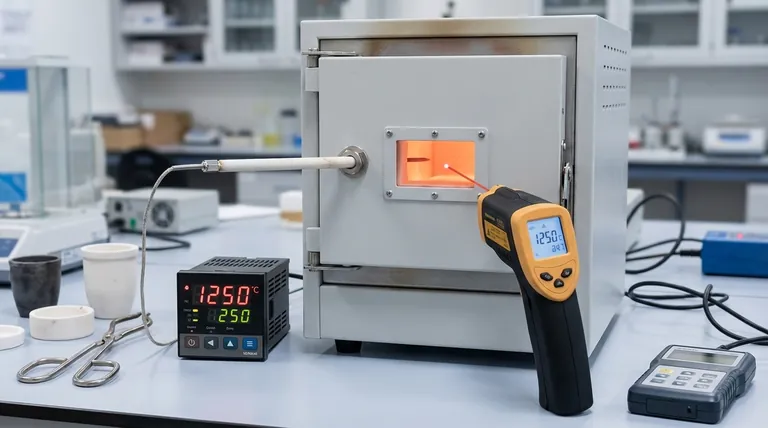
In practice, furnace temperature is measured using two primary methods: contact-based sensors like thermocouples that are physically immersed in the environment, and non-contact sensors like pyrometers that measure thermal radiation from a distance. The choice between them is dictated by the furnace's maximum temperature, its internal atmosphere, and the specific material or process being monitored.
The core challenge of measuring furnace temperature isn't just finding a tool that can survive the heat. It's about selecting a measurement strategy that provides consistent, accurate data despite extreme conditions, ensuring process control, product quality, and operational safety.
Contact-Based Measurement: The Thermocouple
A thermocouple is the most common device for direct temperature measurement in many industrial and laboratory furnaces. It is a robust and well-understood technology.
How Thermocouples Work
A thermocouple operates on the Seebeck effect. It consists of two wires made from different metals joined at one end, called the measuring junction. When this junction is heated, it generates a tiny voltage that is directly proportional to the temperature difference between it and the other end of the wires. This voltage is then read by a controller and converted into a temperature reading.
Common Thermocouple Types for Furnaces
Not all thermocouples are the same. They are designated by letters, with noble metal types being essential for high-temperature furnace applications.
- Type K (Chromel-Alumel): A general-purpose, inexpensive option suitable for temperatures up to about 1250°C (2282°F).
- Type S, R, and B (Platinum-Rhodium): These "noble metal" thermocouples are the standard for high-temperature and high-accuracy applications. Type S and R are used up to ~1450°C (2642°F), while Type B can measure up to 1700°C (3092°F).
The Importance of Protection Sheaths
To survive inside a furnace, the thermocouple wires are housed within a protective ceramic or metal sheath. This sheath shields the sensor from chemical corrosion, physical damage, and contamination from the furnace atmosphere, which can degrade the wires and cause inaccurate readings.
Non-Contact Measurement: The Pyrometer
When temperatures are too high for thermocouples or when physical contact is impossible, a pyrometer is the necessary tool. It measures temperature from a safe distance.
The Principle of Pyrometry
A pyrometer, also known as an infrared or radiation thermometer, works like a camera for heat. All objects above absolute zero emit thermal radiation. A pyrometer has an optical system that focuses this radiation onto a detector, which converts the energy into an electrical signal that corresponds to the object's surface temperature.
The Critical Role of Emissivity
Emissivity is a measure of a material's ability to emit thermal radiation, on a scale from 0 to 1. A perfect blackbody has an emissivity of 1.0, while a shiny, reflective surface might have a value of 0.1. To get an accurate reading, the pyrometer must be set to the correct emissivity value for the specific material being measured. An incorrect setting is the most common source of error in pyrometry.
Types of Pyrometers
There are two main categories of pyrometers used for furnaces:
- Single-Color (or Brightness) Pyrometers: These measure the intensity of radiation at a single wavelength. They are simple and effective but can be fooled by dust, steam, or smoke that partially obscures the view.
- Ratio (or Two-Color) Pyrometers: These measure radiation intensity at two different wavelengths and calculate temperature based on the ratio of the two signals. This makes them far more resistant to errors caused by dust, steam, or a dirty viewing window, as these obstructions tend to affect both wavelengths equally.
Understanding the Trade-offs
Choosing the right sensor involves balancing accuracy, durability, and cost against the specific demands of your furnace application.
Contact vs. Non-Contact
The fundamental choice is between direct immersion and remote sensing. A thermocouple measures the temperature of its immediate surroundings (e.g., the furnace air), while a pyrometer measures the surface temperature of the object or furnace wall it is aimed at. These can be two very different temperatures.
Accuracy vs. Durability
Thermocouples can provide highly accurate point measurements, but the sensor itself degrades over time due to high temperatures and chemical exposure, requiring periodic replacement. Pyrometers do not degrade from heat exposure, but their accuracy is entirely dependent on a clear line of sight and the correct emissivity setting.
Environmental Challenges
Furnace atmospheres can be a significant challenge. Corrosive gases can destroy thermocouple sheaths and wires. For pyrometers, heavy smoke or flames can completely block the sensor's view, rendering it useless unless a ratio pyrometer can "see" through the interference.
Making the Right Choice for Your Application
Your goal determines the best measurement strategy.
- If your primary focus is precise control in a stable, clean atmosphere below 1400°C: A Type S or R thermocouple is the industry standard for its reliability and accuracy.
- If your primary focus is measuring extremely high temperatures (above 1700°C) or moving objects: A non-contact pyrometer is your only viable option.
- If your primary focus is measurement in a dusty, steamy, or partially obscured environment: A ratio (two-color) pyrometer provides the most reliable and stable readings.
- If your primary focus is cost-effective general monitoring in a non-corrosive furnace below 1250°C: A Type K thermocouple is a durable and economical workhorse.
Ultimately, selecting the right sensor is the foundation of effective temperature control and ensures the quality and consistency of your final product.
Summary Table:
| Method | Principle | Max. Temperature | Key Consideration |
|---|---|---|---|
| Thermocouple (Contact) | Seebeck Effect (Voltage from heated junction) | Up to 1700°C (Type B) | Sensor degrades over time; requires protective sheath |
| Pyrometer (Non-Contact) | Thermal Radiation (Infrared energy) | Very High (>1700°C) | Accuracy depends on correct emissivity setting |
Struggling to achieve consistent temperature control in your lab furnace? The right sensor is critical for process reliability and product quality. KINTEK specializes in lab equipment and consumables, offering expert guidance to select the perfect thermocouple or pyrometer for your specific application, atmosphere, and temperature range. Contact us today via the form below to ensure your lab's heating processes are accurate, efficient, and safe.
Visual Guide

Related Products
- 1700℃ Laboratory High Temperature Tube Furnace with Alumina Tube
- 1400℃ Controlled Atmosphere Furnace with Nitrogen and Inert Atmosphere
- 1700℃ Controlled Atmosphere Furnace Nitrogen Inert Atmosphere Furnace
- 1200℃ Muffle Furnace Oven for Laboratory
- 1200℃ Split Tube Furnace with Quartz Tube Laboratory Tubular Furnace
People Also Ask
- What functions does a laboratory high-temperature tube furnace perform? Master Catalyst Synthesis & Carbonization
- What are the primary functions of high-temperature tube furnaces? Master Iron Oxide Nanoparticle Synthesis
- Why is programmed temperature control critical for Ce-TiOx/npAu catalysts? Achieve Precision in Catalyst Activation
- What are the primary functions of a high-temperature tube furnace for iridium-based inverse opals? Expert Annealing Guide
- Why is a high-temperature tube furnace required for the production of biochar from tobacco straw? Expert Pyrolysis Guide



















