Knowledge muffle furnace What are 2 advantages of dry ashing? Achieve High-Throughput Sample Analysis with Safety
Author avatar

Tech Team · Kintek Solution

Updated 2 months ago

What are 2 advantages of dry ashing? Achieve High-Throughput Sample Analysis with Safety


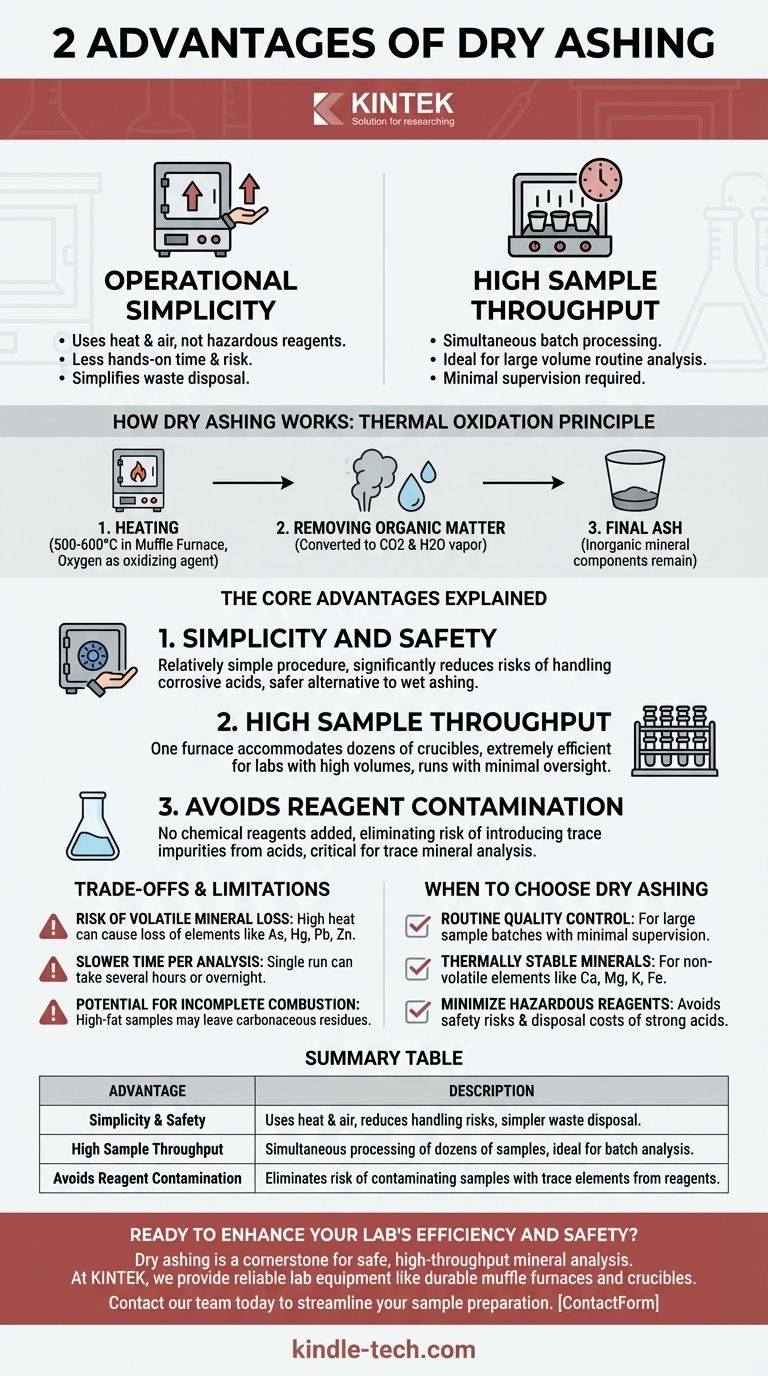
The primary advantages of dry ashing are its operational simplicity and its capacity for high sample throughput. This method requires minimal use of hazardous reagents and allows a technician to process many samples simultaneously with little hands-on supervision, making it a highly efficient choice for many routine analyses.

Choosing a sample preparation technique is a critical decision in analytical chemistry. Dry ashing stands out as the preferred method when your goals are operational efficiency and safety, particularly for large batches of samples where the target minerals are not volatile.
What are 2 advantages of dry ashing? Achieve High-Throughput Sample Analysis with Safety

How Dry Ashing Works: The Principle of Thermal Oxidation

Dry ashing is a process of decomposition that uses high heat and ambient air to eliminate the organic matter from a sample, leaving behind only the inorganic, mineral components.

Heating in the Presence of Oxygen

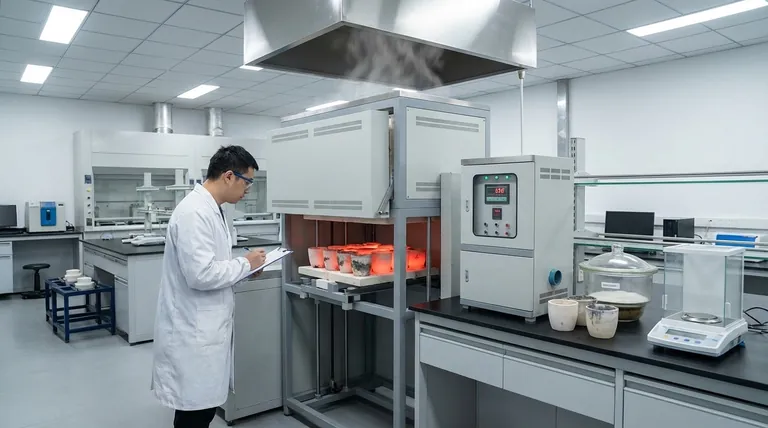
The sample is placed in a muffle furnace and heated to high temperatures, typically between 500 and 600°C. The oxygen in the air within the furnace acts as the oxidizing agent.

Removing Organic Matter

At these temperatures, all organic compounds (materials based on carbon) are burned off. They are converted into gases like carbon dioxide and water vapor, which are then vented from the system.

The Final Ash

The material that remains after this process is complete is called ash. This ash consists of the inorganic mineral components of the original sample, typically in the form of oxides, sulfates, phosphates, and chlorides.

The Core Advantages Explained

The benefits of dry ashing stem directly from its simple and straightforward methodology compared to its primary alternative, wet ashing.

Advantage 1: Simplicity and Safety

Dry ashing is a relatively simple procedure that requires less hands-on time from an analyst. Unlike wet ashing, which relies on potent and hazardous acids, dry ashing primarily uses heat and air. This significantly reduces the risks associated with handling corrosive chemicals and simplifies waste disposal.

Advantage 2: High Sample Throughput

A single muffle furnace can accommodate a large number of crucibles at once. This allows for the simultaneous processing of dozens of samples, making it an extremely efficient method for laboratories that handle a high volume of routine quality control tests. Once the furnace program is started, it requires minimal supervision.

Advantage 3: Avoids Reagent Contamination

Because no chemical reagents are added to the sample, there is no risk of contaminating the sample with trace elements that might be present in acids or oxidizing agents. This can be a critical advantage when performing trace mineral analysis where high purity is essential.

Understanding the Trade-offs and Limitations

No technique is perfect. To use dry ashing effectively, you must understand its inherent limitations.

The Risk of Volatile Mineral Loss

This is the most significant drawback of dry ashing. The high temperatures can cause volatile minerals and trace elements (such as arsenic, mercury, lead, and zinc) to vaporize and be lost. This leads to an underestimation of their content and makes the method unsuitable for analyzing these specific elements.

Slower Time Per Analysis

While throughput for a large batch is high, the actual time for a single dry ashing run can be very long, often taking several hours or even overnight. Wet ashing, while more labor-intensive, can often be completed more quickly for a small number of samples.

Potential for Incomplete Combustion

For samples with very high fat content, the organic matter may not combust completely, sometimes leaving behind carbonaceous residues. This can lead to an overestimation of the final ash content.

When to Choose Dry Ashing

Your analytical goal should always dictate your choice of method. Use these guidelines to make an informed decision.

  • If your primary focus is routine quality control on large sample batches: Dry ashing is highly efficient and cost-effective due to its capacity for batch processing and minimal need for supervision.
  • If your analysis targets thermally stable, non-volatile minerals: For elements like calcium, magnesium, potassium, and iron, dry ashing is a reliable and straightforward method.
  • If your priority is to minimize the use of hazardous chemical reagents: Dry ashing avoids the safety risks, procurement challenges, and disposal costs associated with the strong acids required for wet ashing.

Ultimately, selecting dry ashing is a strategic decision that prioritizes operational efficiency and safety for the analysis of thermally stable minerals.

Summary Table:

Advantage Description
Simplicity & Safety Uses heat and air instead of hazardous acids, reducing handling risks and waste disposal complexity.
High Sample Throughput Allows simultaneous processing of dozens of samples in a muffle furnace, ideal for routine batch analysis.
Avoids Reagent Contamination Eliminates risk of contaminating samples with trace elements from chemical reagents, ensuring analytical purity.

Ready to enhance your lab's efficiency and safety?

Dry ashing is a cornerstone technique for high-throughput, safe mineral analysis. At KINTEK, we specialize in providing the reliable lab equipment—like durable muffle furnaces and crucibles—you need to implement this method effectively.

Our experts can help you select the perfect solution for your specific application, whether you're in food science, pharmaceuticals, or environmental testing. Contact our team today to discuss how our products can streamline your sample preparation and deliver accurate results.

Visual Guide
What are 2 advantages of dry ashing? Achieve High-Throughput Sample Analysis with Safety Visual Guide

Related Products

People Also Ask

Related Products

High Temperature Muffle Oven Furnace for Laboratory Debinding and Pre Sintering

High Temperature Muffle Oven Furnace for Laboratory Debinding and Pre Sintering

KT-MD High temperature debinding and pre-sintering furnace for ceramic materials with various molding processes. Ideal for electronic components such as MLCC and NFC.

Vacuum Dental Porcelain Sintering Furnace

Vacuum Dental Porcelain Sintering Furnace

Get precise and reliable results with KinTek's Vacuum Porcelain Furnace. Suitable for all porcelain powders, it features hyperbolic ceramic furnace function, voice prompt, and automatic temperature calibration.

Laboratory Scientific Electric Heating Blast Drying Oven

Laboratory Scientific Electric Heating Blast Drying Oven

The desktop fast autoclave sterilizer is a compact and reliable device used for rapid sterilization of medical, pharmaceutical, and research items.

Laboratory Muffle Oven Furnace Bottom Lifting Muffle Furnace

Laboratory Muffle Oven Furnace Bottom Lifting Muffle Furnace

Efficiently produce batches with excellent temperature uniformity using our Bottom Lifting Furnace. Features two electric lifting stages and advanced temperature control up to 1600℃.

Vacuum Arc Induction Melting Furnace

Vacuum Arc Induction Melting Furnace

Discover the power of Vacuum Arc Furnace for melting active & refractory metals. High-speed, remarkable degassing effect, and free of contamination. Learn more now!

Graphite Vacuum Furnace High Thermal Conductivity Film Graphitization Furnace

Graphite Vacuum Furnace High Thermal Conductivity Film Graphitization Furnace

The high thermal conductivity film graphitization furnace has uniform temperature, low energy consumption and can operate continuously.

Non Consumable Vacuum Arc Induction Melting Furnace

Non Consumable Vacuum Arc Induction Melting Furnace

Explore the benefits of Non-Consumable Vacuum Arc Furnace with high melting point electrodes. Small, easy to operate & eco-friendly. Ideal for laboratory research on refractory metals & carbides.

Spark Plasma Sintering Furnace SPS Furnace

Spark Plasma Sintering Furnace SPS Furnace

Discover the benefits of Spark Plasma Sintering Furnaces for rapid, low-temperature material preparation. Uniform heating, low cost & eco-friendly.

Mesh belt controlled atmosphere furnace

Mesh belt controlled atmosphere furnace

Discover our KT-MB mesh belt sintering furnace - perfect for high-temperature sintering of electronic components & glass insulators. Available for open air or controlled atmosphere environments.

Ultra-High Temperature Graphite Vacuum Graphitization Furnace

Ultra-High Temperature Graphite Vacuum Graphitization Furnace

The ultra-high temperature graphitization furnace utilizes medium frequency induction heating in a vacuum or inert gas environment. The induction coil generates an alternating magnetic field, inducing eddy currents in the graphite crucible, which heats up and radiates heat to the workpiece, bringing it to the desired temperature. This furnace is primarily used for graphitization and sintering of carbon materials, carbon fiber materials, and other composite materials.

Dental Porcelain Zirconia Sintering Ceramic Furnace Chairside with Transformer

Dental Porcelain Zirconia Sintering Ceramic Furnace Chairside with Transformer

Experience top-notch sintering with Chairside Sintering Furnace with Transformer. Easy to operate, noise-free pallet, and automatic temperature calibration. Order now!

Small Vacuum Heat Treat and Tungsten Wire Sintering Furnace

Small Vacuum Heat Treat and Tungsten Wire Sintering Furnace

The small vacuum tungsten wire sintering furnace is a compact experimental vacuum furnace specially designed for universities and scientific research institutes. The furnace features a CNC welded shell and vacuum piping to ensure leak-free operation. Quick-connect electrical connections facilitate relocation and debugging, and the standard electrical control cabinet is safe and convenient to operate.

Controlled Nitrogen Inert Hydrogen Atmosphere Furnace

Controlled Nitrogen Inert Hydrogen Atmosphere Furnace

KT-AH Hydrogen atmosphere furnace - induction gas furnace for sintering/annealing with built-in safety features, dual housing design, and energy-saving efficiency. Ideal for lab and industrial use.

Vertical High Temperature Graphite Vacuum Graphitization Furnace

Vertical High Temperature Graphite Vacuum Graphitization Furnace

Vertical high temperature graphitization furnace for carbonization and graphitization of carbon materials up to 3100℃.Suitable for shaped graphitization of carbon fiber filaments and other materials sintered in a carbon environment.Applications in metallurgy, electronics, and aerospace for producing high-quality graphite products like electrodes and crucibles.

Vacuum Heat Treat and Pressure Sintering Furnace for High Temperature Applications

Vacuum Heat Treat and Pressure Sintering Furnace for High Temperature Applications

Vacuum pressure sintering furnaces are designed for high temperature hot pressing applications in metal and ceramic sintering. Its advanced features ensure precise temperature control, reliable pressure maintenance, and a robust design for seamless operation.

Vacuum Heat Treat Furnace with Ceramic Fiber Liner

Vacuum Heat Treat Furnace with Ceramic Fiber Liner

Vacuum furnace with polycrystalline ceramic fiber insulation liner for excellent heat insulation and uniform temperature field. Choose from 1200℃ or 1700℃ max. working temperature with high vacuum performance and precise temperature control.

Dental Porcelain Zirconia Sintering Ceramic Vacuum Press Furnace

Dental Porcelain Zirconia Sintering Ceramic Vacuum Press Furnace

Get precise dental results with Dental Vacuum Press Furnace. Automatic temperature calibration, low noise tray, and touch screen operation. Order now!

Graphite Vacuum Furnace Bottom Discharge Graphitization Furnace for Carbon Materials

Graphite Vacuum Furnace Bottom Discharge Graphitization Furnace for Carbon Materials

Bottom-out graphitization furnace for carbon materials, ultra-high temperature furnace up to 3100°C, suitable for graphitization and sintering of carbon rods and carbon blocks. Vertical design, bottom discharging, convenient feeding and discharging, high temperature uniformity, low energy consumption, good stability, hydraulic lifting system, convenient loading and unloading.

Large Vertical Graphite Vacuum Graphitization Furnace

Large Vertical Graphite Vacuum Graphitization Furnace

A large vertical high-temperature graphitization furnace is a type of industrial furnace used for the graphitization of carbon materials, such as carbon fiber and carbon black. It is a high-temperature furnace that can reach temperatures of up to 3100°C.

Graphite Vacuum Continuous Graphitization Furnace

Graphite Vacuum Continuous Graphitization Furnace

High-temperature graphitization furnace is a professional equipment for graphitization treatment of carbon materials. It is a key equipment for the production of high-quality graphite products. It has high temperature, high efficiency and uniform heating. It is suitable for various high-temperature treatments and graphitization treatments. It is widely used in metallurgy, electronics, aerospace, etc. industry.


Leave Your Message