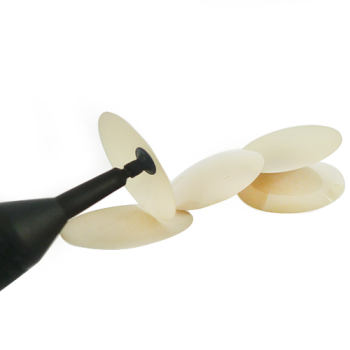
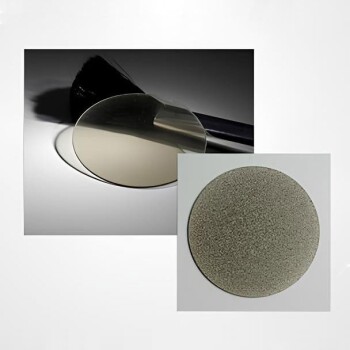
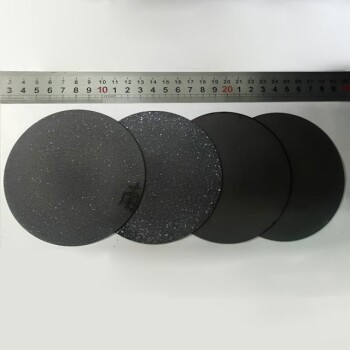
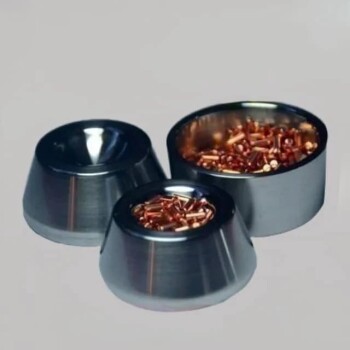
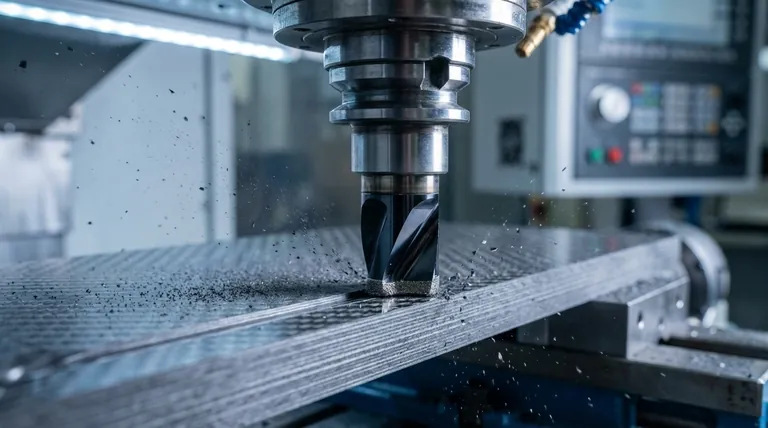
At their core, diamond coated tools are engineered for one primary purpose: to effectively machine highly abrasive, non-ferrous materials. Their extreme hardness creates a protective barrier that resists the intense wear caused by materials like composites, graphite, and green ceramics, dramatically extending the life of the cutting tool where conventional tools would quickly fail.
The decision to use a diamond coated tool is a strategic one, aimed at conquering abrasive wear to boost productivity and reduce downtime. The key is understanding that "diamond" isn't a single solution, but a category of coatings, each optimized for different non-ferrous applications.
The Core Problem: Abrasive Wear
Why Standard Tools Fail
When machining highly abrasive materials, the effect on a standard cutting tool is similar to holding it against sandpaper. The fine, hard particles within the workpiece constantly grind away at the cutting edge, leading to rapid dulling, poor surface finish, and frequent tool changes.
How Diamond Coatings Provide the Solution
A diamond coating creates a super-hard, low-friction surface on the cutting tool. This coating acts as a shield, preventing direct contact between the softer tool substrate and the abrasive workpiece.
This barrier dramatically reduces friction and the associated heat, which are the primary drivers of tool wear. The result is a significantly longer tool lifespan, more consistent performance, and less machine downtime.
Types of Diamond Tooling and Their Applications
Not all diamond tools are the same. The manufacturing process and the type of diamond layer dictate its ideal use case.
Amorphous Diamond (DLC)
Also known as Diamond-Like Carbon (DLC), this coating is applied through a process called Physical Vapor Deposition (PVD). It is a highly versatile coating suitable for a broad range of non-ferrous materials.
Its primary applications include carbon fiber, precious metals, and other high-value non-ferrous alloys where a clean cut and long tool life are essential.
CVD Diamond
This refers to a thicker diamond layer applied via Chemical Vapor Deposition (CVD). These tools are true specialists.
CVD diamond tools excel when machining extremely abrasive materials that produce fine, powdery chips, such as graphite and composite materials.
A Note on PCD Tooling
While not a coating, Polycrystalline Diamond (PCD) tools are often discussed in the same context. PCD tools feature a solid diamond cutting edge brazed onto a carbide body.
They represent the highest level of performance and durability for any non-ferrous abrasive material, often overlapping with and exceeding the capabilities of both DLC and CVD coated tools, albeit at a higher initial cost.
Understanding the Critical Trade-offs
The Ferrous Material Limitation
This is the most critical rule: never use diamond tools on steel, cast iron, or other ferrous materials. At the high temperatures generated during cutting, the carbon in the diamond has a chemical affinity for the iron in the workpiece, causing the diamond to rapidly break down and the tool to fail almost instantly.
Heat Sensitivity
While diamond coatings help reduce friction-generated heat, they are not intended for applications involving extreme external heat sources. The integrity of the coating and the bond to the tool can be compromised under such conditions.
Cost vs. Performance
Diamond coated and PCD tools carry a higher upfront cost than standard carbide tools. This investment is justified by a lower total cost-per-part in the right application due to significantly longer tool life, faster cutting speeds, and drastically reduced machine downtime for tool changes.
Making the Right Choice for Your Material
Your material dictates the best tool for the job.
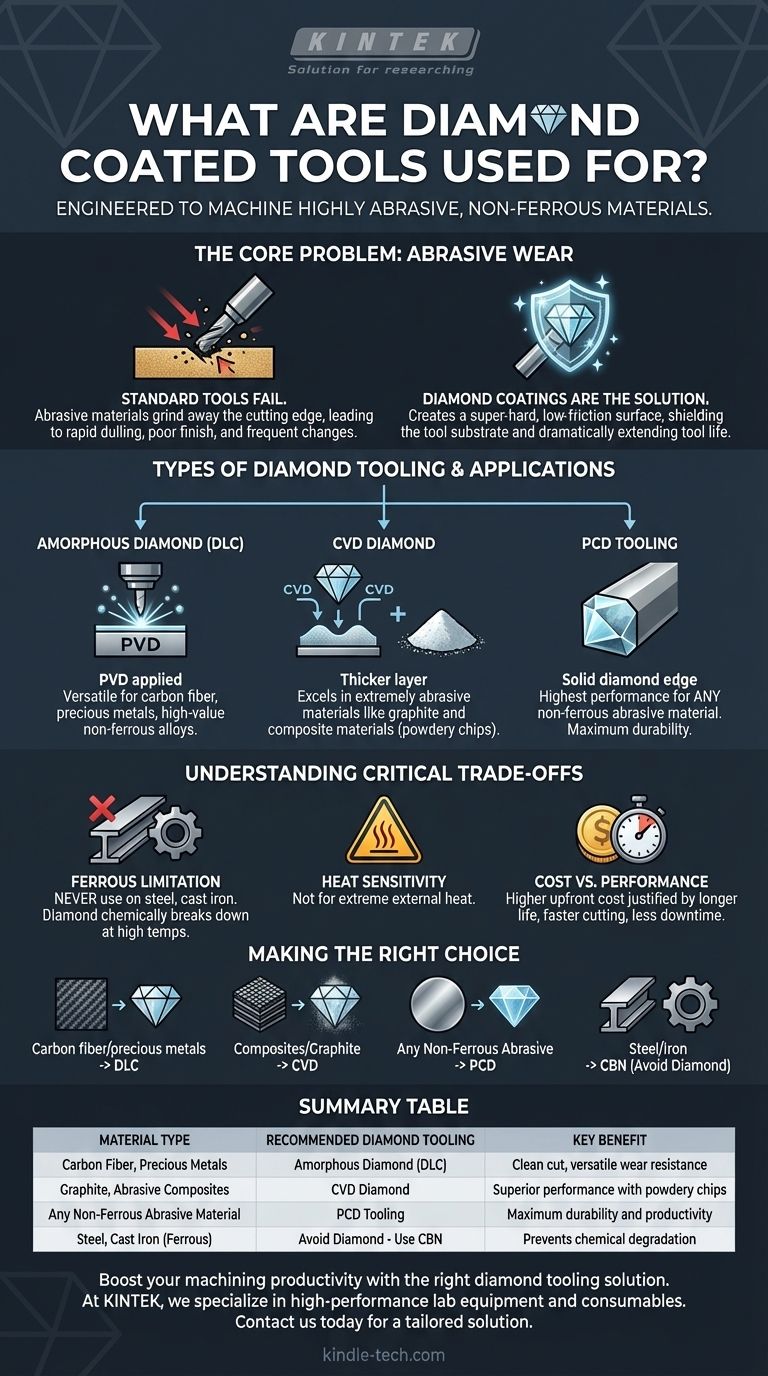
- If your primary focus is machining carbon fiber or precious metals: Amorphous Diamond (DLC) coatings offer an excellent combination of wear resistance and a smooth surface finish.
- If your primary focus is cutting highly abrasive composites or graphite: CVD diamond tools are specifically designed to handle the fine, abrasive dust these materials generate.
- If your primary focus is maximum performance on any non-ferrous abrasive: PCD tooling provides the ultimate solution for the longest possible tool life and highest productivity.
- If your primary focus is machining steel or other iron-based alloys: Avoid diamond entirely; tools made from materials like Cubic Boron Nitride (CBN) are the correct choice for these applications.
Ultimately, selecting the correct diamond tool is about precisely matching its properties to the material you are cutting to unlock significant gains in efficiency and tool longevity.
Summary Table:
| Material Type | Recommended Diamond Tooling | Key Benefit |
|---|---|---|
| Carbon Fiber, Precious Metals | Amorphous Diamond (DLC) | Clean cut, versatile wear resistance |
| Graphite, Abrasive Composites | CVD Diamond | Superior performance with powdery chips |
| Any Non-Ferrous Abrasive Material | PCD Tooling | Maximum durability and productivity |
| Steel, Cast Iron (Ferrous) | Avoid Diamond - Use CBN | Prevents chemical degradation |
Boost your machining productivity and reduce downtime with the right diamond tooling solution.
At KINTEK, we specialize in high-performance lab equipment and consumables, including precision tooling for demanding applications. Our experts can help you select the ideal diamond coated tool for your specific material—whether it's composites, graphite, or ceramics—to maximize tool life and efficiency.
Contact us today to discuss your needs and get a tailored solution that lowers your total cost per part. Reach out via our contact form to get started!
Visual Guide
Related Products
- CVD Diamond Dressing Tools for Precision Applications
- HFCVD Machine System Equipment for Drawing Die Nano-Diamond Coating
- CVD Diamond Cutting Tool Blanks for Precision Machining
- Custom CVD Diamond Coating for Lab Applications
- High Precision Diamond Wire Cutting Machine Laboratory Saw Precision Wire EDM Cutting Machine
People Also Ask
- How do you identify a CVD diamond? The Definitive Guide to Lab-Grown Diamond Verification
- What is chemical vapor deposition of diamond? Grow High-Purity Diamonds Atom-by-Atom
- How do CVD diamonds grow? A Step-by-Step Guide to Lab-Grown Diamond Creation
- What are the raw materials for CVD diamonds? A seed, a gas, and the science of crystal growth.
- What is CVD diamond? The Ultimate Guide to Lab-Grown Diamonds and Their Uses