Knowledge What are the advantages and disadvantages of sieve analysis? A Guide to Cost-Effective Particle Sizing
Author avatar

Tech Team · Kintek Solution

Updated 6 days ago

What are the advantages and disadvantages of sieve analysis? A Guide to Cost-Effective Particle Sizing


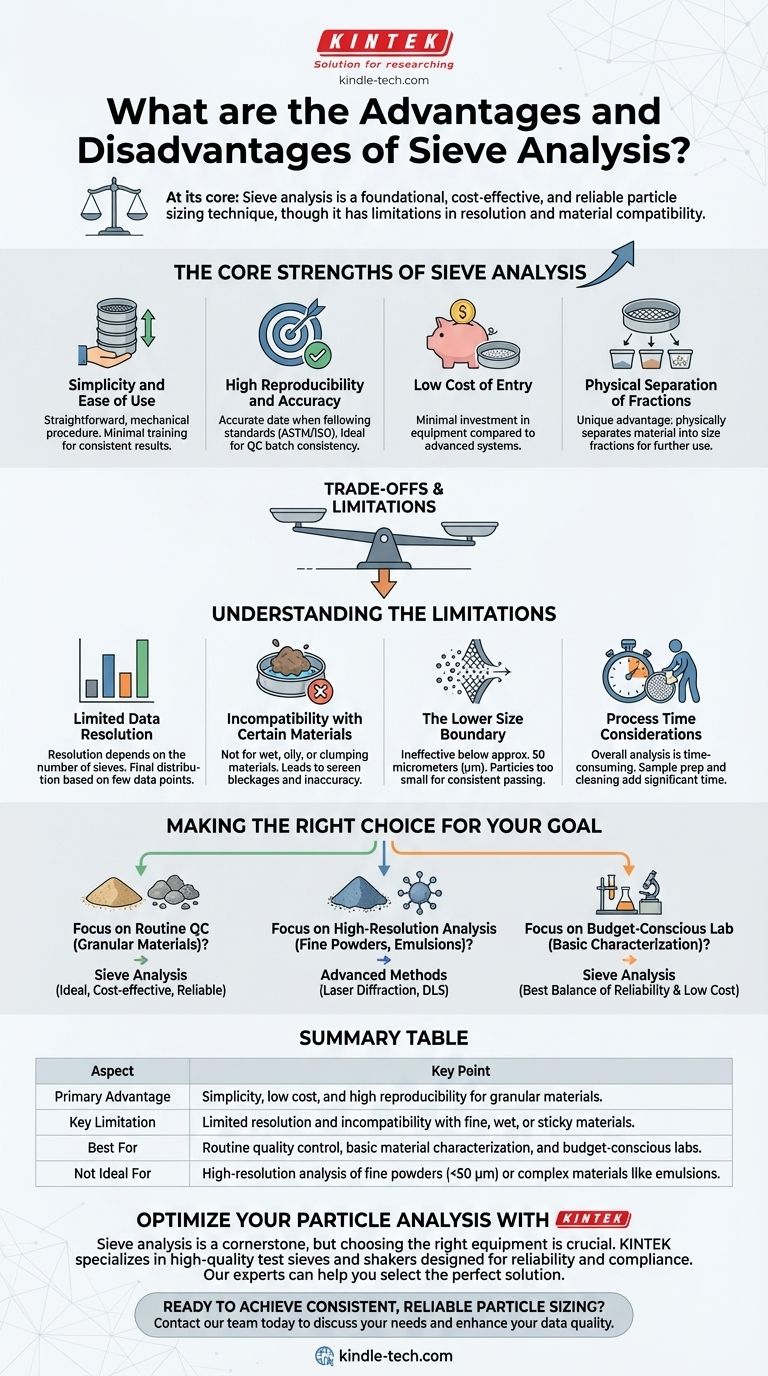
At its core, sieve analysis is a foundational technique in particle size analysis celebrated for its simplicity, low cost, and reliability. Its primary advantages are its ease of use and the highly reproducible results it delivers, while its main disadvantages stem from its limited resolution and its incompatibility with very fine or non-dry materials.

Sieve analysis remains an indispensable tool for fundamental quality control and material characterization. The central trade-off is choosing its cost-effective simplicity versus the higher resolution and broader material compatibility offered by more advanced, and more expensive, analytical methods.
What are the advantages and disadvantages of sieve analysis? A Guide to Cost-Effective Particle Sizing

The Core Strengths of Sieve Analysis

Sieve analysis is a trusted method for good reason. Its advantages make it the go-to choice for countless applications where a fundamental understanding of particle size distribution is sufficient.

Simplicity and Ease of Use

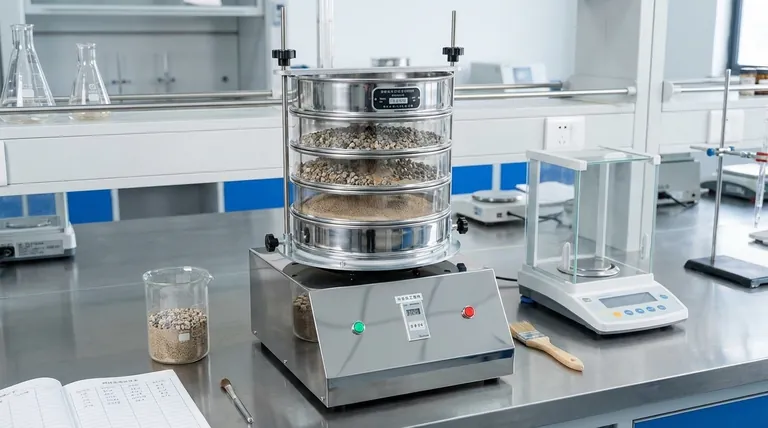
The procedure is straightforward and mechanical. It involves stacking sieves of decreasing mesh size, placing a sample on top, and agitating the stack until the particles have settled into their respective size fractions.

This simplicity means minimal training is required for operators to achieve consistent results.

High Reproducibility and Accuracy

When performed according to established standards (like ASTM or ISO), sieve analysis provides remarkably accurate and reproducible data.

This reliability makes it an excellent tool for quality control, where the goal is to ensure batch-to-batch consistency against a known standard.

Low Cost of Entry

The initial investment for a set of certified test sieves and a sieve shaker is minimal compared to laser diffraction or image analysis systems.

This makes it accessible for a wide range of labs, from educational settings to industrial quality control departments.

Physical Separation of Fractions

A unique advantage is that sieve analysis physically separates the material into different size fractions.

These separated fractions can then be used for further testing or analysis, which is not possible with many other particle sizing methods.

Understanding the Trade-offs and Limitations

While powerful, the method's simplicity comes with clear limitations that make it unsuitable for certain materials or analytical goals. Understanding these trade-offs is critical to its proper application.

Limited Data Resolution

The resolution of your data is directly tied to the number of sieves in your stack. A standard stack may have up to eight sieves.

This means your final particle size distribution curve is based on just eight data points, which can miss finer details within the distribution.

Incompatibility with Certain Materials

Sieve analysis is fundamentally a dry process. The method is not suitable for materials that are wet, oily, or that clump together when agitated.

Attempting to sieve these materials will lead to screen blockages (blinding) and inaccurate results.

The Lower Size Boundary

There is a practical lower limit to the particle size that can be reliably measured.

Generally, woven wire mesh sieves are not effective below approximately 50 micrometers (µm), as the particles become too small to pass through the openings consistently.

Process Time Considerations

While the mechanical shaking process can be short, the overall analysis can be time-consuming.

Sample preparation, which often includes drying, weighing, careful collection of material from each sieve, and cleaning, adds significant time to the total procedure.

Making the Right Choice for Your Goal

Selecting the right particle analysis method depends entirely on your material, your budget, and the specific data you need.

  • If your primary focus is routine quality control for granular materials (like sand, aggregates, or grains): Sieve analysis is the ideal, cost-effective, and highly reliable choice.
  • If your primary focus is high-resolution analysis of fine powders, nanoparticles, or emulsions: You must use a more advanced method like laser diffraction or dynamic light scattering.
  • If your primary focus is a budget-conscious lab setup for basic material characterization: Sieve analysis provides the best balance of reliable data and low initial investment.

Ultimately, sieve analysis serves as a robust and essential workhorse for foundational particle sizing.

Summary Table:

Aspect Key Point
Primary Advantage Simplicity, low cost, and high reproducibility for granular materials.
Key Limitation Limited resolution and incompatibility with fine, wet, or sticky materials.
Best For Routine quality control, basic material characterization, and budget-conscious labs.
Not Ideal For High-resolution analysis of fine powders (<50 µm) or complex materials like emulsions.

Optimize Your Particle Analysis with KINTEK

Sieve analysis is a cornerstone of quality control, but choosing the right equipment is crucial for accurate, reproducible results. KINTEK specializes in high-quality lab equipment, including robust test sieves and efficient sieve shakers designed for reliability and compliance with industry standards.

Whether you're setting up a new lab or upgrading your particle analysis capabilities, our experts can help you select the perfect solution for your specific materials and applications.

Ready to achieve consistent, reliable particle sizing? Contact our team today to discuss your needs and discover how KINTEK's laboratory solutions can enhance your efficiency and data quality.

Visual Guide
What are the advantages and disadvantages of sieve analysis? A Guide to Cost-Effective Particle Sizing Visual Guide

Related Products

People Also Ask

Related Products

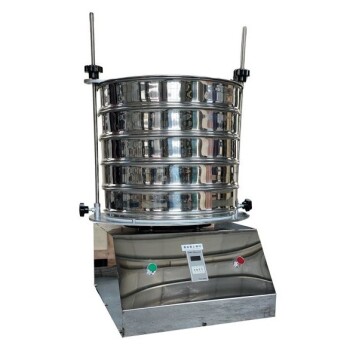
Laboratory Test Sieves and Sieving Machines

Laboratory Test Sieves and Sieving Machines

Precision lab test sieves & sieving machines for accurate particle analysis. Stainless steel, ISO-compliant, 20μm-125mm range. Request specs now!

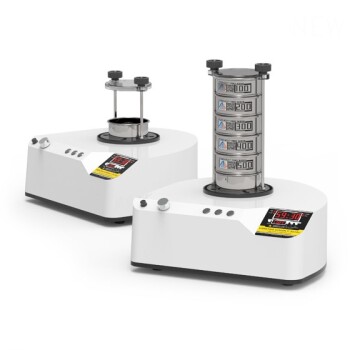
Laboratory Test Sieves and Vibratory Sieve Shaker Machine

Laboratory Test Sieves and Vibratory Sieve Shaker Machine

Efficiently process powders, granules, and small blocks with a high-frequency vibration sieve. Control vibration frequency, screen continuously or intermittently, and achieve accurate particle size determination, separation, and classification.

Three-dimensional electromagnetic sieving instrument

Three-dimensional electromagnetic sieving instrument

KT-VT150 is a desktop sample processing instrument for both sieving and grinding. Grinding and sieving can be used both dry and wet. The vibration amplitude is 5mm and the vibration frequency is 3000-3600 times/min.

Laboratory Vibratory Sieve Shaker Machine Slap Vibrating Sieve

Laboratory Vibratory Sieve Shaker Machine Slap Vibrating Sieve

KT-T200TAP is a slapping and oscillating sieving instrument for laboratory desktop use, with 300 rpm horizontal circular motion and 300 vertical slapping motions to simulate manual sieving to help sample particles pass through better.

Laboratory Multifunctional Small Speed-Adjustable Horizontal Mechanical Shaker for Lab

Laboratory Multifunctional Small Speed-Adjustable Horizontal Mechanical Shaker for Lab

The laboratory multifunctional speed-regulating oscillator is a constant-speed experimental equipment specially developed for modern bioengineering production units.

Custom PTFE Teflon Parts Manufacturer for PTFE Mesh F4 Sieve

Custom PTFE Teflon Parts Manufacturer for PTFE Mesh F4 Sieve

PTFE mesh sieve is a specialized test sieve designed for particle analysis in various industries, featuring a non-metallic mesh woven from PTFE filament. This synthetic mesh is ideal for applications where metal contamination is a concern . PTFE sieves are crucial for maintaining the integrity of samples in sensitive environments, ensuring accurate and reliable results in particle size distribution analysis.

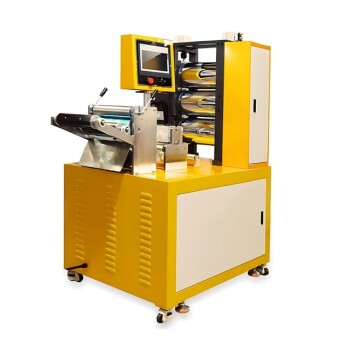
Small Lab Rubber Calendering Machine

Small Lab Rubber Calendering Machine

Small lab rubber calendering machine is used for producing thin, continuous sheets of plastic or rubber materials. It is commonly employed in laboratories, small-scale production facilities, and prototyping environments to create films, coatings, and laminates with precise thickness and surface finish.

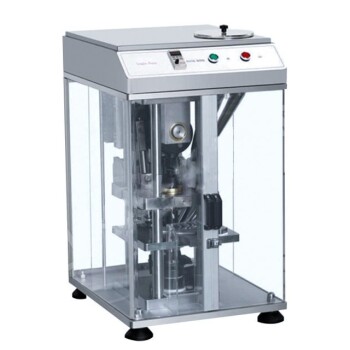
Single Punch Electric Tablet Press Machine Laboratory Powder Tablet Punching TDP Tablet Press

Single Punch Electric Tablet Press Machine Laboratory Powder Tablet Punching TDP Tablet Press

The single-punch electric tablet press is a laboratory-scale tablet press suitable for corporate laboratories in pharmaceutical, chemical, food, metallurgical and other industries.

Laboratory Sterilizer Lab Autoclave Vertical Pressure Steam Sterilizer for Liquid Crystal Display Automatic Type

Laboratory Sterilizer Lab Autoclave Vertical Pressure Steam Sterilizer for Liquid Crystal Display Automatic Type

Liquid crystal display automatic vertical sterilizer is a safe, reliable and automatic control sterilization equipment, which is composed of heating system, microcomputer control system and overheating and overvoltage protection system.

HFCVD Machine System Equipment for Drawing Die Nano-Diamond Coating

HFCVD Machine System Equipment for Drawing Die Nano-Diamond Coating

The nano-diamond composite coating drawing die uses cemented carbide (WC-Co) as the substrate, and uses the chemical vapor phase method ( CVD method for short ) to coat the conventional diamond and nano-diamond composite coating on the surface of the inner hole of the mold.

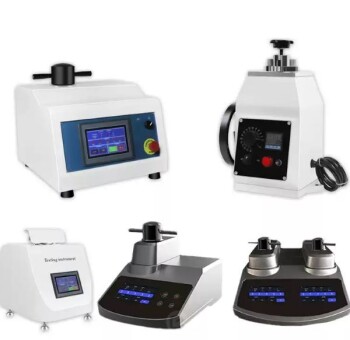
Metallographic Specimen Mounting Machine for Laboratory Materials and Analysis

Metallographic Specimen Mounting Machine for Laboratory Materials and Analysis

Precision metallographic mounting machines for labs—automated, versatile, and efficient. Ideal for sample prep in research and quality control. Contact KINTEK today!

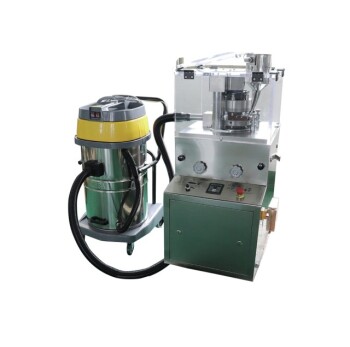
Lab Scale Rotary Single Punch Tablet Press Machine TDP Tablet Punching Machine

Lab Scale Rotary Single Punch Tablet Press Machine TDP Tablet Punching Machine

This machine is a single-pressure automatic rotating, continuous tableting machine that compresses granular raw materials into various tablets. It is mainly used for tablet production in the pharmaceutical industry, and is also suitable for chemical, food, electronics and other industrial sectors.

Desktop Fast Laboratory Autoclave Sterilizer 35L 50L 90L for Lab Use

Desktop Fast Laboratory Autoclave Sterilizer 35L 50L 90L for Lab Use

The desktop fast steam sterilizer is a compact and reliable device used for rapid sterilization of medical, pharmaceutical, and research items. It efficiently sterilizes surgical instruments, glassware, medicines, and resistant materials, making it suitable for various applications.

Double Plate Heating Press Mold for Lab

Double Plate Heating Press Mold for Lab

Discover precision in heating with our Double Plate Heating Mold, featuring high-quality steel and uniform temperature control for efficient lab processes. Ideal for various thermal applications.

Single Punch Tablet Press Machine and Mass Production Rotary Tablet Punching Machine for TDP

Single Punch Tablet Press Machine and Mass Production Rotary Tablet Punching Machine for TDP

Rotary tablet punching machine is an automatic rotating and continuous tableting machine. It is mainly used for tablet manufacturing in the pharmaceutical industry, and is also suitable for industrial sectors such as food, chemicals, batteries, electronics, ceramics, etc. to compress granular raw materials into tablets.

Anti-Cracking Press Mold for Lab Use

Anti-Cracking Press Mold for Lab Use

The anti-cracking press mold is a specialized equipment designed for molding various shapes and sizes of film using high pressure and electric heating.

915MHz MPCVD Diamond Machine Microwave Plasma Chemical Vapor Deposition System Reactor

915MHz MPCVD Diamond Machine Microwave Plasma Chemical Vapor Deposition System Reactor

915MHz MPCVD Diamond Machine and its multi-crystal effective growth, the maximum area can reach 8 inches, the maximum effective growth area of single crystal can reach 5 inches. This equipment is mainly used for the production of large-size polycrystalline diamond films, the growth of long single crystal diamonds, the low-temperature growth of high-quality graphene, and other materials that require energy provided by microwave plasma for growth.

Benchtop Laboratory Freeze Dryer for Lab Use

Benchtop Laboratory Freeze Dryer for Lab Use

Premium benchtop laboratory freeze dryer for lyophilization, preserving samples with ≤ -60°C cooling. Ideal for pharmaceuticals & research.

Small Jaw Crusher for Laboratory and Small Mines Efficient Flexible Affordable Laboratory Ore Crusher Coal Crusher

Small Jaw Crusher for Laboratory and Small Mines Efficient Flexible Affordable Laboratory Ore Crusher Coal Crusher

Discover the small jaw crusher for efficient, flexible, and affordable crushing in labs and small mines. Ideal for coal, ores, and rocks. Learn more now!

Desktop Fast High Pressure Laboratory Autoclave Sterilizer 16L 24L for Lab Use

Desktop Fast High Pressure Laboratory Autoclave Sterilizer 16L 24L for Lab Use

The desktop fast steam sterilizer is a compact and reliable device used for rapid sterilization of medical, pharmaceutical, and research items.


Leave Your Message