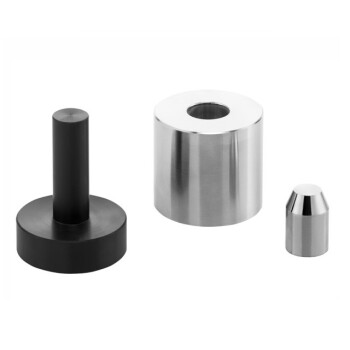
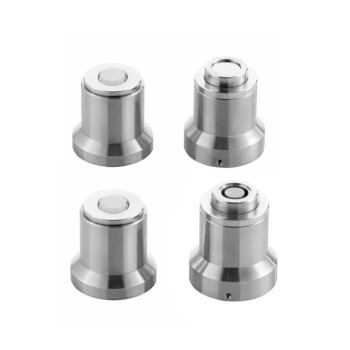
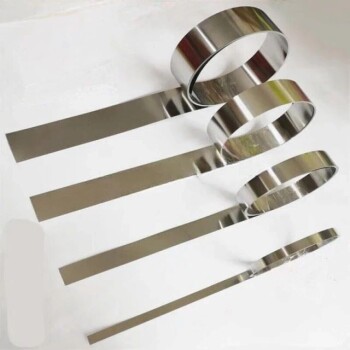
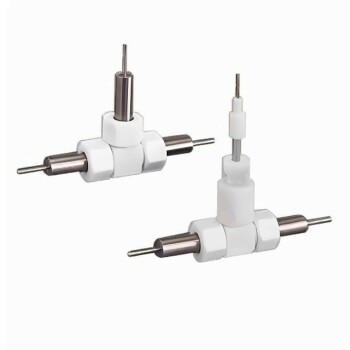
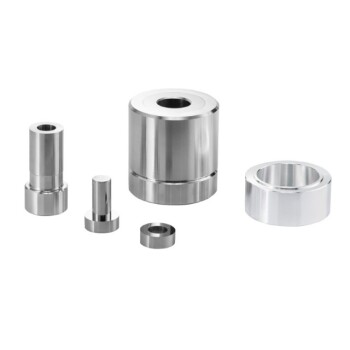
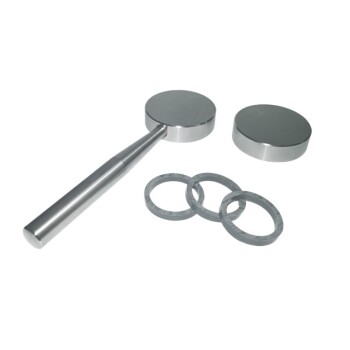
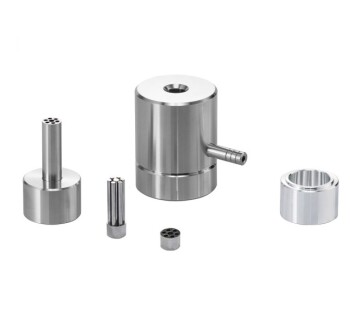
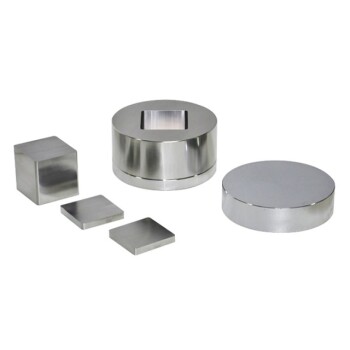
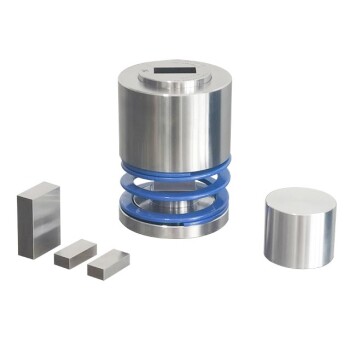
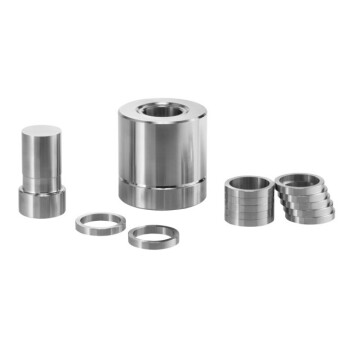
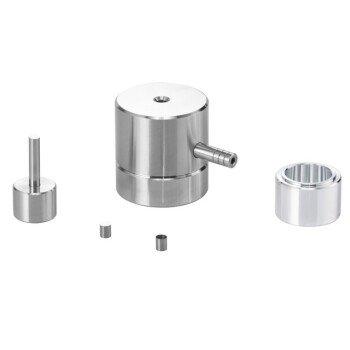
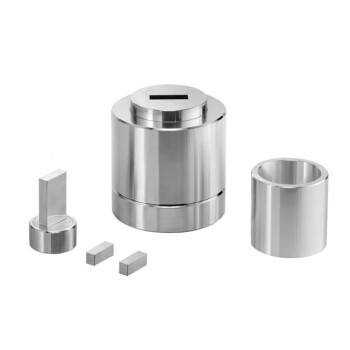
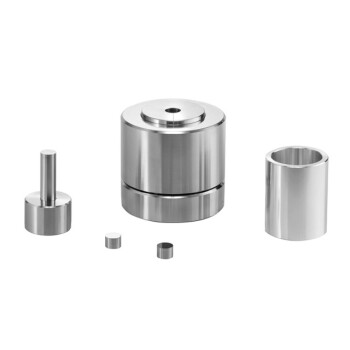
A customized battery test mold integrated with a force sensor provides the critical advantage of real-time monitoring and precise control over uniaxial stack pressure. This setup allows researchers to rigorously quantify the relationship between applied physical force—ranging from 0 to 125 MPa—and electrochemical impedance, ensuring that performance data reflects intrinsic material properties rather than inconsistent physical contact.
By transforming pressure from an unknown variable into a measurable control parameter, this apparatus solves the fundamental challenge of solid-solid contact. It enables the precise correlation of stack pressure with impedance evolution, ensuring reliable data on interface stability during cycling.
The Critical Role of Pressure in Solid-State Systems
Overcoming the Solid-Solid Interface Challenge
Unlike liquid electrolytes that naturally wet electrode surfaces, all-solid-state batteries (ASSBs) rely entirely on physical contact to facilitate ion transport.
Without sufficient external pressure, microscopic voids form at the interface. This leads to high interfacial impedance and poor battery performance.
Managing Volume Fluctuations
During charge and discharge cycles, materials such as Lithium metal undergo significant volume changes due to deposition and stripping.
A customized mold maintains continuous and constant external pressure. This compensates for these physical shifts, preventing the physical separation (delamination) of layers that destroys connectivity.
Advantages of Integrated Force Sensing
Real-Time Monitoring and Control
Standard test cells (like coin cells) often apply an unknown or decaying amount of pressure.
A mold with an integrated sensor allows for real-time feedback. You can adjust and maintain the exact required pressure throughout the experiment, regardless of internal expansion or contraction.
Quantifying Impedance vs. Pressure
The primary advantage is the ability to generate quantitative data.
Researchers can sweep through specific pressure ranges (e.g., 0 to 125 MPa) while performing Electrochemical Impedance Spectroscopy (EIS). This isolates exactly how much pressure is required to minimize resistance, optimizing the system's efficiency.
Ensuring Experimental Reproducibility
Integrated sensing removes the guesswork from cell assembly.
By confirming the exact pressure applied to every sample, you ensure that variations in performance are due to material differences, not inconsistencies in how tight the cell was assembled.
Understanding the Trade-offs
Complexity of Setup
While offering superior data, these customized molds are significantly more complex than standard test cells.
They require precise calibration of the force sensor and robust mechanical frames to sustain high pressures (up to 125 MPa) without deformation, which can complicate the testing hardware.
High Pressure vs. Commercial Viability
A lab mold can easily apply 100+ MPa to achieve perfect contact.
However, commercial battery packs may not be able to sustain such high pressures due to weight and cost constraints. Data obtained at the high end of the pressure spectrum must be carefully evaluated for practical application.
Optimizing Your Experimental Setup
To maximize the value of a force-sensing test mold, align your usage with your specific research goals:
- If your primary focus is Fundamental Material Characterization: Use the pressure control to perform a "pressure sweep" during EIS to identify the minimum pressure required for optimal ionic conductivity.
- If your primary focus is Long-Term Cycle Life: Utilize the sensor to maintain constant pressure to compensate for lithium volume expansion, isolating electrochemical degradation from mechanical delamination.
True insight into solid-state performance is impossible without decoupling physical contact mechanics from electrochemical behavior.
Summary Table:
| Feature | Advantage for ASSB Research |
|---|---|
| Pressure Range | 0 to 125 MPa for wide-spectrum testing |
| Real-Time Monitoring | Accurate feedback on uniaxial stack pressure |
| Interface Stability | Minimizes voids and prevents layer delamination |
| Data Precision | Correlates stack pressure directly with impedance evolution |
| Reproducibility | Eliminates assembly variables for consistent results |
Elevate Your Battery Research with KINTEK Precision Engineering
Unlock the full potential of your all-solid-state battery (ASSB) research with KINTEK’s specialized laboratory solutions. KINTEK excels in providing high-precision equipment designed to tackle the unique challenges of solid-state systems, including customized battery test molds, force sensors, and high-pressure reactors.
Our comprehensive portfolio supports every stage of energy storage development, featuring:
- Battery Research Tools: Advanced molds, coin cell parts, and electrochemical cells.
- Material Processing: High-temperature furnaces (vacuum, CVD, atmosphere), crushing systems, and hydraulic presses for pellet preparation.
- Specialized Consumables: High-quality ceramics, crucibles, and PTFE products.
Don't let inconsistent contact mechanics compromise your EIS data. Partner with KINTEK to achieve the precise control and reproducibility your innovations demand.
Contact our technical experts today to customize your testing setup!
Related Products
- Button Battery Tablet Press Sealing Mold for Lab Use
- Button Battery Disassembly and Sealing Mold for Lab Use
- Battery Lab Equipment 304 Stainless Steel Strip Foil 20um Thick for Battery Test
- Customizable Swagelok Type Test Cells for Advanced Battery Research Electrochemical Analysis
- Ring Press Mold for Lab Applications
People Also Ask
- What role do battery test molds or coin cell cases play? Optimize Your All-Solid-State Battery Assembly Today
- What is the function of a tablet press? Transforming Powder into Precise, Uniform Tablets
- What is tablet pressing in pharmaceutical industry? The Core Process for Producing Solid Oral Dosage Forms
- What is the difference between single punch and rotary tablet press? Choose the Right Machine for Your Lab or Production
- What are pill presses called? The Correct Term is Tablet Press for Pharmaceutical Manufacturing