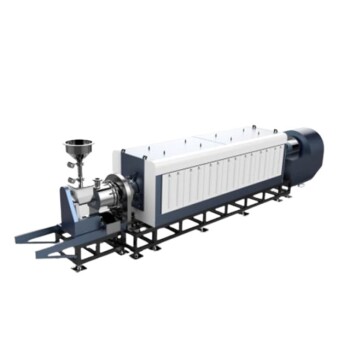
A high-pressure hydrothermal reactor provides a specialized, closed environment essential for synthesizing advanced mesoporous hydroxyapatite catalysts. By utilizing high temperature and pressure, this method overcomes the limitations of standard synthesis, enabling the uniform doping of molybdate anions and ensuring precise control over the material's crystal morphology and phase composition.
Core Insight: The primary value of this reactor technology is not just the mixing of components, but the manipulation of thermodynamic conditions. It forces precursors to react under equilibrium, producing highly crystalline, mesoporous structures with maximized surface areas—a critical factor for high-performance heterogeneous catalysis.
Enhancing Catalytic Performance Through Structure
The physical architecture of a catalyst dictates its efficiency. High-pressure hydrothermal synthesis allows for granular control over this architecture.
Creation of Mesoporous Structures
The reactor environment facilitates the formation of a specific mesoporous structure. This structure is vital because it creates a high specific surface area, providing more active sites for chemical reactions to occur.
Precise Control of Crystal Morphology
Standard precipitation can yield irregular particles. In contrast, this reactor allows you to regulate anisotropic crystal growth (growth in specific directions).
By adjusting reaction parameters—specifically temperature, pressure, and time—you can dictate the final shape and size of the crystals.
Optimization of Powder Dispersibility
Catalysts fail if they clump together. The hydrothermal treatment improves particle dispersion, ensuring the material remains effective when deployed in a reaction.
Optimizing Chemical Composition and Doping
Beyond physical structure, the reactor significantly improves the chemical integration of the molybdate anions into the hydroxyapatite matrix.
Uniform Component Doping
The closed system ensures highly uniform contact between reactants in the liquid phase. This allows molybdate anions to be uniformly incorporated into the hydroxyapatite lattice, rather than simply adhering to the surface.
Increased Solubility and Reactivity
High pressure and temperature significantly increase the solubility of precursors in aqueous solutions.
This heightened solubility enhances the reactivity of the precursors, facilitating chemical bonds that might not form under ambient conditions.
Superior Ion-Exchange Capabilities
The resulting materials demonstrate specific ion-exchange capacities. This is a direct result of the controlled synthesis environment, allowing for functional anions to be effectively integrated.
Ensuring Process Reliability
For a catalyst to be viable, its production must be repeatable. The high-pressure hydrothermal approach offers superior consistency compared to open-system methods.
High Reproducibility
Because the reaction occurs in a sealed system under equilibrium conditions, the phase composition is highly reproducible. External variables are eliminated, ensuring batch-to-batch consistency.
High Crystallinity and Stability
The rigorous conditions within the reactor promote the formation of materials with high crystallinity. This leads to greater thermodynamic stability, ensuring the catalyst maintains its integrity during use.
Understanding the Operational Trade-offs
While this method offers superior material quality, it introduces specific operational demands.
Sensitivity to Parameter Changes
The text emphasizes the need for "precise regulation" and "accurate adjustment" of temperature, pressure, and time. This implies that the process is highly sensitive; small deviations in these parameters can significantly alter the phase composition or pore structure.
Equilibrium Dependencies
Since the process relies on precipitation under equilibrium, the synthesis cannot be rushed. Adequate time must be allotted to reach these states to ensure the desired crystallinity and uniform doping are achieved.
Making the Right Choice for Your Goal
To maximize the benefits of a high-pressure hydrothermal reactor, align your parameters with your specific catalytic objectives.
- If your primary focus is Maximum Reactivity: Prioritize parameter adjustments that maximize the specific surface area and induce a mesoporous structure.
- If your primary focus is Ion Exchange: Focus on the "closed system" benefits to ensure uniform lattice incorporation of the molybdate anions.
- If your primary focus is Manufacturing Consistency: Leverage the automated control of temperature and pressure to ensure high reproducibility of the phase composition across batches.
By leveraging the high-pressure environment to control solubility and crystal growth, you transform basic hydroxyapatite into a robust, high-activity heterogeneous catalyst.
Summary Table:
| Feature | Hydrothermal Reactor Advantage | Impact on Catalyst Performance |
|---|---|---|
| Structural Control | Creates uniform mesoporous architectures | Maximizes surface area and active reaction sites |
| Doping Efficiency | Enables uniform incorporation of molybdate anions | Enhances chemical reactivity and lattice stability |
| Crystal Growth | Regulates anisotropic crystal morphology | Ensures consistent particle size and dispersion |
| Process Stability | Operates under equilibrium in a closed system | Guarantees high reproducibility and phase purity |
| Material Quality | High temperature/pressure synthesis | Produces superior crystallinity and thermal stability |
Elevate Your Catalyst Synthesis with KINTEK Precision
Achieve unmatched consistency and performance in your material research with KINTEK’s high-pressure hydrothermal reactors and autoclaves. Whether you are developing advanced hydroxyapatite catalysts or exploring complex ion-exchange materials, our equipment provides the precise temperature and pressure control necessary for superior crystallinity and uniform doping.
Why partner with KINTEK?
- Comprehensive Laboratory Solutions: From crushing and milling systems to high-temperature muffle and vacuum furnaces.
- Advanced Reactor Technology: Specialized high-pressure reactors designed for sensitive hydrothermal synthesis.
- Expertise in Research Tools: Supporting battery research, electrochemical studies with high-quality electrolytic cells, and essential ceramic consumables.
Ready to optimize your mesoporous structures? Contact our technical experts today to find the perfect high-pressure solution for your laboratory.
References
- Saša Sladić. Batteries versus supercapacitors: recent trends in applications. DOI: 10.21175/rad.abstr.book.2023.12.1
This article is also based on technical information from Kintek Solution Knowledge Base .
Related Products
- Customizable Laboratory High Temperature High Pressure Reactors for Diverse Scientific Applications
- High Pressure Laboratory Autoclave Reactor for Hydrothermal Synthesis
- Customizable High Pressure Reactors for Advanced Scientific and Industrial Applications
- Stainless High Pressure Autoclave Reactor Laboratory Pressure Reactor
- Mini SS High Pressure Autoclave Reactor for Laboratory Use
People Also Ask
- How do high-pressure and high-temperature reactors ensure the effective treatment of lignocellulosic wastewater in WAO?
- What equipment is required for high-pressure high-temperature reactions? Master Extreme Chemistry Safely
- How do you control high pressure in a reactor? A Guide to Safe & Stable Operation
- How does initial oxygen pressure affect the wet oxidation of pharmaceutical sludge? Master Your Oxidation Depth
- Why is argon better than nitrogen for inert atmosphere? Ensure Absolute Reactivity & Stability