High-purity zirconia grinding balls are the superior choice for processing Zr2Al-GNS powders due to a combination of high physical density and exceptional wear resistance. These properties allow the media to generate sufficient impact energy to break down soft powder agglomerates for a homogeneous mixture, while simultaneously preventing metallic contamination that would degrade the material's electrical performance after sintering.
Core Insight: The selection of zirconia media is not just about grinding efficiency; it is a strategic decision to preserve chemical purity. By eliminating metallic wear debris, you ensure the final MAX phase ceramic retains its intended electrical properties after high-temperature processing.
Maximizing Kinetic Energy and Homogeneity
Leveraging High Density for Impact
To effectively mill Zr2Al-GNS powders, the grinding media must deliver substantial kinetic energy.
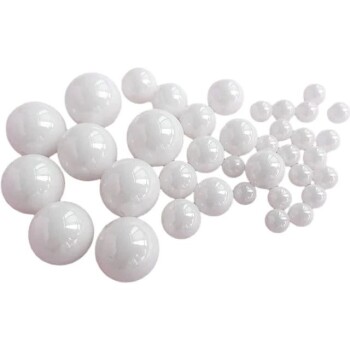
Zirconia balls possess high density, which translates into greater impact force during the milling process. This energy is critical for breaking down soft agglomerates that naturally form in the powder, ensuring the particles are separated rather than just compacted.
Achieving Uniform Dispersion
The ultimate goal of ball milling in this context is a homogeneous mixture.
The high hardness and impact energy of zirconia media facilitate a thorough blending process. This ensures that the components of the Zr2Al-GNS composite are uniformly distributed, which is a prerequisite for consistent material performance.
Preserving Material Purity
Eliminating Metallic Contamination
Standard grinding media, such as stainless steel, often introduces metallic impurities (like iron or chromium) due to wear.
Zirconia offers excellent wear resistance, significantly reducing the generation of wear debris. In the processing of Zr2Al-GNS, maintaining a metal-free environment is essential, as metallic inclusions act as contaminants that can alter the fundamental characteristics of the ceramic.
Protecting Electrical Performance
The presence of impurities is not merely a cosmetic issue; it directly impacts functionality.
For MAX phase ceramics like Zr2Al-GNS, electrical performance is a key property. Metallic impurities introduced during milling can react or segregate during high-temperature sintering, compromising the material's conductivity or resistivity. Zirconia media ensures the powder remains chemically pure, safeguarding these critical electrical properties.
Understanding the Trade-offs
Cost vs. Performance
While zirconia offers superior technical performance, it represents a higher upfront cost compared to standard alumina or steel media.
You must weigh the strict requirement for high purity against the budget of your processing operation. For applications where electrical performance is secondary, the cost of high-grade zirconia may yield diminishing returns.
Media Wear is Not Zero
Although zirconia is highly wear-resistant, it is not wear-proof.
While it prevents metallic contamination, minor zirconia wear can still occur over extended milling durations. However, unlike metallic debris, zirconia is generally chemically stable and less detrimental to the sintering phase of ceramic composites.
Making the Right Choice for Your Project
To determine if zirconia grinding balls are the correct specification for your milling process, consider your specific end-goals:
- If your primary focus is Electrical Performance: Use zirconia media to strictly prevent metallic contamination that leads to post-sintering signal degradation.
- If your primary focus is Mixture Homogeneity: Rely on the high density of zirconia to provide the impact energy needed to break up stubborn agglomerates.
Summary: For Zr2Al-GNS ceramics, zirconia grinding balls provide the necessary kinetic force for mixing while acting as a critical safeguard against performance-killing impurities.
Summary Table:
| Feature | Advantage for Zr2Al-GNS Milling | Benefit to Final Ceramic |
|---|---|---|
| High Density | Delivers greater kinetic impact energy | Breaks down soft agglomerates for uniform dispersion |
| High Hardness | Superior wear resistance | Minimizes media debris and extends service life |
| Chemical Inertness | Eliminates metallic inclusions (Fe, Cr) | Preserves electrical conductivity and material purity |
| Material Stability | Stable during high-temperature sintering | Prevents degradation of MAX phase ceramic properties |
Elevate Your Advanced Material Processing with KINTEK
Precision milling of specialized powders like Zr2Al-GNS requires more than just standard equipment—it demands contamination-free solutions that protect your material's integrity. KINTEK specializes in high-performance laboratory equipment and consumables designed for the most rigorous research and production environments.
From our ultra-wear-resistant zirconia grinding balls and high-efficiency crushing and milling systems to our precision high-temperature furnaces (vacuum, CVD, atmosphere) and hydraulic presses, we provide the end-to-end tools needed to achieve superior sintering results and peak electrical performance.
Ready to optimize your ceramic synthesis? Contact KINTEK today for expert advice and tailored laboratory solutions.
References
- Dumooa R. Hussein, Ahmed Al-Ghaban. Synthesizinge a novel Zr2Al-GNS MAX phase ceramic with superior electrical properties using pressureless sintering technique. DOI: 10.55730/1300-0527.3577
This article is also based on technical information from Kintek Solution Knowledge Base .
Related Products
- Laboratory Jar Ball Mill with Alumina Zirconia Grinding Jar and Balls
- Precision Machined Zirconia Ceramic Ball for Engineering Advanced Fine Ceramics
- Laboratory Jar Mill with Agate Grinding Jar and Balls
- Laboratory Ball Mill Jar Mill with Metal Alloy Grinding Jar and Balls
- Laboratory Micro Tissue Grinding Mill Grinder
People Also Ask
- What are the primary functions of using a ball mill for BZCY72 powder? Achieve High Purity and Enhanced Sintering
- In what way does a laboratory ball mill affect material properties when modifying PHBV/pulp fiber composites?
- Why is a laboratory ball mill required for ultra-fine fly ash? Unlock Nano-Scale Adsorption Power
- What is the function of a laboratory ball mill in the preparation of AMMCs? Optimize Dispersion & Grain Refinement
- What is the function of a laboratory ball mill in the pretreatment of waste tire char (WTC)? Optimize Material Reactivity