Knowledge Mounting Machine What are the characteristics and usage precautions for metallographic polishing nylon cloth? Master Intermediate Polishing for Flawless Samples
Author avatar

Tech Team · Kintek Solution

Updated 3 months ago

What are the characteristics and usage precautions for metallographic polishing nylon cloth? Master Intermediate Polishing for Flawless Samples


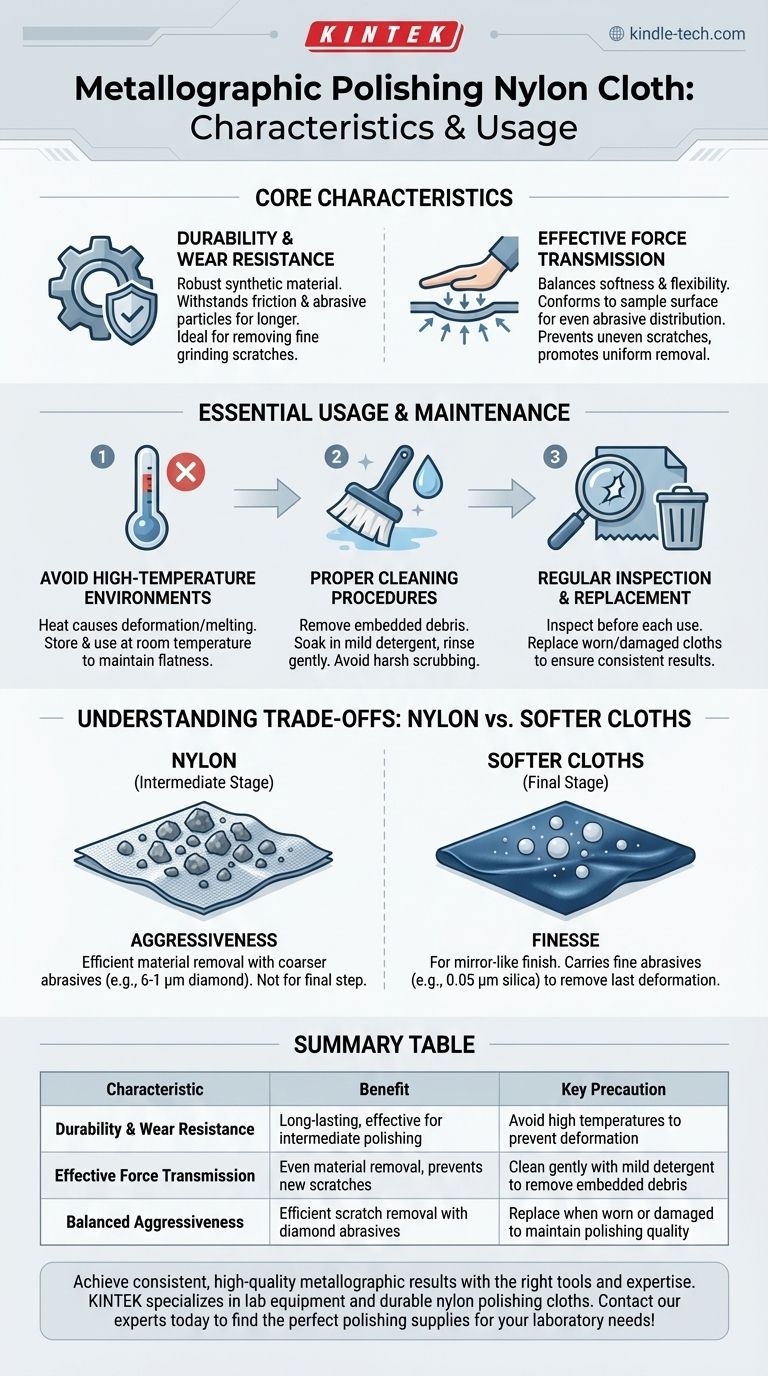
In metallographic polishing, nylon cloth is prized for its excellent wear resistance and durability. It provides a crucial balance of softness for even force distribution and toughness for effective material removal, particularly during intermediate polishing stages. Proper care involves avoiding high temperatures, cleaning gently with mild detergents, and replacing it periodically or when damaged to ensure consistent, high-quality sample finishes.

The core challenge in sample preparation is balancing efficient material removal with a flawless surface finish. Nylon cloth is the workhorse for the intermediate stages, but understanding its role in a sequential process—followed by softer cloths—is the key to achieving a truly mirror-like, artifact-free surface for analysis.

What are the characteristics and usage precautions for metallographic polishing nylon cloth? Master Intermediate Polishing for Flawless Samples

Core Characteristics of Nylon Polishing Cloth

Nylon polishing cloths are a staple in materials science labs due to their specific physical properties that make them ideal for certain steps in the metallographic preparation process.

Durability and Wear Resistance

Nylon is a robust synthetic material. This inherent toughness means the cloth can withstand the friction and abrasive particles used in polishing for longer periods than more delicate cloths.

This makes it highly effective for removing the fine scratches left behind by the final grinding stages, preparing the surface for final polishing.

Effective Force Transmission

While durable, nylon cloth also has sufficient softness and flexibility. This allows it to conform to the sample's surface, ensuring the polishing abrasive is distributed evenly.

This even transmission of force prevents the creation of new, uneven scratches and promotes a uniform material removal rate across the entire specimen.

Essential Usage and Maintenance Protocols

Proper handling and maintenance are not optional; they are critical for achieving repeatable results and protecting your samples from damage.

Avoiding High-Temperature Environments

Nylon is a thermoplastic polymer. Exposing the cloth to high heat can cause its fibers to deform, melt, or harden.

A deformed polishing surface will no longer be flat, leading to uneven polishing and potentially ruining the sample's planarity. Always store and use the cloths at room temperature.

Proper Cleaning Procedures

Over time, abrasive particles and sample debris can become embedded in the cloth, reducing its effectiveness and potentially causing scratches.

For stubborn residue, the cloth can be soaked in a mild detergent and gently rinsed. Avoid harsh scrubbing, which can damage the cloth's texture.

Regular Inspection and Replacement

A worn or damaged cloth is a primary source of polishing failures. You must inspect the cloth before each use for signs of tearing, contamination, or glazing (a smooth, worn-down surface).

Replace the cloth periodically as part of a standard lab protocol, and immediately if any damage is found. This discipline is essential for maintaining polishing effectiveness.

Understanding the Trade-offs: Nylon vs. Softer Cloths

No single polishing cloth is suitable for the entire process. Choosing the right cloth for the right stage is fundamental to success.

Aggressiveness vs. Finesse

Nylon's durability makes it more aggressive than final-polishing cloths. It is designed for efficient material removal with coarser abrasives (e.g., 6 to 1-micron diamond suspensions).

While it creates a very good surface, it is generally not used for the final step, as it may still impart very fine, minute scratches of its own.

The Role of Final Polishing Cloths

For the final, mirror-like finish, technicians switch to much softer, low-nap or napped cloths, such as silk or velvet. These cloths are far more delicate and less durable.

Their purpose is not significant material removal but to carry a very fine abrasive (e.g., 0.05-micron colloidal silica or alumina) to gently remove the last traces of deformation, revealing the true microstructure without introducing new scratches.

Making the Right Choice for Your Process

Selecting and maintaining your polishing cloth directly impacts the quality of your microstructural analysis. Base your decisions on the specific stage of your workflow.

  • If your primary focus is intermediate polishing: Use nylon cloth for its durability and efficient removal of fine grinding scratches with diamond abrasives.
  • If your primary focus is achieving a final, mirror-like finish: Transition from nylon to a softer cloth, like silk or velvet, for the final polishing steps with a sub-micron abrasive.
  • If your primary focus is consistency and tool life: Implement a strict protocol for cleaning, inspecting, and regularly replacing your nylon cloths to prevent sample damage and ensure repeatable results.

Proper cloth selection and care are foundational skills for revealing a material's true microstructure.

Summary Table:

Characteristic Benefit Key Precaution
Durability & Wear Resistance Long-lasting, effective for intermediate polishing Avoid high temperatures to prevent deformation
Effective Force Transmission Even material removal, prevents new scratches Clean gently with mild detergent to remove embedded debris
Balanced Aggressiveness Efficient scratch removal with diamond abrasives Replace when worn or damaged to maintain polishing quality

Achieve consistent, high-quality metallographic results with the right tools and expertise. KINTEK specializes in lab equipment and consumables, including durable nylon polishing cloths designed for intermediate polishing stages. Our products help you balance material removal and surface finish, ensuring your samples are prepared accurately for microstructural analysis. Contact our experts today to find the perfect polishing supplies for your laboratory needs!

Visual Guide
What are the characteristics and usage precautions for metallographic polishing nylon cloth? Master Intermediate Polishing for Flawless Samples Visual Guide

Related Products

People Also Ask

Related Products

Electrode Polishing Material for Electrochemical Experiments

Electrode Polishing Material for Electrochemical Experiments

Looking for a way to polish your electrodes for electrochemical experiments? Our polishing materials are here to help! Follow our easy instructions for best results.

Professional Cutting Tools for Carbon Paper Cloth Diaphragm Copper Aluminum Foil and More

Professional Cutting Tools for Carbon Paper Cloth Diaphragm Copper Aluminum Foil and More

Professional tools for cutting lithium sheets, carbon paper, carbon cloth, separators, copper foil, aluminum foil, etc., with round and square shapes and different sizes of blades.

Boron Nitride (BN) Ceramic Plate

Boron Nitride (BN) Ceramic Plate

Boron nitride (BN) ceramic plates do not use aluminum water to wet, and can provide comprehensive protection for the surface of materials that directly contact molten aluminum, magnesium, zinc alloys and their slag.

Nickel Foam for Industrial and Laboratory Applications

Nickel Foam for Industrial and Laboratory Applications

Nickel foam is a high-tech deep-processing, and the metal nickel is made into a foam sponge, which has a three-dimensional full-through mesh structure.

CVD Diamond Dressing Tools for Precision Applications

CVD Diamond Dressing Tools for Precision Applications

Experience the Unbeatable Performance of CVD Diamond Dresser Blanks: High Thermal Conductivity, Exceptional Wear Resistance, and Orientation Independence.

Laboratory CVD Boron Doped Diamond Materials

Laboratory CVD Boron Doped Diamond Materials

CVD boron-doped diamond: A versatile material enabling tailored electrical conductivity, optical transparency, and exceptional thermal properties for applications in electronics, optics, sensing, and quantum technologies.

Conductive Carbon Fiber Brush for Static Removal and Cleaning

Conductive Carbon Fiber Brush for Static Removal and Cleaning

Discover the benefits of using conductive carbon fiber brush for microbial cultivation and electrochemical testing. Improve your anode's performance.

Cylindrical Press Mold with Scale for Lab

Cylindrical Press Mold with Scale for Lab

Discover precision with our Cylindrical Press Mold. Ideal for high-pressure applications, it molds various shapes and sizes, ensuring stability and uniformity. Perfect for lab use.

Conductive Carbon Cloth Carbon Paper Carbon Felt for Electrodes and Batteries

Conductive Carbon Cloth Carbon Paper Carbon Felt for Electrodes and Batteries

Conductive carbon cloth, paper, and felt for electrochemical experiments. High-quality materials for reliable and accurate results. Order now for customization options.

Reference Electrode Calomel Silver Chloride Mercury Sulfate for Laboratory Use

Reference Electrode Calomel Silver Chloride Mercury Sulfate for Laboratory Use

Find high-quality reference electrodes for electrochemical experiments with complete specifications. Our models offer resistance to acid and alkali, durability, and safety, with customization options available to meet your specific needs.

Silicon Carbide (SIC) Ceramic Sheet Wear-Resistant Engineering Advanced Fine Ceramics

Silicon Carbide (SIC) Ceramic Sheet Wear-Resistant Engineering Advanced Fine Ceramics

Silicon carbide (sic) ceramic sheet is composed of high-purity silicon carbide and ultra-fine powder, which is formed by vibration molding and high-temperature sintering.

Battery Lab Equipment 304 Stainless Steel Strip Foil 20um Thick for Battery Test

Battery Lab Equipment 304 Stainless Steel Strip Foil 20um Thick for Battery Test

304 is a versatile stainless steel, which is widely used in the production of equipment and parts that require good overall performance (corrosion resistance and formability).

Square Lab Press Mold for Laboratory Applications

Square Lab Press Mold for Laboratory Applications

Create uniform samples easily with Square Lab Press Mold - available in various sizes. Ideal for battery, cement, ceramics, and more. Custom sizes available.

Custom PTFE Teflon Parts Manufacturer for PTFE Mesh F4 Sieve

Custom PTFE Teflon Parts Manufacturer for PTFE Mesh F4 Sieve

PTFE mesh sieve is a specialized test sieve designed for particle analysis in various industries, featuring a non-metallic mesh woven from PTFE filament. This synthetic mesh is ideal for applications where metal contamination is a concern . PTFE sieves are crucial for maintaining the integrity of samples in sensitive environments, ensuring accurate and reliable results in particle size distribution analysis.

Liquid Nitrogen Cryogenic Grinder Mill Cryomill with Screw Feeder

Liquid Nitrogen Cryogenic Grinder Mill Cryomill with Screw Feeder

Discover the Liquid Nitrogen Cryogenic Pulverizer with Screw Feeder, perfect for fine material processing. Ideal for plastics, rubber, and more. Boost your lab efficiency now!

Precision Wire Saw Laboratory Cutting Machine with 800mm x 800mm Workbench for Diamond Single Wire Circular Small Cutting

Precision Wire Saw Laboratory Cutting Machine with 800mm x 800mm Workbench for Diamond Single Wire Circular Small Cutting

Diamond wire cutting machines are mainly used for precision cutting of ceramics, crystals, glass, metals, rocks, thermoelectric materials, infrared optical materials, composite materials, biomedical materials and other material analysis samples. Especially suitable for precision cutting of ultra-thin plates with thickness up to 0.2mm.

Powerful Plastic Crusher Machine

Powerful Plastic Crusher Machine

KINTEK's powerful plastic crusher machines process 60-1350 KG/H of diverse plastics, ideal for labs and recycling. Durable, efficient, and customizable.

lab cryogenic grinding use liquid-nitrogen for pulverizing plastic raw materials and heat sensitive materials

lab cryogenic grinding use liquid-nitrogen for pulverizing plastic raw materials and heat sensitive materials

Discover the KT-CG01 Liquid Nitrogen Cryogenic Pulverizer, Ideal for Plastic and Heat-Sensitive Material Pulverization, Preserving Material Integrity and Delivering Ultra-Fine Results.

12 Inch 24 Inch High Precision Automatic Diamond Wire Cutting Machine Laboratory Saw Precision Wire EDM Cutting Machine

12 Inch 24 Inch High Precision Automatic Diamond Wire Cutting Machine Laboratory Saw Precision Wire EDM Cutting Machine

The high precision automatic diamond wire cutting machine is a versatile cutting tool that uses a diamond wire to cut through a wide range of materials, including conductive and non-conductive materials, ceramics, glass, rocks, gems, jade, meteorites, monocrystalline silicon, silicon carbide, polycrystalline silicon, refractory bricks, epoxy boards, and ferrite bodies. It is especially suitable for cutting various brittle crystals with high hardness, high value, and easy to break.

HFCVD Machine System Equipment for Drawing Die Nano-Diamond Coating

HFCVD Machine System Equipment for Drawing Die Nano-Diamond Coating

The nano-diamond composite coating drawing die uses cemented carbide (WC-Co) as the substrate, and uses the chemical vapor phase method ( CVD method for short ) to coat the conventional diamond and nano-diamond composite coating on the surface of the inner hole of the mold.


Leave Your Message