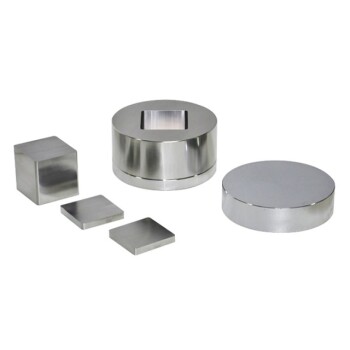
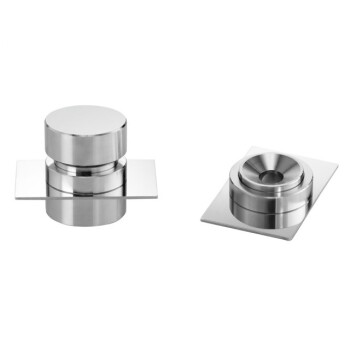
Graphite molds function as the critical interface between the vacuum hot pressing system and the CoCrCuFeNi high-entropy alloy powder. They serve a multi-faceted role by defining the component’s geometry, uniformly transmitting the necessary heat and hydraulic pressure for densification, and actively creating a chemical environment that prevents oxidation.
Core Takeaway Graphite molds are active process enablers, not just passive containers. Their unique ability to maintain mechanical stability at high temperatures while generating a local reducing atmosphere is essential for converting loose alloy powder into a dense, oxidation-free bulk material.
The Mechanics of Densification
Uniform Pressure Transmission
In vacuum hot pressing, densification relies on the rearrangement and plastic deformation of powder particles. The graphite mold acts as the direct transmission medium for this force.
It must withstand substantial axial loads—often ranging from 12 MPa to 50 MPa—applied by the hydraulic system. The mold transfers this pressure evenly to the CoCrCuFeNi powder, eliminating porosity and ensuring a structurally sound final product.
Efficient Thermal Transfer
Graphite possesses excellent thermal conductivity, which is vital for high-entropy alloys processed at elevated temperatures (e.g., 900°C).
The mold draws heat from the furnace elements and distributes it uniformly throughout the powder volume. This prevents thermal gradients that could lead to uneven sintering or residual stresses within the alloy block.
Structural Definition and Stability
High-Temperature Geometry Retention
The fundamental role of the mold is to define the shape of the sample, such as a cylinder or block.
Unlike metal molds that might soften or deform, graphite maintains exceptional thermal stability. It retains its dimensions and structural integrity even under the simultaneous stress of high heat and heavy hydraulic clamping pressure.
Chemical Protection of the Alloy
The Reducing Atmosphere Effect
Oxidation is a major risk for high-entropy alloys containing reactive elements like Chromium (Cr) and Iron (Fe).
At high temperatures, graphite naturally generates a reducing atmosphere. This chemical environment actively consumes residual oxygen within the mold cavity, adding a layer of protection beyond the vacuum itself. This ensures clean interfaces between metal particles, which facilitates better bonding and superior mechanical properties.
Process Considerations and Constraints
Mechanical Load Limits
While graphite is robust, it has a finite mechanical strength compared to tool steels.
Process engineers must carefully calculate the applied pressure (e.g., keeping within the 25–50 MPa range depending on the specific graphite grade) to avoid mold fracture. A cracked mold leads to pressure loss and immediate sintering failure.
Making the Right Choice for Your Goal
To optimize the sintering of CoCrCuFeNi alloys, consider how the mold interacts with your specific processing targets:
- If your primary focus is Densification: Ensure the graphite grade selected has high compressive strength to withstand the maximum hydraulic pressure (up to 50 MPa) without deformation.
- If your primary focus is Microstructural Purity: Maximize the graphite's reducing potential by ensuring a tight fit and high-purity mold material to effectively scavenge oxygen and prevent oxide inclusions.
The success of your vacuum hot pressing process depends as much on the quality of your graphite mold as it does on the furnace parameters.
Summary Table:
| Function | Description | Impact on Sintering |
|---|---|---|
| Pressure Transmission | Evenly transfers 12–50 MPa loads to powder | Eliminates porosity and ensures high density |
| Thermal Conductivity | Rapid, uniform heat distribution at 900°C+ | Prevents thermal gradients and residual stress |
| Geometry Retention | Maintains shape under high heat and pressure | Ensures dimensional accuracy of the bulk material |
| Reducing Atmosphere | Naturally consumes residual oxygen in the cavity | Prevents oxidation of reactive elements like Cr and Fe |
Elevate Your Alloy Research with KINTEK
Precision-engineered sintering requires high-performance equipment and high-purity consumables. KINTEK specializes in laboratory solutions for advanced metallurgy, offering state-of-the-art vacuum hot pressing systems, high-temperature furnaces, and premium graphite molds tailored for high-entropy alloy development.
Whether you need robust hydraulic presses (pellet, hot, or isostatic) or specialized ceramics and crucibles, our team provides the tools necessary to achieve superior densification and microstructural purity. Contact us today to optimize your sintering process!
Related Products
- 2200 ℃ Graphite Vacuum Heat Treat Furnace
- Ball Press Mold for Lab
- Anti-Cracking Press Mold for Lab Use
- Double Plate Heating Press Mold for Lab
- Ultra-High Temperature Graphite Vacuum Graphitization Furnace
People Also Ask
- What is the process of vacuum heat treating? Achieve Superior Hardening with a Clean, Bright Finish
- Why do you heat treat in a vacuum? Achieve Perfect Surface Finish and Material Integrity
- How does heat transmit in a vacuum? Mastering Thermal Radiation for Purity & Precision
- How does a vacuum heat treat furnace work? Achieve Pristine, Oxide-Free Metal Parts
- What is graphite heating? A Guide to Durable, High-Temp Industrial Furnace Solutions