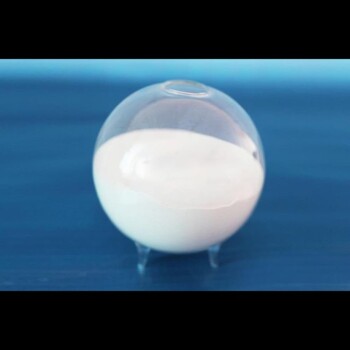
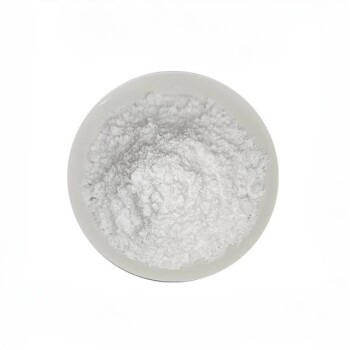
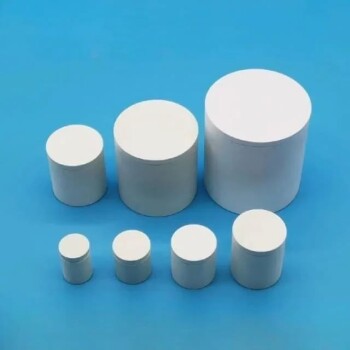
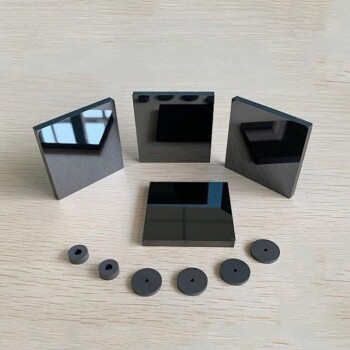
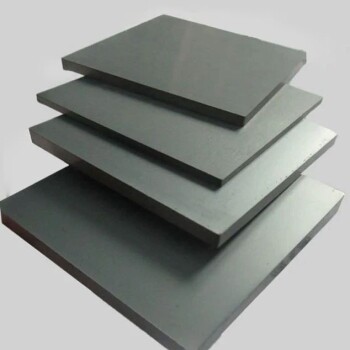
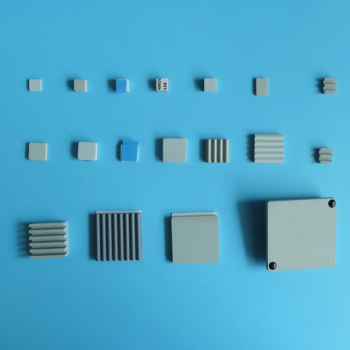
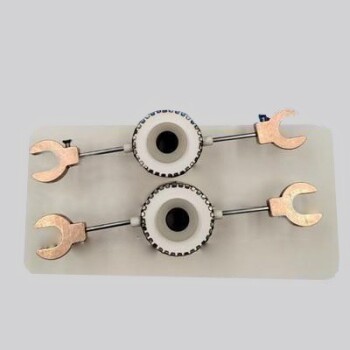
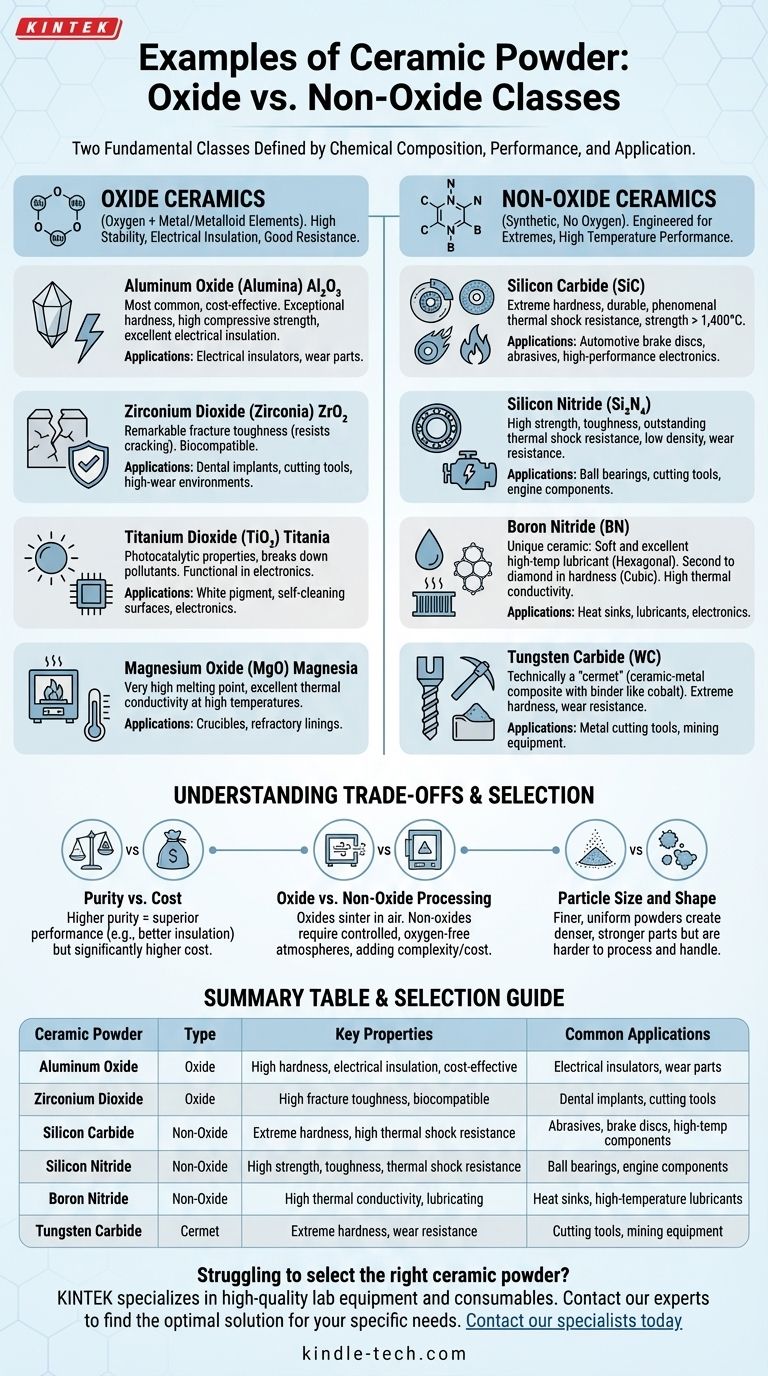
Examples of ceramic powder range from common, naturally derived metal oxides to advanced synthetic compounds engineered for extreme conditions. The most common examples include aluminum oxide (alumina), zirconium dioxide (zirconia), silicon carbide, and silicon nitride, each with distinct properties that define its use.
The most effective way to understand ceramic powders is not as a random list, but as a family of materials defined by their chemical composition. The fundamental distinction is between oxide ceramics and non-oxide ceramics, a classification that directly governs their performance, processing requirements, and ultimate application.
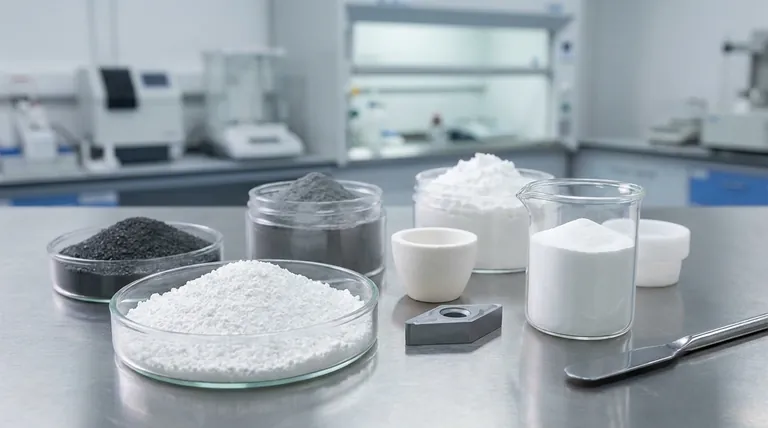
The Two Fundamental Classes of Ceramic Powders
Ceramic powders are the raw materials used to create dense, solid ceramic components through processes like pressing and sintering. Their classification is based on their core chemical makeup, which is the primary determinant of their final characteristics.
Oxide Ceramics: The Foundation
Oxide ceramics are compounds containing oxygen and one or more metallic or metalloid elements. They are generally known for their high stability, electrical insulation, and good resistance to wear and corrosion, making them the most widely used class of ceramics.
Aluminum Oxide (Al₂O₃) Also known as alumina, this is the most common and cost-effective technical ceramic. It is valued for its exceptional hardness, high compressive strength, and excellent electrical insulation properties.
Zirconium Dioxide (ZrO₂) Often called zirconia, this material is renowned for its remarkable fracture toughness, a property not common in most ceramics. This makes it ideal for high-wear environments and biomedical applications like dental implants.
Titanium Dioxide (TiO₂) While widely known as a white pigment in paints and sunscreens, titania is also a functional ceramic powder. It is used for its photocatalytic properties, which can break down organic pollutants, and in various electronic components.
Magnesium Oxide (MgO) Valued for its very high melting point and excellent thermal conductivity at high temperatures, magnesia is often used for crucibles and refractory linings in furnaces.
Non-Oxide Ceramics: Engineered for Extremes
Non-oxide ceramics are synthetic compounds that do not contain oxygen, instead incorporating elements like carbon, nitrogen, or boron. They are engineered to outperform oxides in specific, often extreme, conditions, particularly at very high temperatures.
Silicon Carbide (SiC) One of the hardest and most durable ceramic materials, silicon carbide offers phenomenal thermal shock resistance and maintains its strength at temperatures exceeding 1,400°C. It is used in automotive brake discs, abrasives, and high-performance electronics.
Silicon Nitride (Si₃N₄) This material combines high strength, toughness, and outstanding thermal shock resistance. Its low density and wear resistance make silicon nitride a key material for ball bearings, cutting tools, and components in automotive engines.
Boron Nitride (BN) Often called "white graphite," boron nitride is a unique ceramic that is soft and an excellent high-temperature lubricant. In its cubic form, it is second only to diamond in hardness, while its hexagonal form offers superb thermal conductivity and is used in electronics for heat management.
Tungsten Carbide (WC) Technically a "cermet" (ceramic-metal composite) when combined with a metallic binder like cobalt, tungsten carbide is famous for its extreme hardness and wear resistance. It is the primary material for metal cutting tools and mining equipment.
Understanding the Trade-offs
Choosing a ceramic powder is not just about picking the one with the best single property. It involves a series of critical trade-offs that impact performance, cost, and manufacturability.
Purity vs. Cost
Higher-purity powders (e.g., 99.99% pure alumina vs. 95%) deliver superior performance, such as better electrical insulation or higher strength. However, this purity comes at a significantly higher cost due to the complex chemical processing required.
Oxide vs. Non-Oxide Processing
Oxide ceramics are generally stable and can be sintered (fired) in an air atmosphere. In contrast, non-oxide ceramics like silicon nitride or carbide will readily oxidize at high temperatures, requiring controlled, oxygen-free atmospheres (like nitrogen or argon), which adds considerable complexity and cost to manufacturing.
Particle Size and Shape
The size, shape, and distribution of the powder particles are critical. Finer, more uniform powders can be sintered into denser, stronger final parts. However, these fine powders can be more difficult to handle and process, sometimes requiring specialized equipment to prevent clumping.
Selecting the Right Powder for Your Application
Your choice of ceramic powder must be directly tied to the primary challenge you are trying to solve.
- If your primary focus is general wear resistance and electrical insulation at a reasonable cost: Alumina is the industry standard and the best place to start.
- If your primary focus is exceptional fracture toughness, especially for biomedical or high-impact parts: Zirconia is the leading choice for its ability to resist crack propagation.
- If your primary focus is performance at extreme temperatures and resistance to thermal shock: Silicon Carbide and Silicon Nitride are the superior materials to investigate.
- If your primary focus is thermal management or high-temperature lubrication: Hexagonal Boron Nitride offers a unique combination of properties that other ceramics cannot match.
Understanding these foundational categories transforms your perspective from simply listing examples to strategically selecting the optimal material for your specific engineering challenge.
Summary Table:
| Ceramic Powder | Type | Key Properties | Common Applications |
|---|---|---|---|
| Aluminum Oxide (Alumina) | Oxide | High hardness, electrical insulation, cost-effective | Electrical insulators, wear parts |
| Zirconium Dioxide (Zirconia) | Oxide | High fracture toughness, biocompatible | Dental implants, cutting tools |
| Silicon Carbide (SiC) | Non-Oxide | Extreme hardness, high thermal shock resistance | Abrasives, brake discs, high-temp components |
| Silicon Nitride (Si₃N₄) | Non-Oxide | High strength, toughness, thermal shock resistance | Ball bearings, engine components |
| Boron Nitride (BN) | Non-Oxide | High thermal conductivity, lubricating | Heat sinks, high-temperature lubricants |
| Tungsten Carbide (WC) | Cermet | Extreme hardness, wear resistance | Cutting tools, mining equipment |
Struggling to select the right ceramic powder for your specific lab or production needs? The choice between oxides like alumina and non-oxides like silicon carbide directly impacts your project's performance, cost, and success. KINTEK specializes in high-quality lab equipment and consumables, serving diverse laboratory needs. Our experts can help you navigate material properties and processing requirements to find the optimal solution. Contact our specialists today to discuss your application and ensure you get the right material for the job.
Visual Guide
Related Products
- High Purity Alumina Granulated Powder for Engineering Advanced Fine Ceramics
- Advanced Engineering Fine Ceramics Low Temperature Alumina Granulation Powder
- Boron Nitride (BN) Crucible for Phosphorous Powder Sintered
- Silicon Carbide (SIC) Ceramic Sheet Wear-Resistant Engineering Advanced Fine Ceramics
- Advanced Engineering Fine Ceramics Alumina Ceramic Saggar for Fine Corundum
People Also Ask
- How should alumina powder be selected for polishing a disc electrode, and what is the procedure for removing scratches? Achieve a Perfect Mirror Finish
- What is the purpose of alumina polishing powder in GCE pretreatment? Master Surface Prep for Electrochemistry
- What is the function of high-purity alumina powder in pack cementation? Ensure Uniform Aerospace Blade Coatings
- Why is it necessary to apply alumina powder to graphite molds for TiC10/Cu-Al2O3? Ensure Smooth Release.
- Which of the following is used in furnace to withstand high temperature? Key Materials for Extreme Heat