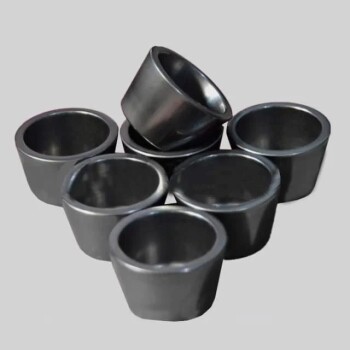
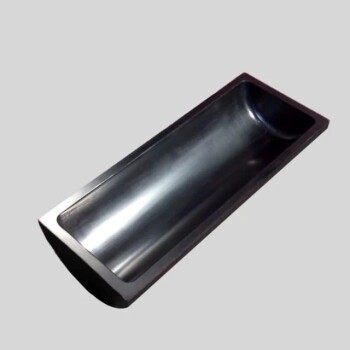
The primary functions of a high-purity graphite die-punch assembly in vacuum hot press sintering are to serve as a precise containment vessel for composite powders and to act as a transmission medium for high mechanical pressure. By leveraging graphite's unique material properties, the assembly ensures the powder is compressed into a dense solid while simultaneously regulating the thermal environment around the sample.
The core value of high-purity graphite lies in its ability to maintain structural integrity under extreme conditions; it allows for the application of massive pressures (tens of megapascals) at temperatures exceeding 1000°C, facilitating the particle rearrangement and gas expulsion necessary for high-density sintering.
The Role of Mechanical Pressure
Transmitting Uniaxial Force
The most critical function of the punch assembly is acting as a physical bridge between the hydraulic ram and the powder. It transmits uniaxial pressure directly to the composite material.
Facilitating Densification
By delivering stable pressure (often reaching 30-35 MPa), the assembly forces powder particles into close contact. This mechanical compression rearranges the particles and drives the expulsion of trapped gases, which is a prerequisite for achieving a non-porous, high-density final product.
Structural Stability at High Temperatures
To function effectively, the die must not yield under load. High-purity graphite is selected specifically for its superior high-temperature strength, allowing it to withstand immense pressure at 1000°C without significant deformation or failure.
Thermal Regulation and Shaping
Ensuring Thermal Uniformity
Beyond mechanics, the graphite die acts as a critical thermal regulator. Because high-purity graphite possesses high thermal conductivity, it ensures that heat is transferred evenly from the furnace environment to the internal powder.
Preventing Microstructural Defects
This uniform heat transfer is vital for the consistency of the sintering process. It prevents thermal gradients that could lead to uneven sintering, warping, or inconsistent material properties across the sample.
Defining Geometrical Constraints
The die assembly serves as the primary forming container. It rigidly fixes the shape of the powder throughout the process, ensuring the final sintered component matches the required geometric specifications.
Understanding the Trade-offs
Pressure Limitations
While graphite is exceptionally strong at high temperatures compared to many metals, it still has finite limits. The assembly is typically rated for pressures in the "tens of megapascals" (e.g., 35 MPa); exceeding this can lead to brittle fracture of the die.
The Necessity of Purity
The specification of "high-purity" is not cosmetic; it is functional. Lower-grade graphite may introduce impurities into the composite powder or suffer from inconsistent density, which would compromise the uniform heat transfer and mechanical stability required for precision sintering.
Making the Right Choice for Your Goal
To maximize the effectiveness of your vacuum hot press process, match your tooling strategy to your specific material requirements:
- If your primary focus is Maximum Density: Prioritize the structural rating of the graphite to ensure it can withstand the upper limits of axial pressure (30+ MPa) without deformation.
- If your primary focus is Microstructural Consistency: Ensure the graphite grade selected has the highest possible thermal conductivity to eliminate cold spots during the heating ramp.
High-purity graphite is not just a container; it is an active participant in the thermodynamic and mechanical evolution of your material.
Summary Table:
| Function | Description | Key Benefit |
|---|---|---|
| Pressure Transmission | Bridges hydraulic ram and powder to apply uniaxial force (30-35 MPa). | Ensures particle rearrangement and gas expulsion for high density. |
| Thermal Regulation | High thermal conductivity ensures even heat distribution across the sample. | Prevents microstructural defects and inconsistent material properties. |
| Structural Containment | Provides rigid geometric constraints at temperatures exceeding 1000°C. | Maintains precise shape and prevents deformation under extreme load. |
| Material Purity | Prevents contamination of the composite powder during sintering. | Ensures high-quality, pure final sintered components. |
Elevate your material science research with KINTEK’s precision engineering. Whether you are performing vacuum hot press sintering or utilizing our extensive range of high-temperature furnaces (CVD, PECVD, vacuum, and atmosphere), our high-purity graphite solutions ensure maximum density and microstructural consistency. KINTEK specializes in laboratory equipment and consumables, from hydraulic presses and crushing systems to high-temperature high-pressure reactors and dental furnaces. Let our experts provide the durable, high-performance tools your lab deserves. Contact KINTEK today to optimize your sintering process!
Related Products
- High Purity Pure Graphite Crucible for Evaporation
- High Purity Pure Graphite Crucible for Electron Beam Evaporation
- Horizontal High Temperature Graphite Vacuum Graphitization Furnace
- Vertical High Temperature Graphite Vacuum Graphitization Furnace
- Large Vertical Graphite Vacuum Graphitization Furnace
People Also Ask
- Why are high-purity graphite crucibles preferred for sulfide solid electrolytes? Achieve Superior Material Purity
- Why is a high-purity graphite crucible required for Chromel-TaC composites? Ensure Peak Purity at 1400°C
- What role do high-purity graphite crucibles play in molten salt corrosion research? Ensure Reactor-Grade Precision
- Why are high-purity graphite crucibles used for magnesium distillation? Ensure 3N8 Purity & Thermal Stability
- Why is a high-purity graphite crucible ideal for nitrogen-doped graphene at 1500 °C? Maximize Purity and Stability