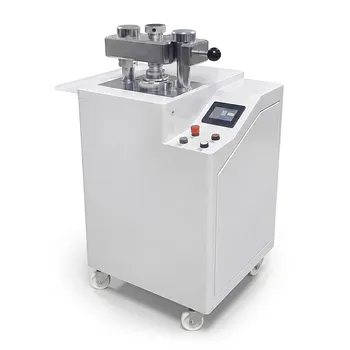
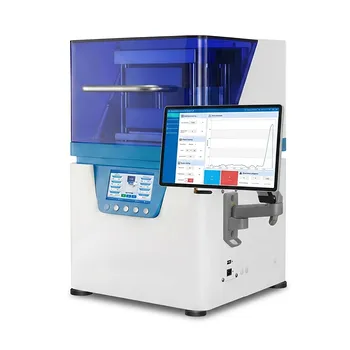
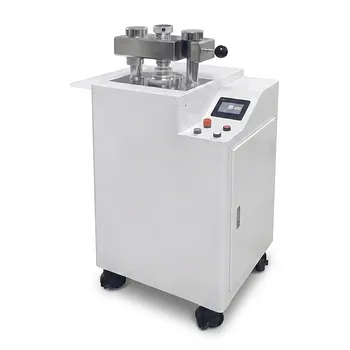
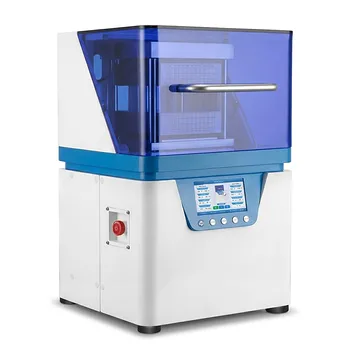
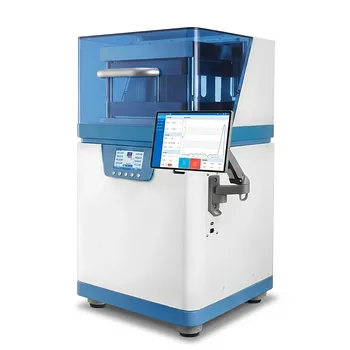
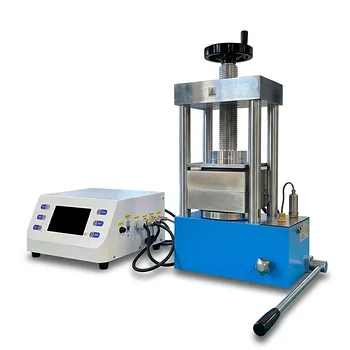
To measure the conductivity of LFMSO samples accurately, a laboratory hydraulic press creates a dense physical baseline while an AC impedance analyzer isolates the material's intrinsic electrochemical properties.
The laboratory hydraulic press densifies loose LFMSO powder into solid pellets to minimize inter-particle contact resistance and eliminate voids. Following this preparation, the AC impedance analyzer measures the complex impedance spectra over a broad frequency range, allowing researchers to use Nyquist plots to distinguish between bulk, grain boundary, and ionic resistance.
Core Takeaway: Reliable conductivity data for LFMSO depends on a two-stage process: using a hydraulic press to eliminate physical inconsistencies in the sample, and utilizing an AC impedance analyzer to mathematically isolate the material's true ionic resistance from external factors.
The Role of the Laboratory Hydraulic Press
Densification and Void Elimination
The primary function of the hydraulic press is to transform loose LFMSO powder into a dense, uniform pellet. By applying controlled high pressure, the press forces particles to rearrange, eliminating internal pores and air gaps that would otherwise impede electrical flow.
Minimizing Inter-particle Contact Resistance
In its powder form, LFMSO exhibits high resistance due to the limited contact area between individual grains. The hydraulic press ensures intimate contact between particles, which is essential for reducing grain boundary resistance and ensuring the sample mimics a continuous solid medium.
Establishing Geometric Consistency
Standardized measurements require precise sample dimensions, such as a specific thickness and diameter. The press, often used with specialized precision molds, ensures that every sample has a uniform density and geometry, which is a critical prerequisite for calculating conductivity from raw resistance data.
The Role of the AC Impedance Analyzer
Frequency-Dependent Impedance Spectroscopy
Unlike simple DC meters, an AC impedance analyzer sweeps through a wide frequency range. This allows the device to capture how the LFMSO sample responds to alternating current at different speeds, revealing the complex electrochemical environment within the pellet.
Isolation of Ionic Conductivity
By generating Nyquist plots, the analyzer enables researchers to visualize different resistive components. This process is vital for fitting data to equivalent circuit models, effectively separating the intrinsic ionic resistance of the LFMSO from the resistance caused by electrodes or grain boundaries.
High-Precision Data Characterization
The analyzer provides the resolution necessary to detect subtle changes in material behavior under varying conditions. This precision ensures that the final conductivity value is a reflection of the material’s chemical composition rather than an artifact of the testing setup or sample preparation.
Understanding the Trade-offs and Pitfalls
Pressure-Induced Material Alteration
While high pressure is necessary for densification, excessive force can lead to mechanical degradation or phase changes in the LFMSO. Researchers must calibrate the pressure—often ranging from 1 MPa to 400 MPa depending on the material—to avoid crushing grains or inducing structural defects.
Complexity of Impedance Fitting
The accuracy of the AC impedance analyzer depends heavily on the mathematical model used to interpret the Nyquist plot. Selecting an incorrect equivalent circuit can lead to the misidentification of bulk resistance, resulting in inaccurate conductivity calculations.
Surface and Contact Quality
Even a perfectly pressed pellet can yield poor data if the contact between the sample and the blocking electrodes is insufficient. Any microscopic gap at the interface acts as an additional capacitor, which can distort the impedance spectra and obscure the material's true properties.
How to Apply These Tools to Your Project
Recommendations Based on Research Goals
- If your primary focus is maximizing data repeatability: Use a standardized mold and a consistent cold pressure (e.g., 10 MPa to 400 MPa) for every LFMSO pellet to ensure a uniform physical baseline.
- If your primary focus is distinguishing bulk vs. grain boundary effects: Utilize an AC impedance analyzer with a broad frequency sweep and employ rigorous Nyquist plot fitting to isolate specific resistive elements.
- If your primary focus is evaluating electrode-electrolyte interfaces: Ensure the hydraulic press provides a smooth, flat surface on the pellet to facilitate seamless contact with the analyzer's probes.
By integrating the physical standardization of the hydraulic press with the analytical depth of the AC impedance analyzer, you can transform raw LFMSO powder into reliable, high-fidelity electrochemical data.
Summary Table:
| Equipment | Primary Function | Key Benefit for LFMSO Analysis |
|---|---|---|
| Laboratory Hydraulic Press | Sample densification & void elimination | Minimizes inter-particle resistance; ensures geometric consistency. |
| AC Impedance Analyzer | Frequency-dependent spectroscopy | Isolates intrinsic ionic conductivity from grain boundary resistance. |
| Precision Molds | Geometric standardization | Ensures uniform density and precise dimensions for conductivity calculations. |
| Nyquist Plot Analysis | Data visualization & modeling | Mathematically separates bulk resistance from external setup artifacts. |
Elevate Your Material Characterization with KINTEK
Precision in LFMSO conductivity measurement begins with flawless sample preparation. KINTEK specializes in high-performance laboratory equipment designed to meet the rigorous demands of electrochemical research. Our comprehensive range of laboratory hydraulic presses (pellet, hot, and isostatic) ensures your samples achieve the density and uniformity required for high-fidelity impedance analysis.
Beyond sample preparation, KINTEK offers a full suite of research tools, including:
- High-temperature furnaces (muffle, vacuum, and atmosphere) for material synthesis.
- Crushing and milling systems for optimal powder processing.
- Advanced electrochemical solutions, including electrolytic cells and battery research consumables.
Ready to eliminate physical inconsistencies and secure reliable data for your next project? Contact KINTEK today to discover how our high-precision equipment and technical expertise can optimize your laboratory workflow!
References
- Zhi Deng, Zhaoxiang Wang. Cation Disordered Anti‐Perovskite Cathode Materials with Enhanced Lithium Diffusion and Suppressed Phase Transition. DOI: 10.1002/aenm.202300695
This article is also based on technical information from Kintek Solution Knowledge Base .
Related Products
- Laboratory Hydraulic Press Split Electric Lab Pellet Press
- Laboratory Hydraulic Press Lab Pellet Press for Button Battery
- Automatic Laboratory Hydraulic Pellet Press Machine for Lab Use
- Automatic XRF Pellet Press 40 Ton Hydraulic Sample Preparation Press for Fluorescent Spectroscopy Analysis
- Laboratory Manual Hydraulic Pellet Press for Lab Use
People Also Ask
- What role does a laboratory hydraulic press play in platinum recovery research? Enhancing Sample Precision
- What are the specific applications of a lab hydraulic press in biochar evaluation? Optimize density and data accuracy.
- What are the roles of a laboratory hydraulic press and stainless steel molds in the preparation of graphite samples?
- What is the role of a laboratory hydraulic press in electrode prep? Maximize Energy Density & Sealing Precision
- Why must a laboratory hydraulic press equipped with cylindrical molds be used when preparing BZY green bodies? High Density