Knowledge vacuum induction melting furnace What are the hazards of induction heating? Key Electrical, Burn, and EMF Risks
Author avatar

Tech Team · Kintek Solution

Updated 2 months ago

What are the hazards of induction heating? Key Electrical, Burn, and EMF Risks


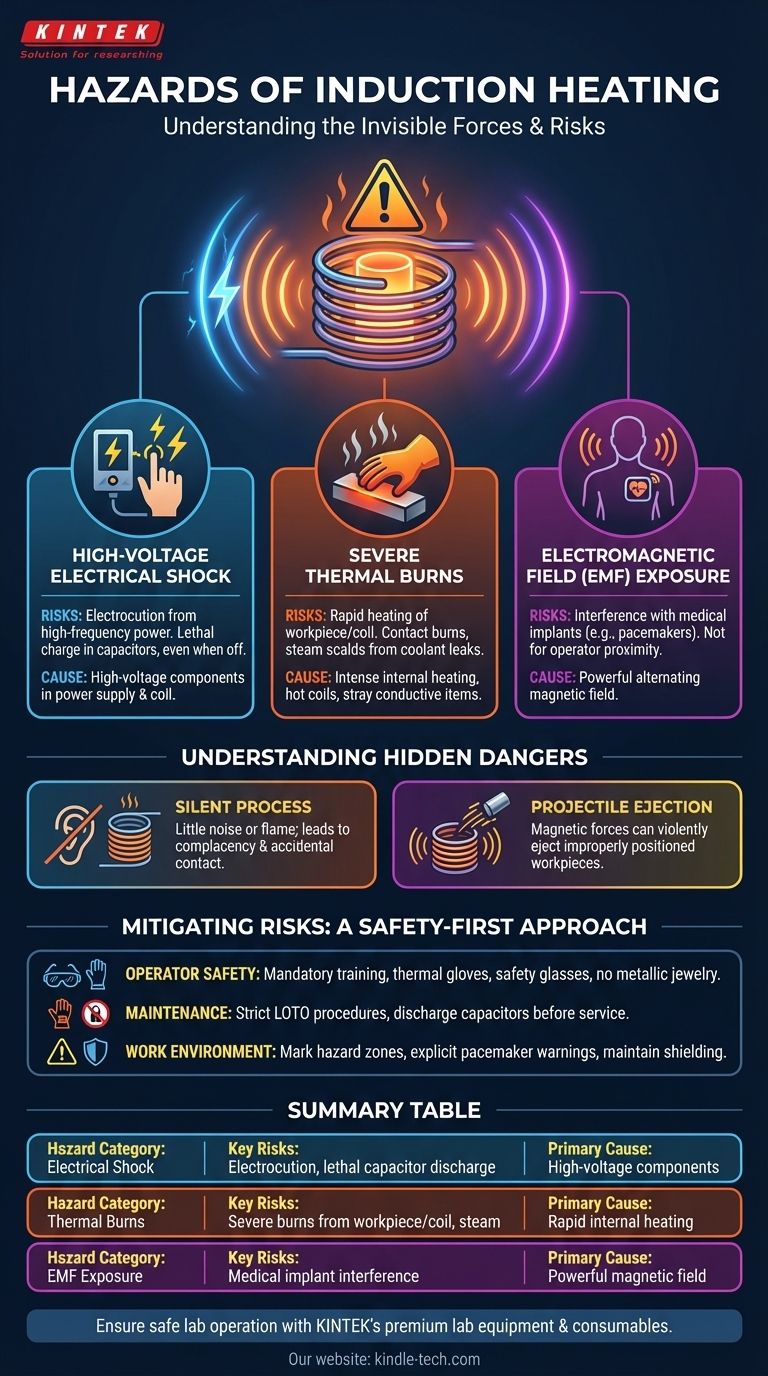
While induction heating is rightly praised for its speed and cleanliness, it presents three primary categories of hazards: severe electrical shock from high-voltage components, serious thermal burns from rapidly heated materials, and potential health risks from strong electromagnetic fields. Understanding these dangers is the first step toward implementing a safe and effective process.

The core hazards of induction heating are often less intuitive than those of open-flame methods. They stem from the invisible forces of high-voltage electricity and powerful magnetic fields, which can cause harm without the warning signs of noise or visible flame.
What are the hazards of induction heating? Key Electrical, Burn, and EMF Risks

The Primary Hazard Categories

To operate an induction system safely, you must understand where the dangers originate. The risks can be broken down into three distinct physical principles at play.

High-Voltage Electrical Shock

The power supply for an induction heater converts standard plant voltage into a high-frequency, high-current output to drive the induction coil. This creates a significant risk of electrocution.

Contact with the internal components of the power supply or the induction coil itself can be lethal. A critical point of awareness is that capacitors within the power supply can store a deadly charge long after the main power has been disconnected.

Severe Thermal Burns

Induction heating generates heat inside the workpiece, leading to extremely rapid temperature increases. This presents several vectors for severe burns.

The workpiece itself can become red-hot in seconds, often without any visible flame or warning. Accidental contact will cause an immediate and deep burn.

The induction coil also becomes hot due to its own electrical resistance (I²R losses) and proximity to the heated part. Coils are typically water-cooled, and a leak in a coolant line can create a secondary scald hazard from steam.

Finally, any stray conductive materials, such as rings, watches, or metallic tools, brought into the magnetic field will also heat up instantly, posing a serious risk of contact burns to the operator.

Electromagnetic Field (EMF) Exposure

The process works by creating a powerful, alternating magnetic field. While generally safe for operators at a distance, this field is a critical hazard for certain individuals.

The primary and most acute risk is to personnel with active medical implants, such as pacemakers or insulin pumps. The strong magnetic field can interfere with or disable these life-sustaining devices.

All facilities using induction heating must have clear signage and protocols to prevent individuals with such implants from entering areas where the field strength is significant.

Understanding the Trade-offs: Hidden Dangers

Unlike conventional heating, the hazards of induction are often silent and invisible, which requires a different level of situational awareness.

The "Silent" Nature of the Process

A gas furnace has a visible flame and a distinct roar. An induction heater, by contrast, can bring a piece of steel to its melting point with little more than a quiet hum. This lack of sensory feedback can lead to complacency and accidental contact.

Risk of Projectile Ejection

The powerful magnetic forces can, in some cases, violently eject a small or improperly positioned workpiece from the coil. This turns the heated part into a dangerous projectile, creating a risk of both impact injury and burns.

Auxiliary System Failures

The safety of the system relies on more than just the power supply and coil. A failure in the water-cooling system is a common point of failure that can cause the coil to overheat and rupture, potentially creating an arc flash or steam explosion.

Mitigating Risks: A Safety-First Approach

Effectively managing these hazards requires specific procedures tailored to the unique nature of induction heating.

  • If your primary focus is operator safety: Implement mandatory training on all hazards, enforce the use of thermal gloves and safety glasses, and establish a strict policy against wearing metallic jewelry near the equipment.
  • If your primary focus is equipment maintenance: Always enforce strict Lockout/Tagout (LOTO) procedures, paying special attention to discharging stored energy from capacitors before any service begins.
  • If your primary focus is managing the work environment: Clearly mark hazard zones around the coil, post explicit warnings for pacemaker wearers, and ensure the equipment's shielding is properly maintained to contain the magnetic field.

By respecting the invisible forces at play, you can leverage the power of induction heating both effectively and safely.

Summary Table:

Hazard Category Key Risks Primary Cause
Electrical Shock Electrocution, lethal capacitor discharge High-voltage components in power supply/coil
Thermal Burns Severe burns from hot workpiece/coil, steam from coolant leaks Rapid internal heating of materials
EMF Exposure Interference with medical implants (pacemakers) Powerful alternating magnetic field

Ensure your lab operates safely with the right equipment. The hazards of induction heating demand reliable, well-designed systems. KINTEK specializes in premium lab equipment and consumables, serving all your laboratory needs. Our experts can help you select the safest induction heating solutions for your application. Contact us today to discuss how we can enhance your lab's safety and efficiency!

Visual Guide
What are the hazards of induction heating? Key Electrical, Burn, and EMF Risks Visual Guide

Related Products

People Also Ask

Related Products

600T Vacuum Induction Hot Press Furnace for Heat Treat and Sintering

600T Vacuum Induction Hot Press Furnace for Heat Treat and Sintering

Discover the 600T Vacuum Induction Hot Press Furnace, designed for high-temperature sintering experiments in vacuum or protected atmospheres. Its precise temperature and pressure control, adjustable working pressure, and advanced safety features make it ideal for nonmetal materials, carbon composites, ceramics, and metal powders.

Infrared Heating Quantitative Flat Plate Press Mold

Infrared Heating Quantitative Flat Plate Press Mold

Discover advanced infrared heating solutions with high-density insulation and precise PID control for uniform thermal performance in various applications.

Lab-Scale Vacuum Induction Melting Furnace

Lab-Scale Vacuum Induction Melting Furnace

Get precise alloy composition with our Vacuum Induction Melting Furnace. Ideal for aerospace, nuclear energy, and electronic industries. Order now for effective smelting and casting of metals and alloys.

Silicon Carbide SiC Thermal Heating Elements for Electric Furnace

Silicon Carbide SiC Thermal Heating Elements for Electric Furnace

Experience the advantages of Silicon Carbide (SiC) Heating Element: Long service life, high corrosion and oxidation resistance, fast heating speed, and easy maintenance. Learn more now!

Laboratory Small Constant Temperature Heated Magnetic Stirrer Heater and Stirrer

Laboratory Small Constant Temperature Heated Magnetic Stirrer Heater and Stirrer

The Laboratory Small Constant Temperature Heating Magnetic Stirrer is a versatile tool designed for precise temperature control and efficient mixing in various laboratory applications.

10L Heating Chilling Circulator Cooling Water Bath Circulator for High and Low Temperature Constant Temperature Reaction

10L Heating Chilling Circulator Cooling Water Bath Circulator for High and Low Temperature Constant Temperature Reaction

Experience efficient lab performance with KinTek KCBH 10L Heating Chilling Circulator. Its all-in-one design offers reliable heating, chilling, and circulating functions for industrial and lab use.

Molybdenum Disilicide (MoSi2) Thermal Elements Electric Furnace Heating Element

Molybdenum Disilicide (MoSi2) Thermal Elements Electric Furnace Heating Element

Discover the power of Molybdenum Disilicide (MoSi2) Heating Element for high-temperature resistance. Unique oxidation resistance with stable resistance value. Learn more about its benefits now!

High Temperature Constant Temperature Heating Circulator Water Bath Chiller Circulator for Reaction Bath

High Temperature Constant Temperature Heating Circulator Water Bath Chiller Circulator for Reaction Bath

Efficient and reliable, KinTek KHB Heating Circulator is perfect for your lab needs. With a max. heating temperature of up to 300℃, it features accurate temperature control and fast heating.

100L Heating Chilling Circulator Cooling Water Bath Circulator for High and Low Temperature Constant Temperature Reaction

100L Heating Chilling Circulator Cooling Water Bath Circulator for High and Low Temperature Constant Temperature Reaction

Get all-in-one heating, chilling, and circulating capabilities with our KinTek KCBH 80L Heating Chilling Circulator. High efficiency, reliable performance for labs and industrial applications.

5L Heating Chilling Circulator Cooling Water Bath Circulator for High and Low Temperature Constant Temperature Reaction

5L Heating Chilling Circulator Cooling Water Bath Circulator for High and Low Temperature Constant Temperature Reaction

KinTek KCBH 5L Heating Chilling Circulator - Ideal for labs and industrial conditions with multi-functional design and reliable performance.

30L Heating Chilling Circulator Cooling Water Bath Circulator for High and Low Temperature Constant Temperature Reaction

30L Heating Chilling Circulator Cooling Water Bath Circulator for High and Low Temperature Constant Temperature Reaction

Get versatile lab performance with KinTek KCBH 30L Heating Chilling Circulator. With max. heating temp of 200℃ and max. chilling temp of -80℃, it's perfect for industrial needs.

Double Plate Heating Press Mold for Lab

Double Plate Heating Press Mold for Lab

Discover precision in heating with our Double Plate Heating Mold, featuring high-quality steel and uniform temperature control for efficient lab processes. Ideal for various thermal applications.

50L Heating Chilling Circulator Cooling Water Bath Circulator for High and Low Temperature Constant Temperature Reaction

50L Heating Chilling Circulator Cooling Water Bath Circulator for High and Low Temperature Constant Temperature Reaction

Experience versatile heating, chilling, and circulating capabilities with our KinTek KCBH 50L Heating Chilling Circulator. Ideal for labs and industrial settings, with efficient and reliable performance.

20L Heating Chilling Circulator Cooling Water Bath Circulator for High and Low Temperature Constant Temperature Reaction

20L Heating Chilling Circulator Cooling Water Bath Circulator for High and Low Temperature Constant Temperature Reaction

Maximize lab productivity with KinTek KCBH 20L Heating Chilling Circulator. Its all-in-one design offers reliable heating, chilling, and circulating functions for industrial and lab use.

Controlled Nitrogen Inert Hydrogen Atmosphere Furnace

Controlled Nitrogen Inert Hydrogen Atmosphere Furnace

KT-AH Hydrogen atmosphere furnace - induction gas furnace for sintering/annealing with built-in safety features, dual housing design, and energy-saving efficiency. Ideal for lab and industrial use.

Heated Hydraulic Press Machine with Integrated Manual Heated Plates for Lab Use

Heated Hydraulic Press Machine with Integrated Manual Heated Plates for Lab Use

Efficiently process heat-pressing samples with our Integrated Manual Heated Lab Press. With a heating range up to 500°C, it's perfect for various industries.

Electric Rotary Kiln Continuous Working Small Rotary Furnace Heating Pyrolysis Plant

Electric Rotary Kiln Continuous Working Small Rotary Furnace Heating Pyrolysis Plant

Efficiently calcine and dry bulk powder and lump fluid materials with an electric heating rotary furnace. Ideal for processing lithium ion battery materials and more.

Manual High Temperature Heated Hydraulic Press Machine with Heated Plates for Lab

Manual High Temperature Heated Hydraulic Press Machine with Heated Plates for Lab

The High Temperature Hot Press is a machine specifically designed for pressing, sintering and processing materials in a high temperature environment. It is capable of operating in the range of hundreds of degrees Celsius to thousands of degrees Celsius for a variety of high temperature process requirements.

Automatic High Temperature Heated Hydraulic Press Machine with Heated Plates for Lab

Automatic High Temperature Heated Hydraulic Press Machine with Heated Plates for Lab

The High Temperature Hot Press is a machine specifically designed for pressing, sintering and processing materials in a high temperature environment. It is capable of operating in the range of hundreds of degrees Celsius to thousands of degrees Celsius for a variety of high temperature process requirements.


Leave Your Message