Knowledge vacuum hot press furnace What role does mechanical pressure play during the vacuum diffusion bonding of tungsten and copper? Keys to Solid Bonding
Author avatar

Tech Team · Kintek Solution

Updated 17 hours ago

What role does mechanical pressure play during the vacuum diffusion bonding of tungsten and copper? Keys to Solid Bonding


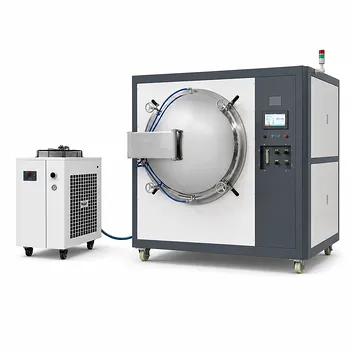
Mechanical pressure acts as the primary physical driver in the vacuum diffusion bonding of tungsten and copper. By applying a continuous force, such as 30 MPa, the vacuum hot press furnace ensures intimate contact between the tungsten substrate, the Fe-W interlayer, and the copper. This physical compression is necessary to overcome surface roughness and initiate the atomic mixing required for a solid bond.

While the vacuum environment prevents new oxidation, mechanical pressure is responsible for breaking down existing barriers. It forces materials together to disrupt residual oxides and close microscopic voids, enabling the mutual diffusion of atoms into a dense, solid-solution layer.

Creating the Physical Interface

Overcoming Surface Irregularities

Even carefully prepared surfaces contain microscopic peaks and valleys. The application of continuous mechanical pressure forces the tungsten and copper surfaces against the Fe-W interlayer.

This pressure flattens these microscopic irregularities. The result is tight physical contact, which is the absolute prerequisite for any diffusion bonding to occur.

Disrupting Residual Oxide Films

Oxide layers are natural barriers that block atomic diffusion and weaken bond strength. Mechanical pressure plays a critical role in physically disrupting these residual films.

By fracturing these layers under load, the process exposes clean metal surfaces. This allows atoms to interact directly, bypassing the blocking effect of surface oxides.

Facilitating Atomic Diffusion

Enhancing Mutual Diffusion

Once physical barriers are removed, pressure promotes the mutual diffusion of atoms across the interface. This is the core mechanism that transforms two separate metals into a unified component.

The movement of atoms across the boundary leads to the formation of a dense solid-solution diffusion layer. This layer is responsible for the mechanical strength of the final assembly.

Increasing Density and Reducing Voids

Inside the furnace, the combination of high temperature and high pressure drives the densification of the materials.

Pressure causes the grains to grow while simultaneously forcing voids and pores to decrease. This results in volume shrinkage and the formation of a compact, polycrystalline sintered body.

Understanding the Trade-offs

Pressure Cannot Replace Vacuum

While pressure breaks down existing oxides, it cannot prevent new oxidation from occurring during the heating process.

Therefore, pressure must be paired with a high-vacuum environment (typically 10^-4 to 10^-3 Pa). If the vacuum is insufficient, the reactive Fe-W interlayer will oxidize, and no amount of mechanical pressure will secure a strong bond.

The Balance of Heat and Force

Pressure creates contact, but heat drives the kinetics. You cannot rely on pressure alone to fuse the materials.

The process requires the thermal energy of the hot press to facilitate grain growth and material transfer. Pressure optimizes the conditions for these thermal processes but does not replace the need for precise temperature control.

Making the Right Choice for Your Goal

To achieve the best results in tungsten-copper diffusion bonding, consider the specific function of pressure versus environment:

  • If your primary focus is Bonding Integrity: Ensure the mechanical pressure (e.g., 30 MPa) is sufficient to physically crush surface asperities and fracture residual oxide films.
  • If your primary focus is Chemical Purity: Prioritize the vacuum level to protect the highly reactive amorphous Fe-W interlayer, as pressure cannot correct chemical contamination.

Success in diffusion bonding requires using pressure to physically bridge the gap, allowing the chemistry of the materials to permanently fuse.

Summary Table:

Function of Mechanical Pressure Impact on Bonding Process Outcome for Material Integrity
Physical Compression Flattens microscopic peaks and valleys Ensures intimate contact between substrates
Oxide Disruption Fractures residual oxide films Exposes clean metal for atomic interaction
Void Reduction Drives volume shrinkage and densification Creates a dense, pore-free polycrystalline bond
Atomic Driver Facilitates movement across interfaces Forms a robust solid-solution diffusion layer

Elevate Your Material Research with KINTEK Precision

Achieving the perfect bond between tungsten and copper requires the precise synchronization of mechanical force, high temperature, and vacuum integrity. KINTEK specializes in advanced laboratory equipment, providing industry-leading vacuum hot press furnaces, CVD/PECVD systems, and high-pressure reactors designed for complex material synthesis.

Whether you are developing new alloys or optimizing diffusion bonding parameters, our comprehensive range of crushing and milling systems, hydraulic presses, and specialized furnace solutions ensures your lab achieves repeatable, high-density results.

Ready to optimize your bonding process? Contact our technical experts today to find the perfect equipment solution for your research and production needs.

Related Products

People Also Ask

Related Products

Vacuum Hot Press Furnace Machine Heated Vacuum Press

Vacuum Hot Press Furnace Machine Heated Vacuum Press

Discover the advantages of Vacuum Hot Press Furnace! Manufacture dense refractory metals & compounds, ceramics, and composites under high temp and pressure.

Vacuum Hot Press Furnace Heated Vacuum Press Machine Tube Furnace

Vacuum Hot Press Furnace Heated Vacuum Press Machine Tube Furnace

Reduce forming pressure & shorten sintering time with Vacuum Tube Hot Press Furnace for high-density, fine-grain materials. Ideal for refractory metals.

600T Vacuum Induction Hot Press Furnace for Heat Treat and Sintering

600T Vacuum Induction Hot Press Furnace for Heat Treat and Sintering

Discover the 600T Vacuum Induction Hot Press Furnace, designed for high-temperature sintering experiments in vacuum or protected atmospheres. Its precise temperature and pressure control, adjustable working pressure, and advanced safety features make it ideal for nonmetal materials, carbon composites, ceramics, and metal powders.

Molybdenum Vacuum Heat Treat Furnace

Molybdenum Vacuum Heat Treat Furnace

Discover the benefits of a high-configuration molybdenum vacuum furnace with heat shield insulation. Ideal for high-purity, vacuum environments like sapphire crystal growth and heat treatment.

Laboratory High Pressure Vacuum Tube Furnace

Laboratory High Pressure Vacuum Tube Furnace

KT-PTF High Pressure Tube Furnace: Compact split tube furnace with strong positive pressure resistance. Working temp up to 1100°C and pressure up to 15Mpa. Also works under controller atmosphere or high vacuum.

Vacuum Heat Treat Furnace with Ceramic Fiber Liner

Vacuum Heat Treat Furnace with Ceramic Fiber Liner

Vacuum furnace with polycrystalline ceramic fiber insulation liner for excellent heat insulation and uniform temperature field. Choose from 1200℃ or 1700℃ max. working temperature with high vacuum performance and precise temperature control.

Vertical High Temperature Graphite Vacuum Graphitization Furnace

Vertical High Temperature Graphite Vacuum Graphitization Furnace

Vertical high temperature graphitization furnace for carbonization and graphitization of carbon materials up to 3100℃.Suitable for shaped graphitization of carbon fiber filaments and other materials sintered in a carbon environment.Applications in metallurgy, electronics, and aerospace for producing high-quality graphite products like electrodes and crucibles.

2200 ℃ Tungsten Vacuum Heat Treat and Sintering Furnace

2200 ℃ Tungsten Vacuum Heat Treat and Sintering Furnace

Experience the ultimate refractory metal furnace with our Tungsten vacuum furnace. Capable of reaching 2200℃, perfect for sintering advanced ceramics and refractory metals. Order now for high-quality results.

2200 ℃ Graphite Vacuum Heat Treat Furnace

2200 ℃ Graphite Vacuum Heat Treat Furnace

Discover the power of the KT-VG Graphite Vacuum Furnace - with a maximum working temperature of 2200℃, it's perfect for vacuum sintering of various materials. Learn more now.

Vacuum Heat Treat and Molybdenum Wire Sintering Furnace for Vacuum Sintering

Vacuum Heat Treat and Molybdenum Wire Sintering Furnace for Vacuum Sintering

A vacuum molybdenum wire sintering furnace is a vertical or bedroom structure, which is suitable for withdrawal, brazing, sintering and degassing of metal materials under high vacuum and high temperature conditions. It is also suitable for dehydroxylation treatment of quartz materials.

Horizontal High Temperature Graphite Vacuum Graphitization Furnace

Horizontal High Temperature Graphite Vacuum Graphitization Furnace

Horizontal Graphitization Furnace: This type of furnace is designed with the heating elements placed horizontally, allowing for uniform heating of the sample. It's well-suited for graphitizing large or bulky samples that require precise temperature control and uniformity.

Vacuum Heat Treat Sintering Brazing Furnace

Vacuum Heat Treat Sintering Brazing Furnace

A vacuum brazing furnace is a type of industrial furnace used for brazing, a metalworking process that joins two pieces of metal using a filler metal that melts at a lower temperature than the base metals. Vacuum brazing furnaces are typically used for high-quality applications where a strong, clean joint is required.

Vacuum Heat Treat and Sintering Furnace with 9MPa Air Pressure

Vacuum Heat Treat and Sintering Furnace with 9MPa Air Pressure

The air pressure sintering furnace is a high-tech equipment commonly used for the sintering of advanced ceramic materials. It combines vacuum sintering and pressure sintering techniques to achieve high-density and high-strength ceramics.

1700℃ Laboratory High Temperature Tube Furnace with Alumina Tube

1700℃ Laboratory High Temperature Tube Furnace with Alumina Tube

Looking for a high-temperature tube furnace? Check out our 1700℃ Tube Furnace with Alumina Tube. Perfect for research and industrial applications up to 1700C.

1400℃ Muffle Oven Furnace for Laboratory

1400℃ Muffle Oven Furnace for Laboratory

Get precise high-temperature control up to 1500℃ with KT-14M Muffle furnace. Equipped with a smart touch screen controller and advanced insulation materials.

Ultra-High Temperature Graphite Vacuum Graphitization Furnace

Ultra-High Temperature Graphite Vacuum Graphitization Furnace

The ultra-high temperature graphitization furnace utilizes medium frequency induction heating in a vacuum or inert gas environment. The induction coil generates an alternating magnetic field, inducing eddy currents in the graphite crucible, which heats up and radiates heat to the workpiece, bringing it to the desired temperature. This furnace is primarily used for graphitization and sintering of carbon materials, carbon fiber materials, and other composite materials.

1700℃ Controlled Atmosphere Furnace Nitrogen Inert Atmosphere Furnace

1700℃ Controlled Atmosphere Furnace Nitrogen Inert Atmosphere Furnace

KT-17A Controlled atmosphere furnace: 1700℃ heating, vacuum sealing technology, PID temperature control, and versatile TFT smart touch screen controller for laboratory and industrial use.

1800℃ Muffle Oven Furnace for Laboratory

1800℃ Muffle Oven Furnace for Laboratory

KT-18 muffle furnace with Japan Al2O3 polycrystalline fibe and Silicon Molybdenum heating element, up to 1900℃, PID temperature control and 7" smart touch screen. Compact design, low heat loss, and high energy efficiency. Safety interlock system and versatile functions.

1700℃ Muffle Oven Furnace for Laboratory

1700℃ Muffle Oven Furnace for Laboratory

Get superior heat control with our 1700℃ Muffle Furnace. Equipped with intelligent temperature microprocessor, TFT touch screen controller & advanced insulation materials for precise heating up to 1700C. Order now!

Graphite Vacuum Furnace High Thermal Conductivity Film Graphitization Furnace

Graphite Vacuum Furnace High Thermal Conductivity Film Graphitization Furnace

The high thermal conductivity film graphitization furnace has uniform temperature, low energy consumption and can operate continuously.


Leave Your Message