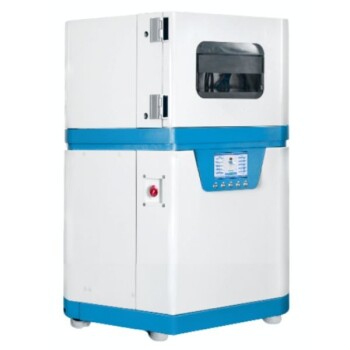
The pressure system in a vacuum hot press furnace serves as a definitive structural architect for Cu-18Ni-2W alloys. By applying a precise mechanical force—typically around 28 MPa—it provides an additional driving force for sintering that thermal energy alone cannot achieve. This mechanical pressure accelerates dynamic recrystallization, refines grain size, and optimizes the grain boundary network, directly enhancing both the thermal conductivity and tensile strength of the final material.
Core Takeaway Heat softens the alloy, but the pressure system is what forces atomic rearrangement and eliminates internal voids. This synergy transforms a porous pre-form into a dense, high-performance conductor by optimizing electron scattering and structural integrity simultaneously.
The Mechanics of Densification
The Synergy of Heat and Force
A vacuum hot press furnace does not rely on temperature alone.
While high temperatures (800 to 900°C) soften the Cu-18Ni-2W matrix, the pressure system applies a simultaneous axial load of 20 to 30 MPa.
This combination creates a powerful synergy that accelerates particle bonding and atomic diffusion far beyond what standard sintering can achieve.
Eliminating Internal Porosity
The primary function of this pressure is to physically collapse voids within the material.
By forcing particles into closer contact, the system effectively eliminates internal pores that would otherwise weaken the alloy.
This results in a significantly higher density, which is the foundational requirement for high-performance mechanical properties.
Microstructural Evolution
Driving Dynamic Recrystallization
The application of mechanical pressure acts as a catalyst for dynamic recrystallization.
This process reorganizes the internal crystal structure of the alloy while it is still under heat and stress.
It prevents the grains from growing excessively large, which is a common issue in pressure-less sintering.
Grain Refinement and Boundary Optimization
The pressure system actively promotes the formation of a finer grain structure.
According to the primary technical data, this process also reduces the number of grain boundaries.
Fewer grain boundaries create a cleaner path for electron flow, which optimizes the electron scattering rate.
Impact on Material Properties
Simultaneous Property Enhancement
Usually, increasing strength comes at the cost of conductivity, but the pressure system allows for a rare dual benefit.
Because the grain structure is refined and density is maximized, the alloy achieves high tensile strength.
Simultaneously, the optimized electron scattering allows the material to maintain high thermal conductivity and a high melting point.
Critical Operational Considerations
Regulating Furnace Atmosphere
The pressure system is not solely about compressing the alloy; it also maintains the integrity of the vacuum environment.
Proper pressure regulation is required to prevent the 'chimney effect,' where density differences create unwanted convection currents.
Failure to maintain this balance can lead to temperature inconsistencies and oxidation.
Safety and Contamination Control
In controlled atmosphere scenarios, the system must maintain positive air pressure.
This ensures that outside air cannot enter the heating chamber.
Preventing this ingress is critical to avoiding hazardous reactions and ensuring the Cu-18Ni-2W alloy remains free of oxides.
Optimizing Your Sintering Strategy
To achieve the best results with Cu-18Ni-2W alloys, align your pressure settings with your specific performance targets:
- If your primary focus is Structural Integrity: maintain axial pressure between 20 and 30 MPa to maximize densification and eliminate porosity.
- If your primary focus is Conductivity: ensure precise pressure application (approx. 28 MPa) to drive dynamic recrystallization and minimize electron scattering obstacles.
- If your primary focus is Process Safety: monitor for positive pressure stability to prevent the chimney effect and atmospheric contamination.
By precisely controlling mechanical pressure, you convert a standard sintering process into a method for manufacturing superior, high-density conductive alloys.
Summary Table:
| Feature | Effect on Cu-18Ni-2W Alloy | Key Benefit |
|---|---|---|
| Mechanical Pressure | Provides additional driving force (20-30 MPa) | Accelerates densification beyond thermal sintering |
| Porosity Control | Physically collapses internal voids | Higher material density and structural integrity |
| Microstructure | Drives dynamic recrystallization | Finer grain size and optimized grain boundaries |
| Electron Flow | Minimizes electron scattering | Simultaneous high thermal and electrical conductivity |
| Atmosphere Control | Prevents 'chimney effect' & oxidation | Ensures material purity and thermal consistency |
Elevate Your Material Science with KINTEK Precision
Unlock the full potential of your alloy research and production with KINTEK’s advanced vacuum hot press furnaces. Whether you are working with Cu-18Ni-2W or other high-performance materials, our equipment provides the precise pressure and temperature control necessary to achieve superior densification and optimized microstructures.
Why choose KINTEK?
- Comprehensive Range: From high-temperature vacuum and atmosphere furnaces to hydraulic pellet presses and crushing systems.
- Specialized Lab Tools: High-pressure reactors, electrolytic cells, and high-quality consumables like crucibles and ceramics.
- Targeted Performance: Designed for researchers and manufacturers who demand reliability and precision in every sinter.
Ready to enhance your lab’s efficiency and material quality? Contact our experts today to find the perfect solution!
Related Products
- Vacuum Hot Press Furnace Heated Vacuum Press Machine Tube Furnace
- 600T Vacuum Induction Hot Press Furnace for Heat Treat and Sintering
- Vacuum Hot Press Furnace Machine for Lamination and Heating
- Vacuum Hot Press Furnace Machine Heated Vacuum Press
- Vacuum Heat Treat and Pressure Sintering Furnace for High Temperature Applications
People Also Ask
- What advantages does a vacuum hot press furnace provide for LSLBO ceramic electrolytes? Achieve 94% Relative Density
- What role does a Vacuum Hot Press (VHP) furnace play in the densification of austenitic stainless steel 316 composites?
- What are the advantages of using a vacuum hot pressing furnace? Superior Densification for 2024Al/Gr/SiC Composites
- What are the advantages of a vacuum hot press furnace for LTPO solid electrolytes? Boost Density and Conductivity
- What core processing conditions does a vacuum hot press furnace provide? Achieve High-Density Cu-SiC/Diamond Composites