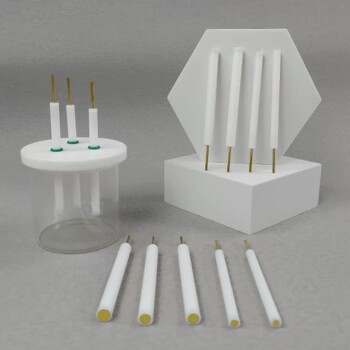
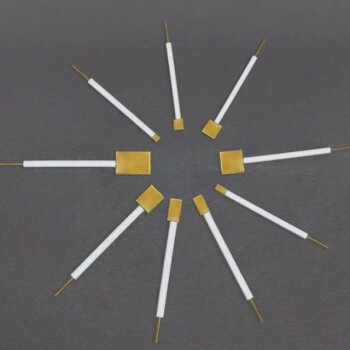
In electrochemical corrosion testing, the helical platinum wire and the silver/silver chloride electrode perform distinct, non-interchangeable roles necessary for a functioning three-electrode system. The helical platinum wire acts as the auxiliary (or counter) electrode, responsible for completing the current circuit with the test specimen. The silver/silver chloride (Ag/AgCl) electrode functions as the reference electrode, providing a fixed, stable potential standard that allows for the precise measurement of the specimen's electrochemical behavior.
The Core Stability Principle Valid corrosion data requires isolating the behavior of the material you are testing. The platinum wire ensures current flows without chemically altering the solution, while the Ag/AgCl electrode provides an unshakeable baseline, ensuring that any measured voltage fluctuation is actually coming from your sample, not your equipment.
The Role of the Helical Platinum Wire
In a standard three-electrode setup, the platinum wire is the workhorse of the current loop. It is commonly referred to as the Counter Electrode (CE) or Auxiliary Electrode.
Completing the Current Circuit
The primary function of the helical platinum wire is to close the electrical circuit.
When the electrochemical workstation applies a potential or current to the working electrode (your test specimen), that current must have a path to flow through the electrolyte. The platinum wire provides this path, facilitating the transmission of current through the solution.
Chemical Inertness
The choice of platinum is driven by its high chemical stability.
Because corrosion testing often involves aggressive environments (such as alkaline solutions or NaCl electrolytes), the counter electrode must resist reacting with the solution. Platinum’s inertness ensures that it conducts current without dissolving or generating interfering byproducts that could contaminate the test environment.
Conductivity and Geometry
High electrical conductivity is essential for minimizing voltage drop across the solution.
The "helical" (coiled) shape of the wire is intentional. It effectively increases the surface area of the electrode within a compact space. This ensures the counter electrode does not become a bottleneck for current flow, allowing the reaction at the working electrode to proceed unhindered.
The Role of the Silver/Silver Chloride Electrode
The Ag/AgCl electrode is the Reference Electrode (RE). Its role is strictly passive; it does not carry significant current but provides a measurement datum.
Providing a Stable Potential Standard
Voltage is a relative measurement; it must be measured against something.
The Ag/AgCl electrode, typically immersed in a saturated potassium chloride (KCl) solution, maintains a constant, known electrochemical potential. This stability provides the "zero point" (or fixed benchmark) for the system.
Enabling Precision Measurement
By having a stable reference, the electrochemical workstation can isolate the behavior of the working electrode.
For example, when testing 304L stainless steel in a 3.5% NaCl solution, the workstation monitors the potential difference between the steel and the Ag/AgCl electrode. Since the Ag/AgCl potential does not change, any fluctuation recorded is guaranteed to be a response from the steel specimen itself.
Understanding the Trade-offs
While this specific setup is the industry standard for many corrosion tests, understanding its limitations is vital for data integrity.
Reference Electrode Drift
Although Ag/AgCl is highly stable, it is not immune to degradation.
If the internal filling solution (saturated KCl) becomes contaminated or depleted, the potential of the reference electrode will shift (drift). This drift leads to erroneous corrosion potential readings, making the test specimen appear more or less noble than it actually is.
Counter Electrode Surface Area
The surface area of the platinum wire must be sufficient relative to the working electrode.
If the helical platinum wire is too small or the coil is too tight, it may limit the maximum current the system can pass. This can distort data during high-current experiments, such as rapid polarization scans.
Making the Right Choice for Your Goal
To ensure your corrosion testing yields valid, publication-grade data, you must maintain these components based on your specific testing goals.
- If your primary focus is accurate potential mapping: Regularly verify the potential of your Ag/AgCl reference electrode against a master standard to ensure it has not drifted due to electrolyte contamination.
- If your primary focus is high-current kinetics: Ensure your helical platinum wire has a surface area significantly larger than your working electrode to prevent current throttling.
Ultimately, the quality of your corrosion data is defined not just by the sample you test, but by the integrity of the circuit you build around it.
Summary Table:
| Electrode Type | Primary Role | Key Function | Material Advantage |
|---|---|---|---|
| Helical Platinum Wire | Counter (Auxiliary) Electrode | Completes the circuit; facilitates current flow without reaction | High inertness and increased surface area via helical shape |
| Silver/Silver Chloride (Ag/AgCl) | Reference Electrode | Provides stable potential standard; measurement baseline | High stability and constant potential for precise voltage data |
Elevate Your Electrochemical Research with KINTEK
Precision in corrosion testing starts with high-quality instrumentation. KINTEK specializes in advanced laboratory equipment, offering premium electrolytic cells and electrodes—including high-purity platinum wires and stable Ag/AgCl reference electrodes—designed to deliver publication-grade data.
From high-temperature high-pressure reactors to specialized battery research tools and consumables, we provide researchers with the reliability needed for complex material analysis. Ensure your testing circuit is flawless—contact our experts today to find the perfect electrochemical solutions for your lab!
References
- Anirban Naskar, Saumyadeep Jana. Pitting behavior of friction stir repair-welded 304L stainless steel in 3.5% NaCl solution at room temperature: role of grain and defect structures. DOI: 10.1007/s42452-020-03935-0
This article is also based on technical information from Kintek Solution Knowledge Base .
Related Products
- Rotating Platinum Disk Electrode for Electrochemical Applications
- Platinum Sheet Electrode for Laboratory and Industrial Applications
- Platinum Sheet Electrode for Battery Lab Applications
- Platinum Auxiliary Electrode for Laboratory Use
- RRDE rotating disk (ring disk) electrode / compatible with PINE, Japanese ALS, Swiss Metrohm glassy carbon platinum
People Also Ask
- What is the working principle of a platinum disk electrode? A Guide to Precise Electrochemical Analysis
- What are the temperature limitations for a platinum disk electrode? The Critical Factor is the Insulating Body
- What can cause poisoning of a platinum disk electrode and how can it be prevented? Ensure Reliable Electrochemical Data
- How should a platinum disk electrode be polished? Master the Technique for Reliable Electrochemical Data
- How should a platinum disk electrode be used during an experiment? A Guide to Accurate Electrochemical Measurements