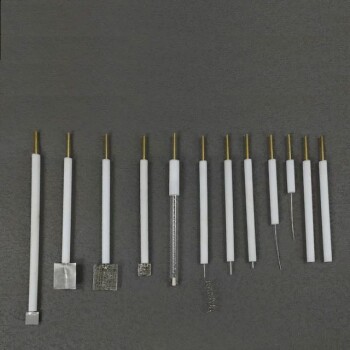
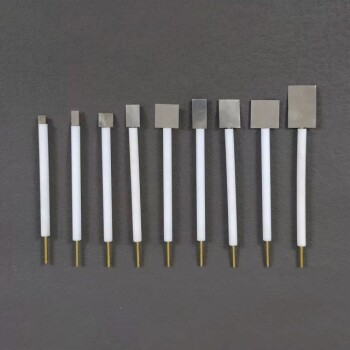
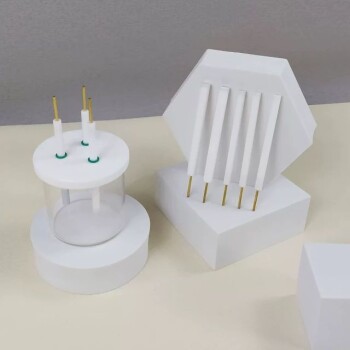
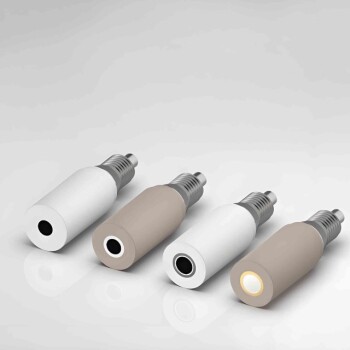
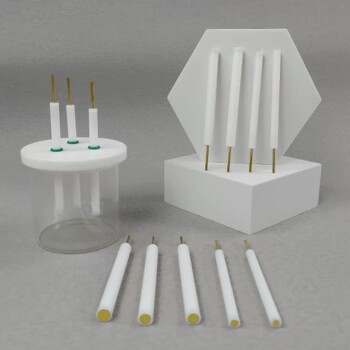
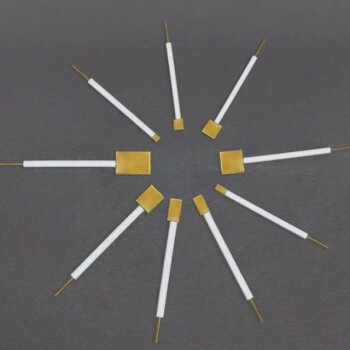
The preference for platinum wire (PtW) as a counter electrode in cathode Linear Sweep Voltammetry (LSV) is driven by its exceptional electrochemical stability and chemical inertness. In tests lacking a substrate, PtW ensures that the data collected represents only the intrinsic performance of the cathode, free from external interference or contamination.
Core Takeaway Platinum wire acts as an "invisible" facilitator in the electrochemical circuit. Its primary function is to complete the current loop and support redox-balancing reactions without participating in them or introducing impurities, thereby guaranteeing that the working electrode's signal is the only variable being measured.
The Critical Role of Stability
Eliminating Chemical Interference
The most significant advantage of platinum wire is its extreme chemical inertness. In an electrochemical cell, the counter electrode must not degrade or react with the electrolyte.
Platinum resists self-dissolution during voltammetry scans. This prevents metal ions from the counter electrode from leaching into the solution and contaminating the working electrode, which would otherwise skew the results.
Ensuring Reproducible Data
Reliability is paramount in LSV testing. Platinum provides a highly stable reaction environment that does not change over time or between repeated scans.
Because the material is robust, it allows for reproducible assessments of cathode performance. Researchers can be confident that variations in data are due to the cathode itself, not the degradation of the counter electrode.
Electrical and Physical Properties
High Electrical Conductivity
To function effectively as an auxiliary electrode, the material must facilitate electron flow without significant resistance.
Platinum offers high electrical conductivity, essential for establishing an efficient current loop in a three-electrode system. This ensures that the potential applied is accurately directed toward driving the reaction at the working electrode.
Optimized Surface Characteristics
The physical structure of the wire plays a role in measurement precision. Platinum wire typically exhibits low surface roughness.
This smooth profile minimizes physical variables that could introduce experimental noise. It ensures the electrode provides a consistent surface area for the necessary redox-balancing reactions required to complete the circuit.
Understanding the Operational Requirements
The Necessity of Catalytic Activity
While the counter electrode should be chemically inert regarding the working electrode's reaction, it must still be active enough to support the opposing reaction to close the circuit.
Platinum is highly catalytically active for these balancing reactions. This capability allows it to sink or source the necessary current without becoming a bottleneck in the system, ensuring the current measured is limited only by the working electrode's kinetics.
Potential Pitfalls of Alternative Materials
Using a less stable material than platinum introduces significant risk. If a counter electrode participates in redox reactions or dissolves, it creates "phantom" currents.
These currents interfere with the intrinsic response of the working electrode. In a substrate-free environment where baseline accuracy is critical, such interference renders the LSV data unusable.
Making the Right Choice for Your Goal
When designing your electrochemical setup, the choice of counter electrode dictates the integrity of your data.
- If your primary focus is Data Precision: Rely on platinum wire to minimize noise and prevent the introduction of impurities into your electrolyte.
- If your primary focus is Reproducibility: Use platinum to ensure that the reaction environment remains constant across multiple scans and experiments.
Ultimately, platinum wire is preferred because it isolates the variable of interest, providing a transparent window into the true performance of your cathode.
Summary Table:
| Feature | Advantage of Platinum Wire (PtW) | Impact on LSV Testing |
|---|---|---|
| Chemical Stability | Extreme inertness & resistance to dissolution | Prevents electrolyte contamination and phantom currents. |
| Conductivity | High electrical conductivity | Facilitates efficient electron flow for accurate potential control. |
| Catalytic Activity | Superior activity for balancing reactions | Ensures the counter electrode is never the rate-limiting step. |
| Surface Profile | Low surface roughness | Minimizes experimental noise and ensures consistent surface area. |
Elevate Your Electrochemical Research with KINTEK
Precision in Linear Sweep Voltammetry starts with high-quality components. KINTEK specializes in providing premium laboratory equipment and consumables designed for the most demanding research environments.
Whether you need high-purity platinum wire electrodes, advanced electrolytic cells, or comprehensive battery research tools, our solutions ensure your data is accurate and reproducible. From high-temperature furnaces and vacuum systems to specialized PTFE consumables and ceramics, we empower scientists to push the boundaries of material science.
Ready to optimize your lab's performance? Contact our experts today to find the perfect electrochemical solutions for your specific application.
References
- Hyungwon Chai, Sokhee P. Jung. Validity and Reproducibility of Counter Electrodes for Linear Sweep Voltammetry Test in Microbial Electrolysis Cells. DOI: 10.3390/en17112674
This article is also based on technical information from Kintek Solution Knowledge Base .
Related Products
- Platinum Auxiliary Electrode for Laboratory Use
- Platinum Sheet Electrode for Laboratory and Industrial Applications
- Rotating Platinum Disk Electrode for Electrochemical Applications
- Platinum Sheet Electrode for Battery Lab Applications
- RRDE rotating disk (ring disk) electrode / compatible with PINE, Japanese ALS, Swiss Metrohm glassy carbon platinum
People Also Ask
- What is the function of a platinum electrode as an auxiliary electrode? Ensure Precise Nickel Coating Corrosion Testing
- Why is platinum typically selected as the auxiliary electrode for electrochemical testing of oxazoline inhibitors?
- What does the auxiliary electrode do? Ensuring Accurate Electrochemical Measurements
- What are the roles of Pt counter and reference electrodes in nitrided steel testing? Optimize Your Electrochemical Data
- What are the advantages of using a platinum counter electrode? Ensure Purity in Photocatalytic Coating Deposition