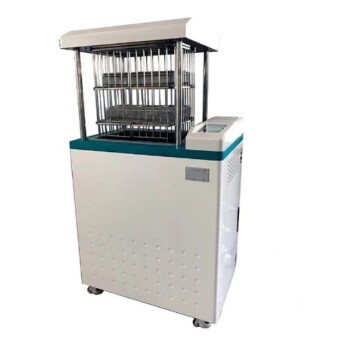
The primary technical advantage of using a high-pressure reactor for Autoclave (AC) extraction is the ability to supersede atmospheric limitations, enabling solvents to function well beyond their standard boiling points. By creating a sealed environment that heats solvents like toluene to temperatures such as 150°C, the system drastically enhances dissolution capabilities, resulting in faster and more accurate separation of polymer interfaces compared to traditional methods.
While standard extraction relies on time, high-pressure AC extraction leverages thermodynamics. By elevating temperature and pressure simultaneously, this method maximizes solvent penetration to ensure the complete removal of physically adsorbed rubber, leaving behind a precise measurement of chemically bonded material.
The Physics of High-Pressure Extraction
Overcoming Atmospheric Boiling Points
In open systems like Soxhlet extraction, the process is limited by the solvent's natural boiling point. A high-pressure reactor utilizes a sealed environment to bypass this limit.
This allows solvents to be heated significantly higher than normal—for example, bringing toluene to 150°C, far exceeding its atmospheric boiling point.
Enhanced Solvent Capabilities
At these elevated temperatures and pressures, the physical properties of the solvent change.
The conditions significantly enhance the solvent's penetration and dissolution capabilities, allowing it to permeate the rubber matrix more effectively than a solvent at ambient pressure.
Impact on Separation Accuracy
Removing Physically Adsorbed Polymers
The primary goal of this analysis is to distinguish between rubber that is mechanically stuck and rubber that is chemically bonded.
High-pressure conditions facilitate the rapid and complete removal of loosely bound (physically adsorbed) rubber. This ensures that the material removed is truly "loose," rather than material that was simply too difficult for a standard solvent to reach.
Isolating Tightly Bound Rubber (TBR)
Once the loosely bound rubber is stripped away, the remaining material represents the chemically bonded Tightly Bound Rubber (TBR).
Because the cleaning process is more thorough, the isolation of the TBR is significantly more precise, providing a truer representation of the interface chemistry.
Operational Efficiency
Drastic Reduction in Time
Traditional extraction methods can be slow, relying on repeated cycles of solvent wash.
The aggressive thermodynamic conditions of AC extraction substantially reduce extraction time, delivering results faster without compromising the integrity of the sample.
Understanding the Trade-offs
Equipment Complexity and Safety
While AC extraction offers superior performance, utilizing a high-pressure reactor introduces operational complexity not found in simple glassware setups like Soxhlet.
Operators must manage high-temperature and high-pressure conditions, which requires robust safety protocols and specialized equipment maintenance to prevent leaks or mechanical failures.
Thermal Stability Concerns
The elevated temperatures (e.g., 150°C) are highly effective for extraction but require that the sample itself remains thermally stable.
You must ensure that the high heat does not degrade the chemically bonded rubber you are trying to isolate, which could skew results in the opposite direction.
Making the Right Choice for Your Goal
To determine if transitioning to high-pressure Autoclave extraction is the right move for your laboratory, consider your specific analytical priorities:
- If your primary focus is Data Precision: The AC method is superior for accurately isolating chemically bonded TBR by eliminating false positives caused by residual loosely bound rubber.
- If your primary focus is Laboratory Throughput: The ability to substantially reduce extraction time makes AC extraction the ideal choice for high-volume testing environments.
High-pressure AC extraction transforms the separation process from a passive wash into an active, high-energy penetration, yielding a cleaner baseline for your material analysis.
Summary Table:
| Feature | Soxhlet Extraction | High-Pressure AC Extraction |
|---|---|---|
| Temperature | Limited to solvent boiling point | High-temperature (e.g., 150°C for toluene) |
| Pressure | Atmospheric | Elevated/High Pressure |
| Mechanism | Passive cyclical washing | Active thermodynamic penetration |
| Extraction Time | Slow/Extended cycles | Substantially reduced/Rapid |
| Separation Accuracy | Risk of residual physically adsorbed rubber | Complete removal of loosely bound rubber |
| Primary Outcome | Standard material separation | Precise isolation of Tightly Bound Rubber (TBR) |
Elevate Your Material Analysis with KINTEK Precision
Unlock the full potential of your carbon black and rubber interface studies with KINTEK’s high-pressure high-pressure reactors and autoclaves. Our advanced systems enable you to bypass atmospheric limits, ensuring faster extraction times and the most accurate isolation of Tightly Bound Rubber (TBR) available in the industry.
As specialists in laboratory excellence, KINTEK provides more than just hardware; we offer a comprehensive suite of solutions including:
- High-Temperature & High-Pressure Reactors: Built for safety and thermodynamic efficiency.
- Sample Preparation Tools: From crushing and milling systems to hydraulic presses and pellet dies.
- Complete Lab Support: Including ULT freezers, ceramics, and essential consumables.
Ready to transform your laboratory throughput and data precision? Contact us today to discuss your specific application and find the perfect reactor configuration!
References
- Takashi Kyotani, Takafumi Ishii. What can we learn by analyzing the edge sites of carbon materials?. DOI: 10.7209/carbon.010406
This article is also based on technical information from Kintek Solution Knowledge Base .
Related Products
- Mini SS High Pressure Autoclave Reactor for Laboratory Use
- Stainless High Pressure Autoclave Reactor Laboratory Pressure Reactor
- High Pressure Laboratory Autoclave Reactor for Hydrothermal Synthesis
- Customizable High Pressure Reactors for Advanced Scientific and Industrial Applications
- Desktop Fast High Pressure Laboratory Autoclave Sterilizer 16L 24L for Lab Use
People Also Ask
- Why use high-pressure reactors for molecular sieve synthesis? Unlock Superior Crystallinity and Framework Control
- Why are high-pressure reactors or autoclaves necessary for the synthesis of new functional materials? Unlock Precision.
- What is the function of a high-pressure reactor autoclave? Enhancing Cu/N Co-Doped Carbon Catalyst Synthesis
- What are the advantages of using a high-pressure reactor like an autoclave? Maximize Liquefaction Speed & Yield
- How are high-pressure reactors used to prepare metaphosphate electrocatalysts? Master In-Situ Precursor Growth