The primary technical advantage of a three-electrode configuration in photoelectrochemical (PEC) systems is the ability to precisely isolate and control the potential of the working electrode. By incorporating a high-precision reference electrode that carries negligible current, this setup effectively decouples the potential measurement of the photoelectrode from the polarization effects and potential shifts occurring at the counter electrode.
Core Insight: In PEC carbon dioxide reduction, the three-electrode setup acts as a diagnostic standard. It enables the measurement of intrinsic material activity—such as Incident Photon-to-Current Efficiency (IPCE)—by ensuring that the data reflects the true performance of the semiconductor catalyst, free from the electrical noise and resistance of the rest of the cell.
Decoupling Control from Current Transmission
To understand the advantage of this configuration, you must first understand the limitations of a standard two-electrode system.
The Problem with Counter Electrode Polarization
In a simple two-electrode setup, the voltage is applied across the entire cell.
As current flows, the counter electrode polarizes, meaning its potential shifts unpredictably due to reaction kinetics and mass transport limitations. This makes it impossible to know exactly how much of the applied voltage is actually driving the reaction at your working electrode (the photoelectrode).
The Solution: Independent Monitoring
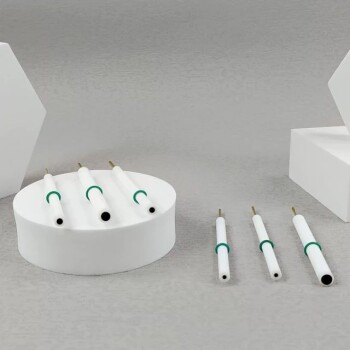
The three-electrode configuration solves this by adding a reference electrode (such as Ag/AgCl) to the circuit.
Because the reference electrode draws almost zero current, its potential remains stable and constant. This allows the system to measure the potential of the working electrode relative to this stable reference, rather than relative to the fluctuating counter electrode.
Separating Functions
This setup essentially decouples the circuit functions:
- The Counter Electrode completes the circuit and allows current transmission.
- The Reference Electrode provides a fixed baseline for potential control.
- The Working Electrode drives the light-dependent reaction.
Enhancing Data Accuracy and Reproducibility
For researchers developing new materials for $CO_2$ reduction, accuracy is paramount. The three-electrode system is the standard for obtaining valid performance metrics.
Measuring Intrinsic Activity
To evaluate a semiconductor's true capability, you must assess its intrinsic activity under specific bias voltages.
The three-electrode setup maintains a stable working electrode potential regardless of what is happening at the counter electrode. This stability is required to accurately study oxidation or reduction kinetics and ensures that the data collected is highly reproducible.
Calculating IPCE
One of the most critical metrics in PEC is Incident Photon-to-Current Efficiency (IPCE).
IPCE measures how efficiently a material converts incoming photons into charge carriers. Accurate IPCE calculation requires precise knowledge of the potential acting on the semiconductor. Without a three-electrode setup, errors in potential measurement would lead to incorrect efficiency calculations.
Understanding the Trade-offs
While the three-electrode configuration is superior for characterization, it introduces complexities that must be managed.
Complexity in Cell Design
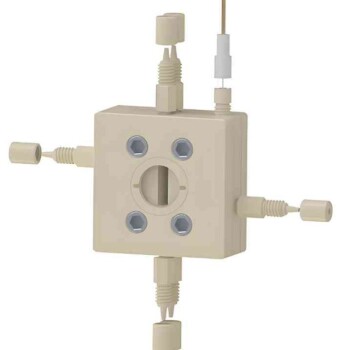
Integrating a third electrode requires a more complex reaction vessel design.
As noted in advanced designs, this often involves integrating specific materials (like titanium working electrodes and stainless steel counter electrodes) into a single vessel or utilizing specialized flow cells. This adds mechanical complexity compared to simple two-electrode stacks.
Not Representative of Commercial Devices
Most commercial electrolyzers operate on a two-electrode basis to minimize resistance and cost.
Therefore, while the three-electrode setup is ideal for studying a catalyst, performance data gathered this way must eventually be validated in a two-electrode full-cell prototype to prove real-world viability.
Making the Right Choice for Your Goal
The decision to use a three-electrode configuration depends entirely on whether you are characterizing a material or building a prototype.
- If your primary focus is Fundamental Research: Use a three-electrode setup to isolate the intrinsic kinetics and IPCE of your photoelectrode without interference from the counter electrode.
- If your primary focus is Material Screening: Use this configuration to ensure reproducibility, allowing you to compare different catalysts under identical electrochemical conditions.
- If your primary focus is Commercial Prototyping: Use the three-electrode data to select your best material, but transition to a two-electrode setup to optimize overall cell energy efficiency.
Summary: The three-electrode configuration is the definitive tool for isolating the physics of the photoelectrode, transforming ambiguous total-cell data into precise, actionable insights about material performance.
Summary Table:
| Feature | Two-Electrode Configuration | Three-Electrode Configuration |
|---|---|---|
| Primary Function | Device-level performance / Prototyping | Fundamental research / Material screening |
| Potential Control | Relative to fluctuating counter electrode | Relative to a stable, zero-current reference |
| Data Accuracy | Low (includes cell resistance/polarization) | High (isolates intrinsic material kinetics) |
| Key Metric | Overall energy efficiency | IPCE and specific catalyst activity |
| Complexity | Simple, low-cost design | Higher complexity in cell and vessel design |
Elevate Your PEC Research with KINTEK Precision
Ready to achieve unmatched accuracy in your $CO_2$ reduction studies? KINTEK specializes in high-performance laboratory solutions tailored for advanced electrochemical research. From specialized electrolytic cells and electrodes to precision high-temperature reactors and cooling solutions, we provide the tools necessary to isolate intrinsic material activity and scale your innovations.
Our value to you:
- Comprehensive Portfolio: Access high-quality muffle and vacuum furnaces, hydraulic presses, and specialized consumables like PTFE and ceramics.
- Research-Grade Reliability: Our tools are designed to ensure the reproducibility required for top-tier scientific publications.
- Expert Support: We help target customers—from lab researchers to industrial engineers—optimize their setup for both fundamental screening and commercial prototyping.
Contact KINTEK Today to Optimize Your Lab Setup
References
- Evangelos Kalamaras, Huizhi Wang. Solar carbon fuel via photoelectrochemistry. DOI: 10.1016/j.cattod.2018.02.045
This article is also based on technical information from Kintek Solution Knowledge Base .
Related Products
- Customizable CO2 Reduction Flow Cell for NRR ORR and CO2RR Research
- Glassy Carbon Sheet RVC for Electrochemical Experiments
- Rotating Platinum Disk Electrode for Electrochemical Applications
- Laboratory CVD Boron Doped Diamond Materials
- Glassy Carbon Electrochemical Electrode
People Also Ask
- Why is a customized electrochemical flow cell used for eCO2RR? Achieve Industrial-Grade Performance and Current Density
- What is the purpose of an anion exchange membrane (AEM) or PEM? Enhance Electrochemical Efficiency
- How do the electrochemical cell and three-electrode testing system collaborate? Optimize Zinc Anode Deposition Control
- What is the difference between a voltaic cell and an electrochemical cell? Understand the Two Types of Energy Conversion
- Why must the electrochemical cell be continuously purged with nitrogen? Ensure Precision in Ni-Cr Corrosion Tests