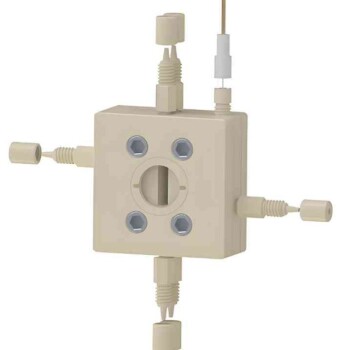
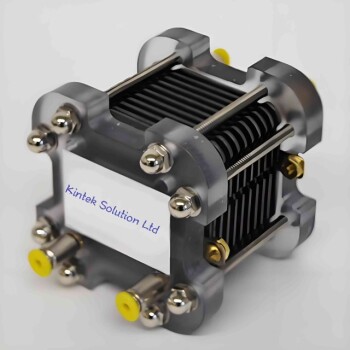
Flow cells paired with Gas Diffusion Electrodes (GDE) are primarily utilized to eliminate the mass transfer limitations inherent to Carbon Monoxide (CO) gas in aqueous electrolytes. By delivering reactants directly to the interface, this configuration enables the system to achieve industrial-grade current densities while a continuous flow of electrolyte maintains a stable chemical environment for long-term testing.
The combination of flow cells and GDEs bridges the gap between laboratory theory and industrial reality, allowing researchers to verify the morphological stability and selectivity of catalysts under high-performance conditions that standard setups cannot replicate.
Overcoming Physical Limitations
The Mass Transfer Barrier
In standard aqueous setups, CO gas suffers from poor solubility. This creates a bottleneck where the reaction is limited by how fast CO can reach the catalyst, rather than how fast the catalyst can work.
The GDE Solution
Gas Diffusion Electrodes bypass this solubility limit by delivering CO gas directly to the catalyst surface. This allows the system to operate at significantly higher, industrial-level current densities that are impossible in traditional stagnant cells.
Maintaining Chemical Consistency
Continuous Electrolyte Refresh
Long-term stability testing requires a constant chemical environment to be valid. Flow cells utilize a continuous stream of electrolyte, such as 1 M KOH, to flush the system.
Preventing Local Depletion
This flow prevents the local depletion of reactants and the accumulation of products near the electrode. It ensures that any observed changes in performance are due to the catalyst itself, not a degrading testing environment.
Validating Catalyst Performance
Morphological Stability
This setup is critical for verifying the physical durability of specific catalysts, such as copper nanocubes. It allows researchers to observe if the catalyst maintains its shape and structure over extended periods of operation.
Product Selectivity
Beyond structural integrity, the flow cell setup confirms that the catalyst continues to produce the desired chemical products efficiently over time. It ensures that high current densities do not alter the reaction pathway or product yield.
Understanding the Operational Constraints
Specific Potential Ranges
While robust, this method is often specific to certain operating windows. For example, verifying stability is most effective in non-corrosive potential ranges (typically greater than -0.4 VRHE).
Electrolyte Dependency
The success of this configuration relies heavily on the interaction between the catalyst and the chosen electrolyte. The continuous flow of 1 M KOH is a standard requirement to maintain the necessary conductivity and pH balance for the reaction.
Making the Right Choice for Your Goal
To determine if a Flow Cell/GDE setup is required for your specific testing needs, consider the following parameters:
- If your primary focus is industrial scalability: You must use this setup to replicate the high current densities and mass transfer rates found in commercial applications.
- If your primary focus is catalyst durability: You need the continuous electrolyte flow to distinguish between actual catalyst degradation and environmental changes.
Ultimately, utilizing flow cells with GDEs is the only reliable method to validate that a catalyst can survive and perform in a high-output, real-world environment.
Summary Table:
| Feature | Traditional Aqueous Setup | Flow Cell + GDE Setup |
|---|---|---|
| Mass Transfer | Limited by CO solubility | Direct gas delivery to catalyst |
| Current Density | Low (Laboratory scale) | High (Industrial scale) |
| Electrolyte State | Stagnant (Local depletion) | Continuous flow (Stable environment) |
| Testing Goal | Basic catalytic activity | Long-term morphological stability |
| Key Outcome | Theoretical validation | Real-world scalability & durability |
Elevate Your CORR Research with KINTEK Precision
Transition from laboratory theory to industrial reality with KINTEK’s advanced electrochemical solutions. As specialists in high-performance laboratory equipment, we provide the critical tools needed for rigorous stability testing, including specialized electrolytic cells and electrodes, flow systems, and comprehensive battery research consumables.
Whether you are verifying the morphological stability of copper nanocubes or optimizing product selectivity at high current densities, our team delivers the reliable hardware necessary for breakthrough results. Maximize your catalyst’s potential—contact KINTEK today for expert guidance and tailored equipment solutions.
References
- Shikai Liu, Qian He. Alkali cation-induced cathodic corrosion in Cu electrocatalysts. DOI: 10.1038/s41467-024-49492-7
This article is also based on technical information from Kintek Solution Knowledge Base .
Related Products
- Customizable CO2 Reduction Flow Cell for NRR ORR and CO2RR Research
- Electrolytic Electrochemical Cell Gas Diffusion Liquid Flow Reaction Cell
- Glassy Carbon Electrochemical Electrode
- Flat Corrosion Electrolytic Electrochemical Cell
- Electrolytic Electrochemical Cell for Coating Evaluation
People Also Ask
- Why is a customized electrochemical flow cell used for eCO2RR? Achieve Industrial-Grade Performance and Current Density
- What is the purpose of an anion exchange membrane (AEM) or PEM? Enhance Electrochemical Efficiency
- How do the electrochemical cell and three-electrode testing system collaborate? Optimize Zinc Anode Deposition Control
- What is the difference between a voltaic cell and an electrochemical cell? Understand the Two Types of Energy Conversion
- Why must the electrochemical cell be continuously purged with nitrogen? Ensure Precision in Ni-Cr Corrosion Tests