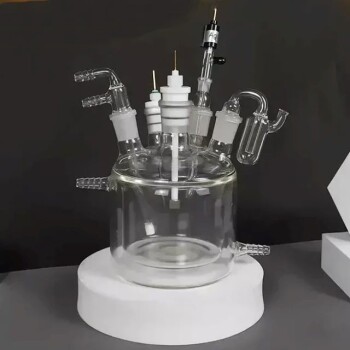
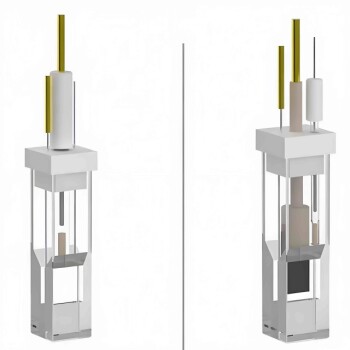
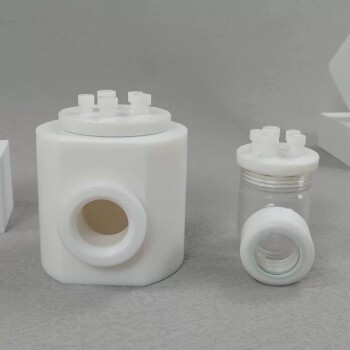
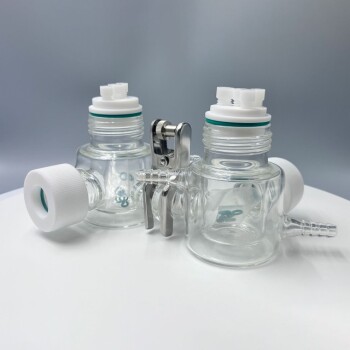
The primary role of a three-electrode electrolytic cell system in the synthesis of semiconductor anodic oxidation films is to isolate the control of the anodic potential from the current flow. This configuration enables the establishment of a stable, precise high-voltage electric field directly on the metal surface, which is the driving force required to guide ion migration across the oxide layer.
By decoupling the potential measurement from the counter electrode's activity, researchers can ensure the reproducibility of film growth and accurately evaluate kinetic parameters without interference from the rest of the cell.
The core advantage of this system is precision through isolation. It separates the circuit responsible for carrying current from the circuit responsible for measuring voltage, effectively removing errors caused by solution resistance or cathode polarization.
The Mechanics of Precision Control
The Function of the Three Electrodes
To understand the system's role, you must understand how the components interact. The Working Electrode serves as the substrate where the semiconductor film grows.
The Counter Electrode (often a graphite rod) acts as the auxiliary component that completes the circuit, handling the current conduction required for the reaction.
The Reference Electrode provides a stable, unchanging baseline potential. It draws negligible current, ensuring that the voltage readings reflect only the activity at the working electrode.
Establishing the High-Voltage Field
The synthesis of anodic oxidation films relies on driving ions through a growing oxide barrier. This requires a robust electric field.
The three-electrode setup ensures that the applied voltage creates a stable high-voltage electric field specifically at the metal-electrolyte interface.
This field is the mechanism that guides ion migration across the oxide layer, promoting the directional growth of structures like vertically aligned nanotubes.
Why Precision Matters for Film Growth
Ensuring Reproducibility
In semiconductor fabrication, consistency is paramount. A two-electrode system can fluctuate based on changes in the electrolyte or the counter electrode's condition.
The three-electrode system locks the potential of the working electrode against the reference. This guarantees that the driving force for film growth remains constant, ensuring reproducibility from one batch to the next.
Accurate Kinetic Evaluation
For researchers characterizing these films, simple growth is not enough; they must understand the underlying physics.
This configuration allows for the accurate measurement of kinetic parameters, such as the overpotential, Tafel slope, and double-layer capacitance.
Because the reference electrode is isolated, the resulting current-voltage curves purely reflect the electrocatalytic properties of the film, uncluttered by external noise.
Avoiding Common Pitfalls (The Trade-offs)
Eliminating Cathode Polarization Interference
In a simpler two-electrode cell, the voltage you measure is the difference between the anode and the cathode. If the cathode polarizes (changes potential due to current flow), your data becomes skewed.
The three-electrode system excludes interference from cathode polarization, ensuring that the measurements apply strictly to the anodic oxidation process.
Neglecting Membrane Resistance
Electrolytes and membranes introduce resistance that can cause a voltage drop (IR drop), meaning the voltage you apply isn't the voltage the sample actually "feels."
By measuring potential relative to a reference electrode placed near the sample, this system allows you to decouple intrinsic activity from membrane resistance. This is critical for distinguishing between the true performance of the material and the limitations of the cell hardware.
Making the Right Choice for Your Goal
When designing your experimental setup for semiconductor film synthesis, your choice of electrode configuration defines the quality of your data.
- If your primary focus is reproducible manufacturing: Rely on the three-electrode system to maintain a stable electric field that ensures identical film thickness and structure every time.
- If your primary focus is fundamental research: Use this configuration to isolate kinetic data (like Tafel slopes) to prove your material's intrinsic properties without mathematical noise.
By controlling the potential with absolute precision, you transform the oxidation process from a rough chemical reaction into a tunable tool for nanotechnology.
Summary Table:
| Component | Primary Function | Impact on Film Synthesis |
|---|---|---|
| Working Electrode | Substrate for film growth | Determines the location of oxide layer formation |
| Counter Electrode | Completes the electrical circuit | Handles current conduction for the reaction |
| Reference Electrode | Provides stable baseline potential | Eliminates voltage errors from solution resistance |
| Potential Control | Decouples voltage from current | Ensures reproducible growth and accurate kinetics |
Elevate Your Semiconductor Research with KINTEK Precision
Unlock superior control over your anodic oxidation processes with KINTEK’s premium electrolytic cells and electrodes. Whether you are developing vertically aligned nanotubes or characterizing new materials, our high-precision hardware eliminates cathode polarization and IR drop interference, ensuring absolute reproducibility in every batch.
From advanced electrolytic cells to high-performance high-temperature furnaces and autoclaves, KINTEK specializes in laboratory equipment designed for the most demanding research environments. Our comprehensive portfolio also includes battery research tools, crushing systems, and specialized consumables like PTFE and ceramics to support your entire workflow.
Ready to refine your film synthesis? Contact KINTEK today to discuss your customized equipment needs!
References
- Ronald Vargas, B.R. Scharifker. High-Field Growth of Semiconducting Anodic Oxide Films on Metal Surfaces for Photocatalytic Application. DOI: 10.1155/2019/2571906
This article is also based on technical information from Kintek Solution Knowledge Base .
Related Products
- H Type Electrolytic Cell Triple Electrochemical Cell
- Electrolytic Electrochemical Cell Gas Diffusion Liquid Flow Reaction Cell
- Electrolytic Electrochemical Cell with Five-Port
- PTFE Electrolytic Cell Electrochemical Cell Corrosion-Resistant Sealed and Non-Sealed
- Customizable PEM Electrolysis Cells for Diverse Research Applications
People Also Ask
- What is a H type cell? A Guide to Divided Electrochemical Cells for Accurate Experiments
- How should the electrolyte be prepared and added to the H-type electrolytic cell? Best Practices for Purity and Safety
- What is the technical necessity of using an H-type electrolytic cell for NO3RR tests? Protect Your Ammonia Yields
- How does the design of an H-type electrolytic cell benefit the neutral water electrolysis process for metal recovery?
- What is the primary function of an H-type electrolytic cell in NitRR? Ensure Accurate Product Yields