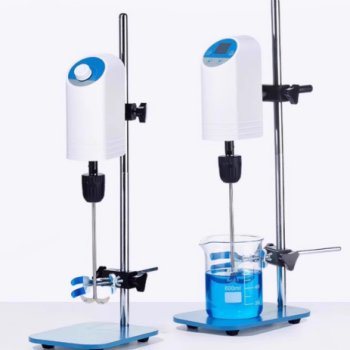
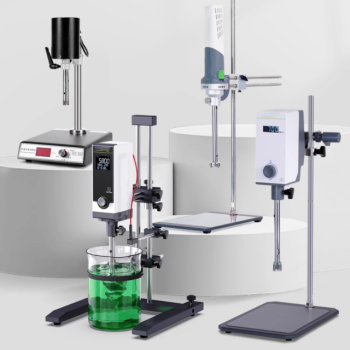
High-speed mechanical stirrers provide the critical shear force necessary to overcome the natural immiscibility of corn oil and methanol. By operating at speeds typically around 600 rpm, these devices eliminate external mass transfer limitations, ensuring the reactants interact efficiently rather than remaining in separate phases.
The core technical value lies in the creation of a fine emulsion. By mechanically forcing the two distinct liquids to mix, the stirrer maximizes the interfacial surface area, allowing the catalyst to function immediately and significantly reducing the time required to start the reaction.
Overcoming Phase Separation
Addressing Immiscibility
In a static or low-agitation state, corn oil and methanol are immiscible. They naturally resist mixing and separate into distinct layers.
Eliminating Mass Transfer Limitations
The primary role of the high-speed stirrer is to remove external mass transfer limitations. Without sufficient mechanical energy, the reaction is limited by how slowly the molecules can move across the boundary between the oil and the alcohol.
Creating a Fine Emulsion
At speeds such as 600 rpm, the stirrer generates intense mechanical agitation. This shears the two liquid phases, forcing them into a fine emulsion where microscopic droplets of one liquid are suspended in the other.
Optimizing Reaction Kinetics
Maximizing Interfacial Contact
The transition from distinct layers to an emulsion dramatically increases the interfacial contact area. This provides a vastly larger surface where the chemical reaction can actually occur.
Enhancing Catalyst Efficiency
For the catalyst to promote the methanolysis reaction, it requires access to both reactants. The increased contact area allows the catalyst to encounter the reactants much more frequently and efficiently.
Shortening the Induction Period
Chemical reactions often suffer from an "induction period"—a lag time before the reaction rate picks up. By forcing immediate contact through high-speed shearing, the stirrer significantly shortens this induction period.
Critical Operational Dependencies
The Importance of Shear Thresholds
It is important to note that this process relies on reaching a specific agitation threshold.
If the stirring speed falls significantly below the recommended range (e.g., 600 rpm), the shear force may be insufficient to break the surface tension between the liquids.
This would result in a failure to form the necessary emulsion, causing the mass transfer limitations to return and the reaction efficiency to plummet.
Optimizing Your Methanolysis Setup
To ensure your process achieves the highest efficiency, align your equipment settings with your specific production goals:
- If your primary focus is Speed: Ensure your agitator can maintain a consistent 600 rpm to minimize the induction period and start the reaction immediately.
- If your primary focus is Process Reliability: Verify that your mixing equipment provides enough torque to maintain a stable emulsion throughout the entire reaction phase to prevent phase separation.
High-speed agitation is not merely an operational preference; it is a fundamental requirement for efficient corn oil methanolysis.
Summary Table:
| Technical Feature | Benefit in Methanolysis |
|---|---|
| High-Speed Agitation (600 rpm) | Overcomes immiscibility by creating a fine liquid-liquid emulsion. |
| Elimination of Mass Transfer Limits | Removes physical barriers between reactants, allowing immediate interaction. |
| Increased Interfacial Surface Area | Maximizes contact between oil and methanol for faster kinetics. |
| Reduced Induction Period | Shortens the lag time before the reaction begins, increasing throughput. |
| Enhanced Catalyst Efficiency | Provides the catalyst with simultaneous access to both reaction phases. |
Elevate Your Chemical Synthesis with KINTEK
Ready to optimize your corn oil methanolysis and achieve superior reaction kinetics? KINTEK specializes in precision laboratory equipment designed to handle the most demanding mixing and thermal processing requirements.
Our extensive portfolio includes:
- High-Speed Agitation & Homogenizers: Ensure stable emulsions and eliminate mass transfer limitations.
- Reaction Vessels: Including high-temperature high-pressure reactors and autoclaves for advanced biodiesel research.
- Comprehensive Lab Tools: From crushing and milling systems to hydraulic presses and cooling solutions like ULT freezers.
Whether you are refining biofuels or developing new chemical processes, KINTEK provides the reliability and technical edge your research deserves. Contact us today to find the perfect equipment solution for your lab!
References
- Noureddin El Boulifi, José Aracil. Process Optimization for Biodiesel Production from Corn Oil and Its Oxidative Stability. DOI: 10.1155/2010/518070
This article is also based on technical information from Kintek Solution Knowledge Base .
Related Products
- High Performance Laboratory Stirrers for Diverse Applications
- High-Speed Desktop Centrifuge for Blood Sample Processing
- Benchtop High Speed Small Lab Centrifuge for Serum Separation and Low Temperature Dehydration
- Laboratory Multifunctional Small Speed-Adjustable Horizontal Mechanical Shaker for Lab
- Laboratory Benchtop High Speed Small Centrifuge for Low Temp Serum Separation Dehydration Research
People Also Ask
- How does a laboratory stirrer influence MOF product quality? Master Precision in Non-Solvothermal Synthesis
- What critical role does a Laboratory Stirrer play during leaching? Enhance Titanium-Magnesium Waste Recovery
- What is the primary function of laboratory stirring equipment in the preparation of compost leachate? Optimize Extraction
- What is a laboratory mixer? A Guide to Achieving Perfect Sample Homogeneity
- What is a laboratory mixer used for? Choose the Right Tool for Liquids or Solids