Knowledge What are the two methods of sieve analysis? Choose the Right Method for Accurate Particle Sizing
Author avatar

Tech Team · Kintek Solution

Updated 6 days ago

What are the two methods of sieve analysis? Choose the Right Method for Accurate Particle Sizing


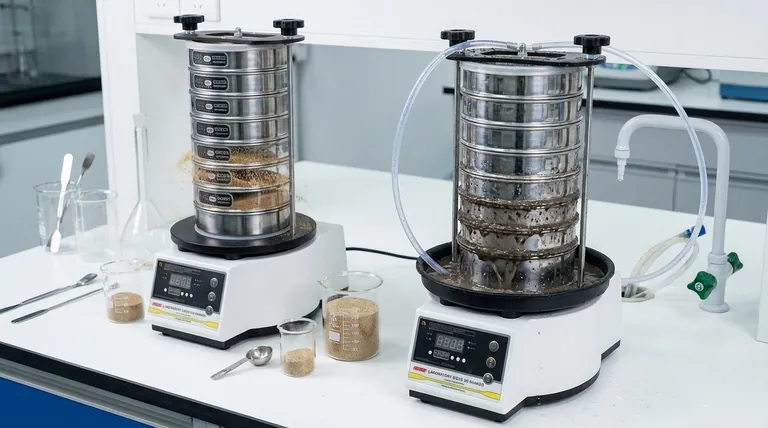
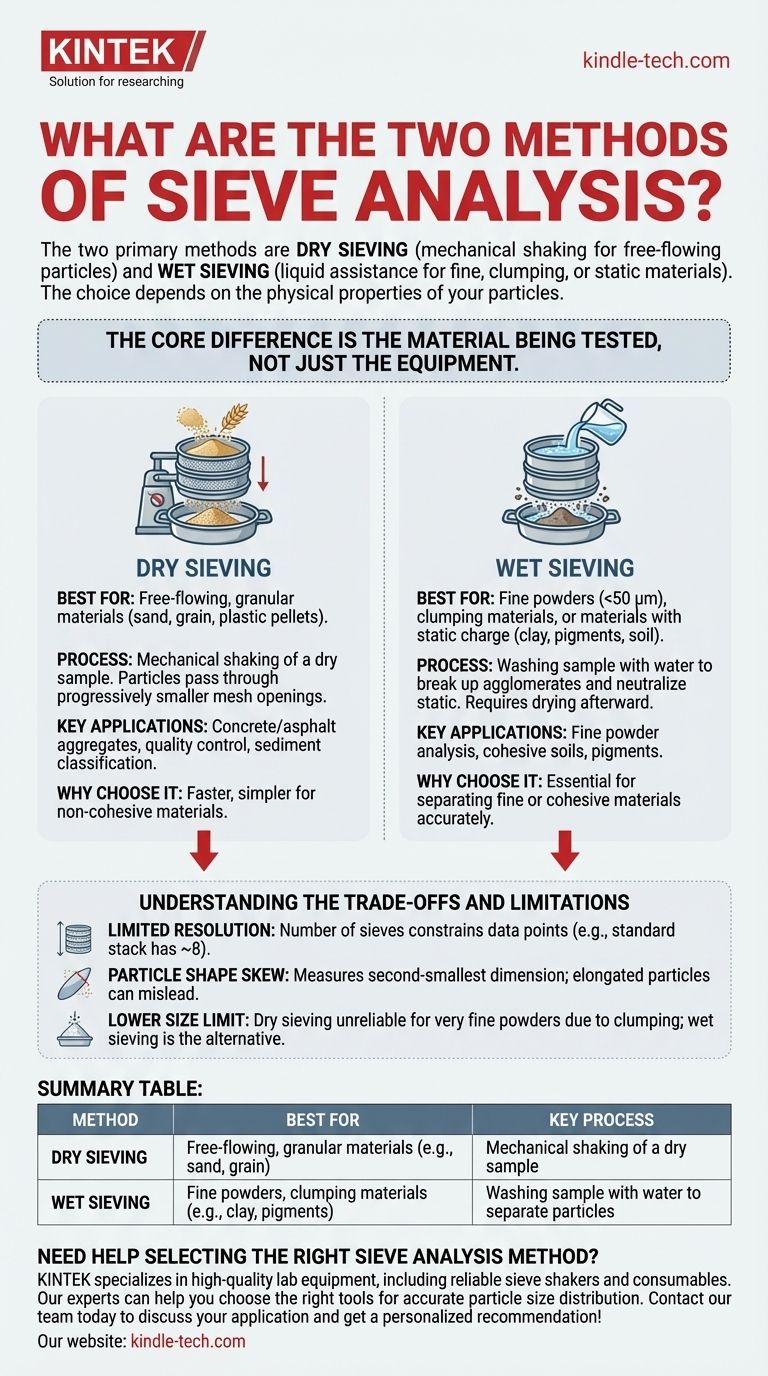
The two primary methods of sieve analysis are dry sieving and wet sieving. Dry sieving is the most common approach, using mechanical shaking to separate dry, free-flowing particles, while wet sieving uses a liquid (typically water) to help separate materials that are very fine, tend to clump together, or hold a static charge.

The core difference isn't the equipment but the material being tested. Your choice between dry and wet sieving depends entirely on the physical properties of your particles and whether they can pass through the sieve mesh freely without assistance from a liquid.
What are the two methods of sieve analysis? Choose the Right Method for Accurate Particle Sizing

The Purpose of Sieve Analysis

Sieve analysis is a long-established and trusted method for determining the particle size distribution of a granular material. It is a cornerstone of quality control in many industries.

Why It's Used

The goal is to sort a sample of material into different size ranges, known as fractions. The weight of each fraction is then measured to calculate the proportion of particles in each size range.

Key Applications

This data is critical for ensuring material consistency and suitability. It's widely used in civil engineering for selecting aggregates for concrete and asphalt, in manufacturing for quality control, and in geology for classifying sediments.

The Two Core Methods Explained

While the principle of passing particles through a mesh is the same, the method of agitation and sample preparation separates the two techniques.

Dry Sieve Analysis

This is the default and most straightforward method. It is suitable for any material composed of particles that do not stick together and can flow freely when agitated.

The process involves placing a dried sample into the top of a stack of sieves with progressively smaller mesh openings. A mechanical sieve shaker then vibrates or taps the stack, causing the particles to work their way down until they are retained by a sieve with a mesh smaller than their diameter.

Wet Sieve Analysis

This method is required when particles are too fine (typically below 50 µm), tend to agglomerate due to moisture, or hold static electricity that causes them to cling to the sieve mesh.

In wet sieving, the sample is placed in the top sieve, and a gentle stream of water is used to wash the finer particles through the stack. This liquid action breaks up clumps and neutralizes static charges, allowing for an accurate separation that would be impossible with dry shaking alone. After sieving, each fraction must be dried before it can be weighed.

Understanding the Trade-offs and Limitations

While sieve analysis is valued for its simplicity, low cost, and reproducibility, it's essential to recognize its limitations to ensure your results are valid.

Resolution is Limited

The detail of your particle size distribution is constrained by the number of sieves you can use. A standard stack may have only 8 sieves, meaning your entire analysis is based on a small number of data points.

Particle Shape Can Skew Results

Sieve analysis measures the second-smallest dimension of a particle—the one that determines if it can pass through a square mesh. Elongated or irregular particles can produce misleading results compared to methods that analyze the true shape, like image processing.

The Lower Size Limit

Dry sieving becomes unreliable for very fine powders, as intermolecular forces can cause significant clumping and screen blockage. This is the primary reason wet sieving exists as an alternative for these challenging materials.

Making the Right Choice for Your Material

Selecting the correct method is the most critical step for achieving an accurate particle size distribution.

  • If your material is free-flowing and granular (like sand, grain, or plastic pellets): Dry sieve analysis is the faster, simpler, and appropriate choice.
  • If your material is a fine powder, clay, or prone to clumping (like pigments or soil): Wet sieve analysis is necessary to break up agglomerates and ensure particles separate correctly.

Ultimately, choosing the right sieving method ensures the data you collect is a true and reliable reflection of your material's properties.

Summary Table:

Method Best For Key Process
Dry Sieving Free-flowing, granular materials (e.g., sand, grain) Mechanical shaking of a dry sample
Wet Sieving Fine powders, clumping materials (e.g., clay, pigments) Washing sample with water to separate particles

Need help selecting the right sieve analysis method for your materials?
KINTEK specializes in high-quality lab equipment, including reliable sieve shakers and consumables for both dry and wet analysis. Our experts can help you choose the right tools to ensure accurate particle size distribution data for your quality control needs.
Contact our team today to discuss your application and get a personalized recommendation!

Visual Guide
What are the two methods of sieve analysis? Choose the Right Method for Accurate Particle Sizing Visual Guide

Related Products

People Also Ask

Related Products

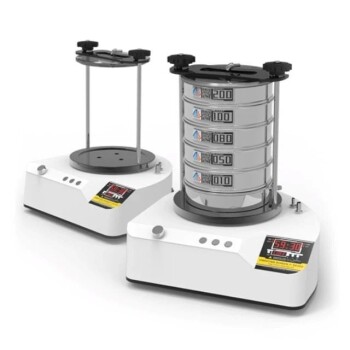
Laboratory Test Sieves and Vibratory Sieve Shaker Machine

Laboratory Test Sieves and Vibratory Sieve Shaker Machine

Efficiently process powders, granules, and small blocks with a high-frequency vibration sieve. Control vibration frequency, screen continuously or intermittently, and achieve accurate particle size determination, separation, and classification.

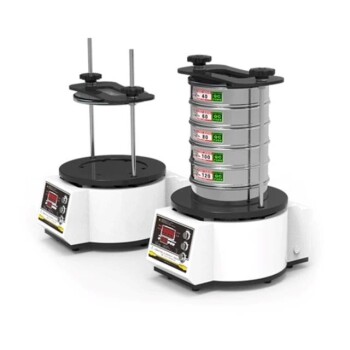
Laboratory Vibratory Sieve Shaker Machine for Dry and Wet Three-Dimensional Sieving

Laboratory Vibratory Sieve Shaker Machine for Dry and Wet Three-Dimensional Sieving

KT-VD200 can be used for sieving tasks of dry and wet samples in the laboratory. The screening quality is 20g-3kg. The product is designed with a unique mechanical structure and an electromagnetic vibrating body with a vibration frequency of 3000 times per minute.

Three-dimensional electromagnetic sieving instrument

Three-dimensional electromagnetic sieving instrument

KT-VT150 is a desktop sample processing instrument for both sieving and grinding. Grinding and sieving can be used both dry and wet. The vibration amplitude is 5mm and the vibration frequency is 3000-3600 times/min.

Laboratory Vibratory Sieve Shaker Machine Slap Vibrating Sieve

Laboratory Vibratory Sieve Shaker Machine Slap Vibrating Sieve

KT-T200TAP is a slapping and oscillating sieving instrument for laboratory desktop use, with 300 rpm horizontal circular motion and 300 vertical slapping motions to simulate manual sieving to help sample particles pass through better.

Laboratory Wet Three-Dimensional Vibratory Sieve Shaker Machine

Laboratory Wet Three-Dimensional Vibratory Sieve Shaker Machine

The wet three-dimensional vibrating sieving instrument focuses on solving the sieving tasks of dry and wet samples in the laboratory. It is suitable for sieving 20g - 3kg dry, wet or liquid samples.

Custom PTFE Teflon Parts Manufacturer for PTFE Mesh F4 Sieve

Custom PTFE Teflon Parts Manufacturer for PTFE Mesh F4 Sieve

PTFE mesh sieve is a specialized test sieve designed for particle analysis in various industries, featuring a non-metallic mesh woven from PTFE filament. This synthetic mesh is ideal for applications where metal contamination is a concern . PTFE sieves are crucial for maintaining the integrity of samples in sensitive environments, ensuring accurate and reliable results in particle size distribution analysis.

Small Lab Rubber Calendering Machine

Small Lab Rubber Calendering Machine

Small lab rubber calendering machine is used for producing thin, continuous sheets of plastic or rubber materials. It is commonly employed in laboratories, small-scale production facilities, and prototyping environments to create films, coatings, and laminates with precise thickness and surface finish.

Mini Planetary Ball Mill Machine for Laboratory Milling

Mini Planetary Ball Mill Machine for Laboratory Milling

Discover the KT-P400 desktop planetary ball mill, ideal for grinding and mixing small samples in the lab. Enjoy stable performance, long service life, and practicality. Functions include timing and overload protection.

Metallographic Specimen Mounting Machine for Laboratory Materials and Analysis

Metallographic Specimen Mounting Machine for Laboratory Materials and Analysis

Precision metallographic mounting machines for labs—automated, versatile, and efficient. Ideal for sample prep in research and quality control. Contact KINTEK today!

Lab Internal Rubber Mixer Rubber Kneader Machine for Mixing and Kneading

Lab Internal Rubber Mixer Rubber Kneader Machine for Mixing and Kneading

Lab internal rubber mixer is suitable for mixing, kneading and dispersing various chemical raw materials such as plastics, rubber, synthetic rubber, hot melt adhesive and various low-viscosity materials.

Lab Plastic PVC Calender Stretch Film Casting Machine for Film Testing

Lab Plastic PVC Calender Stretch Film Casting Machine for Film Testing

The cast film machine is designed for the molding of polymer cast film products and has multiple processing functions such as casting, extrusion, stretching, and compounding.

Automatic Laboratory Heat Press Machine

Automatic Laboratory Heat Press Machine

Precision automatic heat press machines for labs—ideal for material testing, composites, and R&D. Customizable, safe, and efficient. Contact KINTEK today!

Desktop Fast Laboratory Autoclave Sterilizer 35L 50L 90L for Lab Use

Desktop Fast Laboratory Autoclave Sterilizer 35L 50L 90L for Lab Use

The desktop fast steam sterilizer is a compact and reliable device used for rapid sterilization of medical, pharmaceutical, and research items. It efficiently sterilizes surgical instruments, glassware, medicines, and resistant materials, making it suitable for various applications.

Rubber Vulcanizer Vulcanizing Machine Plate Vulcanizing Press for Lab

Rubber Vulcanizer Vulcanizing Machine Plate Vulcanizing Press for Lab

The Plate vulcanizing press is a kind of equipment used in the production of rubber products, mainly used for the vulcanization of rubber products. Vulcanization is a key step in rubber processing.

High Energy Planetary Ball Mill Machine for Laboratory Horizontal Tank Type

High Energy Planetary Ball Mill Machine for Laboratory Horizontal Tank Type

The KT-P2000H uses a unique Y-axis planetary trajectory, and utilizes the collision, friction and gravity between the sample and the grinding ball.

Double Plate Heating Press Mold for Lab

Double Plate Heating Press Mold for Lab

Discover precision in heating with our Double Plate Heating Mold, featuring high-quality steel and uniform temperature control for efficient lab processes. Ideal for various thermal applications.

Powerful Plastic Crusher Machine

Powerful Plastic Crusher Machine

KINTEK's powerful plastic crusher machines process 60-1350 KG/H of diverse plastics, ideal for labs and recycling. Durable, efficient, and customizable.

Single Punch Electric Tablet Press Machine Laboratory Powder Tablet Punching TDP Tablet Press

Single Punch Electric Tablet Press Machine Laboratory Powder Tablet Punching TDP Tablet Press

The single-punch electric tablet press is a laboratory-scale tablet press suitable for corporate laboratories in pharmaceutical, chemical, food, metallurgical and other industries.

Single Punch Electric Tablet Press Machine TDP Tablet Punching Machine

Single Punch Electric Tablet Press Machine TDP Tablet Punching Machine

The electric tablet punching machine is a laboratory equipment designed for pressing various granular and powdery raw materials into discs and other geometric shapes. It is commonly used in pharmaceutical, healthcare products, food, and other industries for small batch production and processing. The machine is compact, lightweight, and easy to operate, making it suitable for use in clinics, schools, laboratories, and research units.

Single Punch Tablet Press Machine and Mass Production Rotary Tablet Punching Machine for TDP

Single Punch Tablet Press Machine and Mass Production Rotary Tablet Punching Machine for TDP

Rotary tablet punching machine is an automatic rotating and continuous tableting machine. It is mainly used for tablet manufacturing in the pharmaceutical industry, and is also suitable for industrial sectors such as food, chemicals, batteries, electronics, ceramics, etc. to compress granular raw materials into tablets.


Leave Your Message