Knowledge What are the two types of sieve analysis? Choosing the Right Method for Accurate Particle Sizing
Author avatar

Tech Team · Kintek Solution

Updated 1 week ago

What are the two types of sieve analysis? Choosing the Right Method for Accurate Particle Sizing


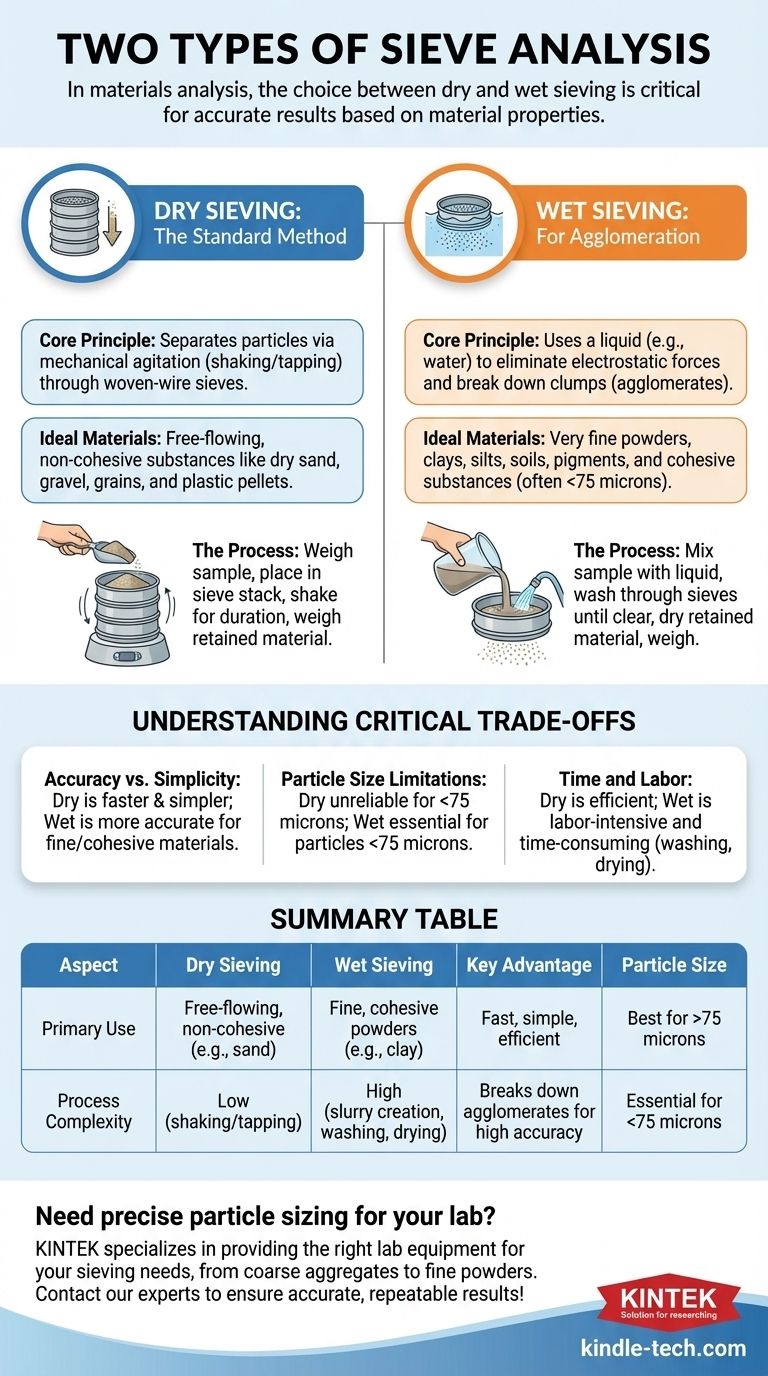
In materials analysis, the two primary types of sieve analysis are dry sieving and wet sieving. Dry sieving is the most common method, used for particles that flow freely and do not clump together. Wet sieving is a more specialized technique required for fine powders or materials that tend to agglomerate, using a liquid to separate the particles accurately.

The choice between wet and dry sieving is not a matter of preference; it is a critical decision dictated by the physical properties of your material. The core challenge is overcoming inter-particle attraction in fine or cohesive powders, a problem that only wet sieving can reliably solve.
What are the two types of sieve analysis? Choosing the Right Method for Accurate Particle Sizing

The Standard Method: Dry Sieve Analysis

Core Principle

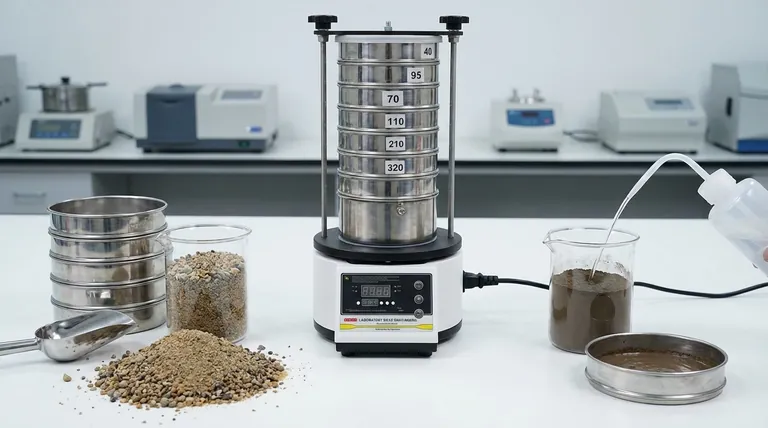
Dry sieve analysis separates particles based on size by passing a sample through a stack of woven-wire sieves with progressively smaller mesh openings. The separation is achieved through mechanical agitation, such as shaking or tapping, which allows particles to find their way to an opening they can pass through.

Ideal Materials

This method is the standard for materials that are free-flowing and non-cohesive. The particles must not stick to each other or to the sieves due to moisture or electrostatic forces.

Typical examples include dry sand, gravel, grains, plastic pellets, and other coarse, granular substances.

The Process in Brief

The process begins with weighing a representative sample of the dry material. The sample is placed on the top sieve of a pre-stacked nest of sieves, which is then secured in a mechanical shaker. After shaking for a standardized duration, the stack is disassembled, and the material retained on each sieve is weighed to determine the particle size distribution.

When Agglomeration is an Issue: Wet Sieve Analysis

Core Principle

Wet sieve analysis is designed to overcome the limitations of the dry method. It uses a liquid—typically water, often with a wetting agent—to eliminate electrostatic forces and break down mechanical clumps (agglomerates). The liquid acts as a medium to wash fine particles through the sieve openings.

Ideal Materials

This method is essential for materials containing very fine particles (often below 75 microns) or for substances that are naturally cohesive. This includes clays, silts, soils, pigments, and fine pharmaceutical or chemical powders that would provide inaccurate results with dry sieving.

The Process in Brief

A pre-weighed sample is first mixed with the liquid to form a slurry. This slurry is poured onto the top sieve while being rinsed. The washing process continues until the liquid passing through the sieves runs clear. After washing, the material retained on each sieve must be carefully dried in an oven before it can be weighed to calculate the final distribution.

Understanding the Critical Trade-offs

Accuracy vs. Simplicity

Dry sieving is significantly faster, simpler, and requires less equipment. It is the go-to method for its efficiency.

However, for fine or cohesive materials, wet sieving provides far more accurate and repeatable results. It physically separates agglomerated particles that would otherwise be registered as a single, larger particle in a dry analysis.

Particle Size Limitations

Dry sieving becomes unreliable for very fine powders. Electrostatic attraction between tiny particles can cause them to clump or "blind" the sieve mesh, preventing proper separation.

Wet sieving neutralizes these forces, making it the only reliable method for accurately determining the distribution of particles smaller than about 75 microns (200 mesh).

Time and Labor

The primary drawback of wet sieving is that it is a much more labor-intensive and time-consuming process. The additional steps of creating a slurry, washing the sample, and, most importantly, oven-drying the retained fractions add significant time and complexity to the analysis.

Making the Right Choice for Your Material

Your material's inherent properties will dictate the correct method. There is no ambiguity; choosing the wrong technique will lead to flawed data.

  • If your primary focus is speed and the material is coarse and free-flowing (e.g., sand, gravel): Dry sieving is the correct and most efficient method.
  • If your material contains fine particles, clay, or tends to clump (e.g., soil, pigments): Wet sieving is mandatory to achieve an accurate particle size distribution.
  • If you are adhering to an industry standard (e.g., ASTM, ISO): The standard will explicitly define the required method, and in some cases, may call for a combination of both wet and dry techniques for a single sample.

Ultimately, understanding your material is the key to selecting the right analytical tool.

Summary Table:

Aspect Dry Sieving Wet Sieving
Primary Use Free-flowing, non-cohesive materials (e.g., sand, gravel) Fine, cohesive powders (e.g., clay, pigments)
Key Advantage Fast, simple, efficient Breaks down agglomerates for high accuracy
Particle Size Best for particles >75 microns Essential for particles <75 microns
Process Complexity Low (shaking/tapping) High (slurry creation, washing, drying)

Need precise particle sizing for your lab?

Choosing the wrong sieve analysis method can lead to inaccurate results and wasted time. KINTEK specializes in providing the right lab equipment and consumables for your specific sieving needs—whether you're working with coarse aggregates or fine, cohesive powders.

Our experts can help you select the ideal sieving setup to ensure accurate, repeatable particle size distribution data for your materials.

Contact our team today to discuss your application and find the perfect sieving solution for your laboratory!

Visual Guide
What are the two types of sieve analysis? Choosing the Right Method for Accurate Particle Sizing Visual Guide

Related Products

People Also Ask

Related Products

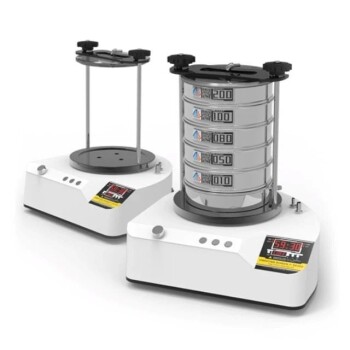
Laboratory Test Sieves and Vibratory Sieve Shaker Machine

Laboratory Test Sieves and Vibratory Sieve Shaker Machine

Efficiently process powders, granules, and small blocks with a high-frequency vibration sieve. Control vibration frequency, screen continuously or intermittently, and achieve accurate particle size determination, separation, and classification.

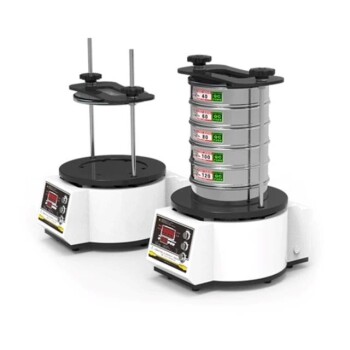
Laboratory Vibratory Sieve Shaker Machine for Dry and Wet Three-Dimensional Sieving

Laboratory Vibratory Sieve Shaker Machine for Dry and Wet Three-Dimensional Sieving

KT-VD200 can be used for sieving tasks of dry and wet samples in the laboratory. The screening quality is 20g-3kg. The product is designed with a unique mechanical structure and an electromagnetic vibrating body with a vibration frequency of 3000 times per minute.

Three-dimensional electromagnetic sieving instrument

Three-dimensional electromagnetic sieving instrument

KT-VT150 is a desktop sample processing instrument for both sieving and grinding. Grinding and sieving can be used both dry and wet. The vibration amplitude is 5mm and the vibration frequency is 3000-3600 times/min.

Laboratory Vibratory Sieve Shaker Machine Slap Vibrating Sieve

Laboratory Vibratory Sieve Shaker Machine Slap Vibrating Sieve

KT-T200TAP is a slapping and oscillating sieving instrument for laboratory desktop use, with 300 rpm horizontal circular motion and 300 vertical slapping motions to simulate manual sieving to help sample particles pass through better.

Laboratory Wet Three-Dimensional Vibratory Sieve Shaker Machine

Laboratory Wet Three-Dimensional Vibratory Sieve Shaker Machine

The wet three-dimensional vibrating sieving instrument focuses on solving the sieving tasks of dry and wet samples in the laboratory. It is suitable for sieving 20g - 3kg dry, wet or liquid samples.

Custom PTFE Teflon Parts Manufacturer for PTFE Mesh F4 Sieve

Custom PTFE Teflon Parts Manufacturer for PTFE Mesh F4 Sieve

PTFE mesh sieve is a specialized test sieve designed for particle analysis in various industries, featuring a non-metallic mesh woven from PTFE filament. This synthetic mesh is ideal for applications where metal contamination is a concern . PTFE sieves are crucial for maintaining the integrity of samples in sensitive environments, ensuring accurate and reliable results in particle size distribution analysis.

Laboratory Multifunctional Small Speed-Adjustable Horizontal Mechanical Shaker for Lab

Laboratory Multifunctional Small Speed-Adjustable Horizontal Mechanical Shaker for Lab

The laboratory multifunctional speed-regulating oscillator is a constant-speed experimental equipment specially developed for modern bioengineering production units.

Small Lab Rubber Calendering Machine

Small Lab Rubber Calendering Machine

Small lab rubber calendering machine is used for producing thin, continuous sheets of plastic or rubber materials. It is commonly employed in laboratories, small-scale production facilities, and prototyping environments to create films, coatings, and laminates with precise thickness and surface finish.

Automatic Laboratory Heat Press Machine

Automatic Laboratory Heat Press Machine

Precision automatic heat press machines for labs—ideal for material testing, composites, and R&D. Customizable, safe, and efficient. Contact KINTEK today!

Lab Plastic PVC Calender Stretch Film Casting Machine for Film Testing

Lab Plastic PVC Calender Stretch Film Casting Machine for Film Testing

The cast film machine is designed for the molding of polymer cast film products and has multiple processing functions such as casting, extrusion, stretching, and compounding.

Mini Planetary Ball Mill Machine for Laboratory Milling

Mini Planetary Ball Mill Machine for Laboratory Milling

Discover the KT-P400 desktop planetary ball mill, ideal for grinding and mixing small samples in the lab. Enjoy stable performance, long service life, and practicality. Functions include timing and overload protection.

Metallographic Specimen Mounting Machine for Laboratory Materials and Analysis

Metallographic Specimen Mounting Machine for Laboratory Materials and Analysis

Precision metallographic mounting machines for labs—automated, versatile, and efficient. Ideal for sample prep in research and quality control. Contact KINTEK today!

Heated Hydraulic Press Machine with Integrated Manual Heated Plates for Lab Use

Heated Hydraulic Press Machine with Integrated Manual Heated Plates for Lab Use

Efficiently process heat-pressing samples with our Integrated Manual Heated Lab Press. With a heating range up to 500°C, it's perfect for various industries.

Powerful Plastic Crusher Machine

Powerful Plastic Crusher Machine

KINTEK's powerful plastic crusher machines process 60-1350 KG/H of diverse plastics, ideal for labs and recycling. Durable, efficient, and customizable.

Double Plate Heating Press Mold for Lab

Double Plate Heating Press Mold for Lab

Discover precision in heating with our Double Plate Heating Mold, featuring high-quality steel and uniform temperature control for efficient lab processes. Ideal for various thermal applications.

Single Punch Electric Tablet Press Machine Laboratory Powder Tablet Punching TDP Tablet Press

Single Punch Electric Tablet Press Machine Laboratory Powder Tablet Punching TDP Tablet Press

The single-punch electric tablet press is a laboratory-scale tablet press suitable for corporate laboratories in pharmaceutical, chemical, food, metallurgical and other industries.

Single Punch Tablet Press Machine and Mass Production Rotary Tablet Punching Machine for TDP

Single Punch Tablet Press Machine and Mass Production Rotary Tablet Punching Machine for TDP

Rotary tablet punching machine is an automatic rotating and continuous tableting machine. It is mainly used for tablet manufacturing in the pharmaceutical industry, and is also suitable for industrial sectors such as food, chemicals, batteries, electronics, ceramics, etc. to compress granular raw materials into tablets.

Single Punch Electric Tablet Press Machine TDP Tablet Punching Machine

Single Punch Electric Tablet Press Machine TDP Tablet Punching Machine

The electric tablet punching machine is a laboratory equipment designed for pressing various granular and powdery raw materials into discs and other geometric shapes. It is commonly used in pharmaceutical, healthcare products, food, and other industries for small batch production and processing. The machine is compact, lightweight, and easy to operate, making it suitable for use in clinics, schools, laboratories, and research units.

Desktop Fast Laboratory Autoclave Sterilizer 35L 50L 90L for Lab Use

Desktop Fast Laboratory Autoclave Sterilizer 35L 50L 90L for Lab Use

The desktop fast steam sterilizer is a compact and reliable device used for rapid sterilization of medical, pharmaceutical, and research items. It efficiently sterilizes surgical instruments, glassware, medicines, and resistant materials, making it suitable for various applications.

High Energy Planetary Ball Mill Machine for Laboratory Horizontal Tank Type

High Energy Planetary Ball Mill Machine for Laboratory Horizontal Tank Type

The KT-P2000H uses a unique Y-axis planetary trajectory, and utilizes the collision, friction and gravity between the sample and the grinding ball.


Leave Your Message