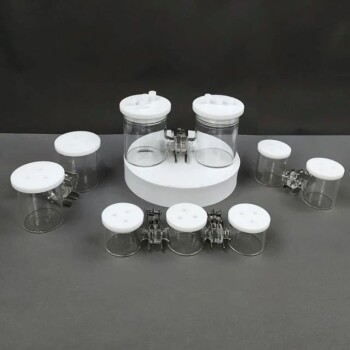
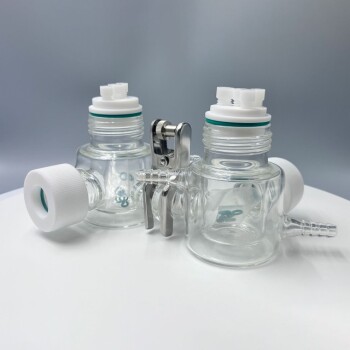
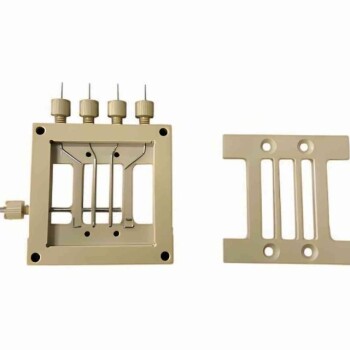
Standard all-PTFE electrolytic cells are typically available in volumes ranging from 10ml to 500ml. While these standardized sizes are designed to accommodate the majority of three-electrode system applications, manufacturers generally offer full customization options to meet specific dimensional or capacity requirements upon request.
The standard capacity for an all-PTFE cell lies between 10ml and 500ml, catering to most benchtop electrochemical studies. However, the true value of this hardware lies in its customizability and the material’s ability to ensure chemical stability in aggressive environments.
Volume and Configuration Standards
Standard Capacity Ranges
For off-the-shelf procurement, the primary reference indicates that volumes start as low as 10ml for micro-volume studies and scale up to 500ml for larger batch electrolysis.
This range is specifically optimized for three-electrode systems, which are the standard configuration for precise electrochemical measurements.
Customization Options
Because PTFE (polytetrafluoroethylene) is machined rather than blown like glass, it offers significant flexibility in design.
If standard volumes do not fit your experimental design, manufacturers can customize specifications upon request. This allows for the adjustment of cell geometry, port locations, and total volume to fit unique electrode shapes or electrolyte limitations.
The Material Advantage: Why PTFE?
Unmatched Corrosion Resistance
The decision to use an all-PTFE cell is usually driven by the nature of the electrolyte.
These cells provide excellent resistance to strong acids, strong bases, and strong oxidizing agents. Unlike glass, which can be etched by hydrofluoric acid or strong alkalis, PTFE remains inert.
Ensuring Experimental Accuracy
High chemical stability ensures the cell body does not react with the electrolyte.
This stability guarantees the accuracy and repeatability of the electrolysis process, as there is zero risk of the container leaching contaminants into your solution.
Electrical Insulation
PTFE is an excellent electrical insulator.
Using an all-PTFE body naturally prevents short circuits between the anode and cathode, a critical safety and performance feature when designing compact cell configurations.
Understanding the Trade-offs
Visibility Limitations
The most significant operational difference between PTFE and glass is optical transparency.
PTFE is opaque, meaning you cannot visually monitor electrode alignment, bubble formation, or color changes within the electrolyte during the experiment.
Cost and Fabrication
Machining solid blocks of PTFE is generally more labor-intensive and material-heavy than producing glass cells.
Consequently, all-PTFE cells often carry a higher cost and may require longer lead times if a customized geometry is required.
Making the Right Choice for Your Goal
Before selecting a cell, evaluate your specific experimental constraints against the material properties.
- If your primary focus is aggressive media: Choose an all-PTFE cell to prevent container corrosion from strong acids or bases.
- If your primary focus is standard benchtop volume: Select a pre-fabricated size between 10ml and 500ml to reduce lead times and cost.
- If your primary focus is unique electrode geometry: Leverage the customization options "upon request" to machine the cell to your exact spatial requirements.
Select the smallest volume that accommodates your electrodes to conserve expensive electrolytes while ensuring complete chemical compatibility.
Summary Table:
| Feature | Standard Specifications | Customization Options |
|---|---|---|
| Volume Range | 10ml to 500ml | Bespoke capacities available upon request |
| Electrode System | Optimized for 3-electrode setups | Adjustable port locations and geometry |
| Material | High-purity PTFE | Machined to specific spatial requirements |
| Chemical Resistance | Acids, bases, and oxidizing agents | Ideal for HF and strong alkalis |
| Key Advantage | High insulation & zero leaching | Precision machining for unique designs |
Elevate Your Electrochemical Precision with KINTEK
Maximize the accuracy of your research with KINTEK’s premium all-PTFE electrolytic cells and electrodes. Designed for the most aggressive chemical environments, our solutions ensure zero contamination and unmatched durability. Whether you need a standard 10ml cell or a fully customized system tailored to your unique electrode geometry, KINTEK provides the engineering expertise your laboratory demands.
Beyond electrolytic cells, KINTEK specializes in a comprehensive range of high-performance laboratory equipment, including:
- High-Temperature Furnaces: Muffle, tube, vacuum, and CVD systems.
- Material Processing: Crushing, milling, and hydraulic pellet presses.
- Battery Research: Specialized tools, consumables, and cooling solutions like ULT freezers.
Ready to optimize your experimental setup? Contact our technical experts today to discuss your specific requirements and see how KINTEK can empower your next breakthrough.
Related Products
- PTFE Electrolytic Cell Electrochemical Cell Corrosion-Resistant Sealed and Non-Sealed
- Electrolytic Electrochemical Cell with Five-Port
- Double Layer Five-Port Water Bath Electrolytic Electrochemical Cell
- Optical Water Bath Electrolytic Electrochemical Cell
- Thin-Layer Spectral Electrolysis Electrochemical Cell
People Also Ask
- What is the necessity of selecting a PTFE electrolytic cell? Ensure Precise Graphene Corrosion Testing Accuracy
- What is the proper method for cleaning the surface of an all-PTFE electrolytic cell? Ensure Accurate Results with a Pristine Surface
- How should an all-PTFE electrolytic cell be stored after use? Expert Maintenance Tips for Long-Lasting Performance
- What is the proper cleaning method for an all-PTFE electrolytic cell? Essential Tips for Surface Integrity
- What are the standard opening specifications for all-PTFE electrolytic cells? A Guide to Sealed vs. Non-Sealed Ports