In any laboratory focused on physical materials, a sieve is a fundamental tool for determining particle size distribution. This process, often called sieve analysis, is used to separate granular materials, powders, and even some suspensions into distinct size fractions for quality control, material grading, and foundational research.
Sieving is more than just sorting particles by size. It is a critical analytical process that ensures a material possesses the correct physical properties to perform as intended, impacting everything from the efficacy of a pharmaceutical drug to the structural integrity of concrete.
The Core Functions of Laboratory Sieving
At its heart, sieving provides a clear, quantitative picture of a material's physical composition. This data is essential for predicting and controlling how a material will behave.
Particle Size Distribution Analysis
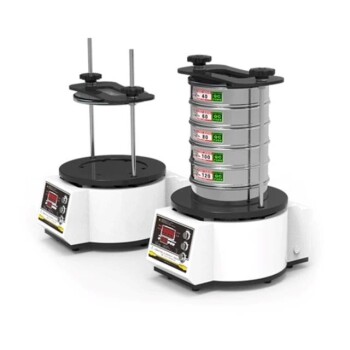
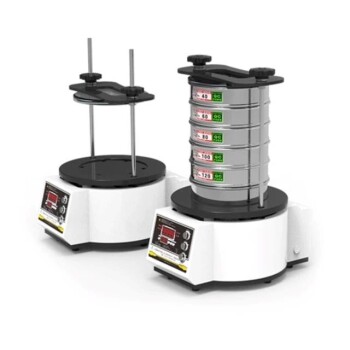
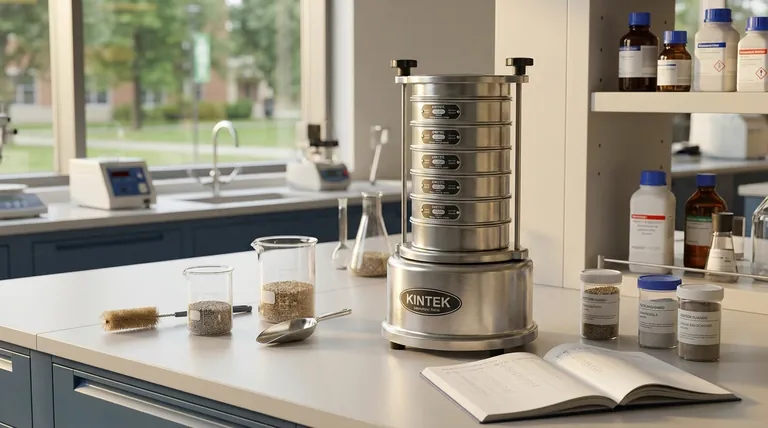
The primary use of a laboratory sieve is to conduct a particle size distribution analysis. This involves passing a sample through a stack of sieves with progressively smaller mesh openings.
By weighing the material retained on each sieve, you can determine the exact percentage of particles that fall within each size range. This distribution is a critical specification for countless materials.
Material Separation and Fractioning
Beyond analysis, sieves are used to physically separate a bulk material into different size groups, or "fractions."
This is often a preparatory step. A researcher might isolate particles of a specific size to study their unique chemical or physical properties, or a manufacturer might separate a product to create different grades for sale.
Quality Control and Assurance
In an industrial setting, sieving is a cornerstone of quality control. It provides a simple, reliable method to verify that raw materials and finished products meet precise specifications.
For example, the size of powder particles in a pharmaceutical tablet directly affects how quickly it dissolves in the body. Sieves ensure that every batch is consistent and effective.
Determining Material Purity
Sieves can also be used to measure the content of impurities or solids in a sample.
By washing a liquid sample through a sieve of a specific size, analysts can capture and quantify any undesirable solid content. Similarly, it can identify oversized or undersized contaminants in a dry powder.
Applications Across Diverse Industries
The fundamental nature of particle size makes sieving a universally relevant technique across nearly every scientific and industrial field.
In Construction and Geology
The performance of materials like concrete, asphalt, and drainage fills depends entirely on the size distribution of the aggregates (sand, gravel, stone) used. Civil engineers and geologists use sieves to analyze soil and rock to ensure structural stability and safety.
In Pharmaceuticals and Food Production
Particle size is critical in the food and drug industries. It affects the texture and mouthfeel of products like flour and coffee, the dissolution rate of medicines, and the consistency of chemical reactions.
In Agriculture and Environmental Science
Sieving is used to grade seeds by size for uniform planting and growth. Environmental scientists use it to analyze soil and sediment samples to understand their composition, which is vital for assessing soil health and pollution.
In Metallurgy and Chemistry
Advanced manufacturing processes, such as 3D printing with metal powders, require extremely tight control over particle size to ensure the final product has the desired density and strength. Chemists use sieves to control the surface area of catalysts, which influences reaction rates.
Understanding the Limitations and Trade-offs
While powerful, sieve analysis is a mechanical process with inherent limitations that every operator must understand to ensure accurate results.
Particle Shape Can Skew Results
Sieves measure a particle based on its ability to pass through a square aperture. Elongated or flat particles may pass through a mesh that does not accurately represent their true length or volume, leading to a biased analysis.
Clogging and Blinding of the Mesh
Fine, sticky, or electrostatically charged particles can clog the mesh openings, a problem known as blinding. This prevents other particles from passing through, halting the analysis and producing an incorrect result until the sieve is cleaned.
An Ineffective Method for Ultrafine Particles
Standard woven-wire sieves have a practical lower limit, typically around 20 micrometers (μm). For analyzing nanoparticles or other extremely fine powders, alternative methods like laser diffraction or air jet sieving are required.
Dependency on Consistent Procedure
Results can be influenced by operator technique. Factors like the shaking time, intensity, and sample load can all affect the final distribution. Therefore, maintaining a standardized, repeatable procedure is critical for reliable data.
Applying Sieve Analysis to Your Goal
The way you use laboratory sieves should be dictated by your specific objective.
- If your primary focus is quality control: Use a defined set of test sieves to quickly verify that incoming raw materials and outgoing final products fall within established particle size specifications.
- If your primary focus is research and development: Employ a full stack of sieves to fractionate a material, allowing you to isolate and study the unique properties of different particle size ranges.
- If your primary focus is material grading: Use sieving to classify bulk materials like soil, sand, or agricultural seeds according to established industry or regulatory standards.
Ultimately, mastering the use of laboratory sieves empowers you to control the fundamental physical characteristics of a material, ensuring its consistency, safety, and performance.
Summary Table:
| Primary Use | Key Application | Industry Example |
|---|---|---|
| Particle Size Distribution | Quality Control & Consistency | Pharmaceuticals, Food Production |
| Material Separation & Fractioning | R&D & Material Grading | Metallurgy, Agriculture |
| Impurity & Purity Determination | Quality Assurance | Environmental Science, Chemicals |
Ensure your materials meet precise specifications with reliable lab equipment from KINTEK.
Whether you are in pharmaceuticals, construction, metallurgy, or food production, accurate particle size analysis is critical for your product's quality, safety, and performance. KINTEK specializes in high-quality laboratory sieves and consumables designed for consistent, repeatable results.
Contact our experts today to find the perfect sieving solution for your lab's needs and enhance your quality control processes.
Visual Guide

Related Products
- Laboratory Vibratory Sieve Shaker Machine Slap Vibrating Sieve
- Laboratory Vibratory Sieve Shaker Machine for Dry and Wet Three-Dimensional Sieving
- Laboratory Test Sieves and Sieving Machines
- Laboratory Test Sieves and Vibratory Sieve Shaker Machine
- Laboratory Wet Three-Dimensional Vibratory Sieve Shaker Machine
People Also Ask
- What is the function of sieve in laboratory? A Guide to Accurate Particle Size Analysis
- What are laboratory sieves used for? Measure Particle Size for Quality Control & R&D
- Why is it necessary to use a laboratory sieve after the synthesis and calcination of a photocatalyst? Ensure Accuracy
- What role does a laboratory vibrating sieve shaker play in the LiFePO4 powder processing workflow? Ensure Batch Quality
- What are the sieve used in laboratory? A Guide to Choosing the Right Sieve for Accurate Particle Analysis